Key Points
- Economic services receipts projected to rise to Rs72.7 billion.
- Commodity operation guarantees reached Rs895 billion by March 2026.
- Current agriculture-related expenditure falls to Rs33.2 billion.
- National Food Security Division receives Rs22.2 billion allocation.
- PARC allocated Rs7.3 billion for research initiatives.
- Development spending for food security set at Rs4.2 billion.
- Oil Seed Development Fund receipts rise to Rs201 million.
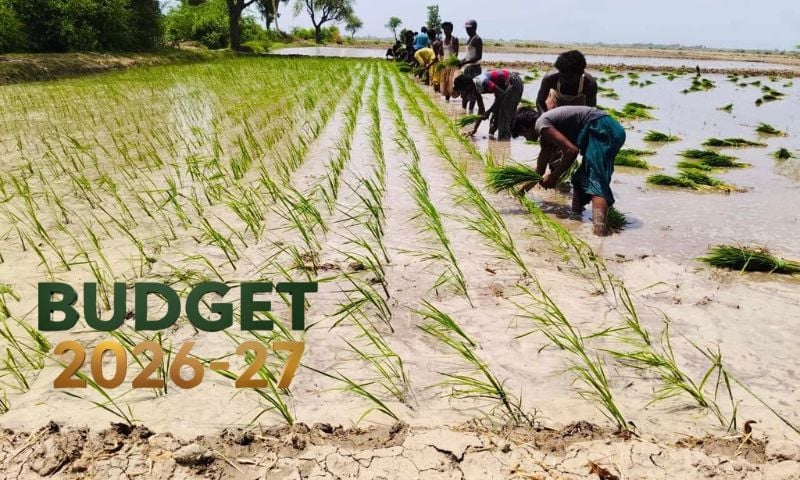
ISLAMABAD: Pakistan’s federal government has unveiled its Annual Budget Statement for the fiscal year 2026-27. As part of its broader strategy to support economic recovery and inclusive growth, the government highlighted its commitment to the expansion and sustained support of productive sectors, specifically prioritising the country’s agriculture industry.
A detailed review of the budgetary allocations and the newly introduced structural risk statements reveals key targeted numbers, development allocations, and fiscal vulnerabilities related to the agriculture sector.
Key revenue projections
The agriculture sector continues to interface with federal financial operations through non-tax economic services and federally backed commodity operations.
Under federal non-tax revenue, budget estimates for economic services receipts (which encompass agriculture, food, irrigation, forestry, and fisheries) are projected at Rs72,727 million for FY2026-27, marking an increase from Rs65,168 million allocations in FY2025-26.
Commodity operations financing
The federal government has extended significant sovereign guarantees to public sector enterprises (PSEs) involved in stabilising supply chains. As of end-March 2026, outstanding guarantees issued for commodity operations reached Rs895 billion, representing 21 per cent of the government’s total outstanding guarantee stock.
PASSCO & TCP guarantees
Looking closely at the individual entities handling agricultural storage and trade, the Pakistan Agriculture Storage & Services Corporation (PASSCO) commands a Rs528 billion share (12 per cent) of total outstanding sovereign guarantees. Concurrently, the Trading Corporation of Pakistan (TCP) holds Rs 366 billion (8 per cent).
Current vs development portfolio
The government has recalibrated its spending on agriculture, food, and irrigation across both current operational accounts and specialised structural development funds.
Under the current expenditure on the revenue account — which covers agriculture, food, irrigation, forestry, and fisheries — the government has projected Rs33,204 million for the FY2026-27 budget. This represents a decrease from the revised estimate of Rs40,645 million for FY2025-26, bringing it back closer to that year’s original budget estimate of Rs33,476 million.
When looking at demand-wise voted spending, the National Food Security & Research Division has been allocated Rs22,232 million for the upcoming FY2026-27 fiscal year. From within this allocation, the Pakistan Agricultural Research Council (PARC) is set to receive Rs7,291 million in voted spending to support its ongoing initiatives.
Furthermore, the government has earmarked Rs4,183 million specifically for development expenditure for the National Food Security & Research Division.
Additionally, the Pakistan Oil Seed Development Fund under the Public Account reserves shows an estimated receipt of Rs201 million for FY2026-27, a marginal rise from the Rs191 million approved for the preceding year.
Climate shocks & green agriculture
The newly incorporated Statement of Fiscal Risks outlines severe potential vulnerabilities facing the sector, linking agricultural resilience directly to macro-fiscal stability.
Disaster and climate risks
The budget identifies climate-related shocks, floods, and droughts as massive threats that trigger unbudgeted emergency relief expenditures.
An average unmitigated disaster event can severely impact infrastructure and cause massive agricultural losses, potentially widening the national fiscal deficit up to 1.5 per cent of GDP — constituting the single largest deviation among all identified fiscal risks.
Furthermore, assuming a 25 per cent probability of actualisation regarding the guarantees issued for commodity financing operations, the federal deficit could rise by 0.1 per cent of GDP in FY2026-27.
To counter these systemic issues, the government has introduced Green Budgeting principles under its public financial management reforms. For the upcoming fiscal year, the state is shifting focus towards sustainable agriculture and climate resilience.
It has mandated federal departments to tag and prioritise green economic initiatives, backed by the reality that 11 per cent of the total development budget for FY2026-27 has been strictly allocated to climate-responsive interventions.