Key Points
- Rs 18.771 trillion Budget with 4 per cent growth target
- Salary, Pension and tax relief
- Higher social safety net support under Benazir Income Support Programme for 12 million families
- Focus on youth, export, energy, agriculture and infrastructure
ISLAMABAD: Pakistan’s federal budget for 2026–27 contains targeted relief for salaried workers, pensioners, exporters and small businesses, alongside higher spending on social protection, energy and infrastructure.
However, it is also a tightly constrained budget, with a large share of government resources going towards debt servicing and defence.
Finance Minister Muhammad Aurangzeb presented the Rs18.77 trillion budget on Friday, June 12.
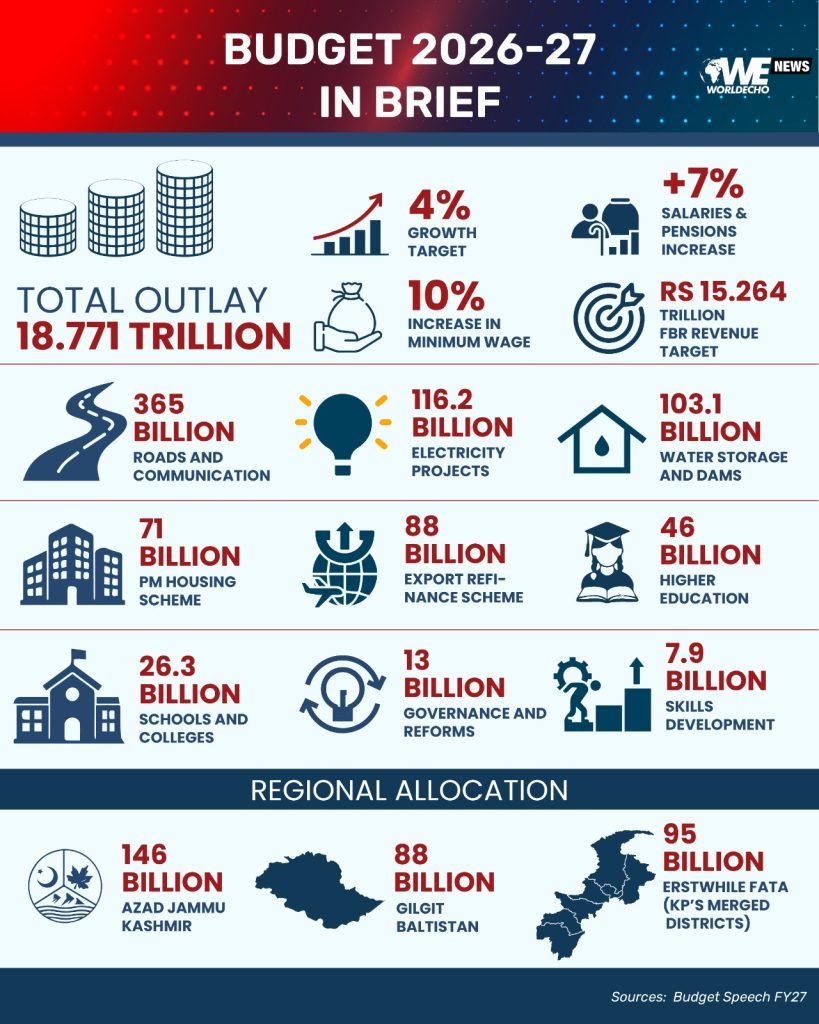
The government is targeting 4 per cent economic growth and projecting inflation at 8.2 per cent during the coming financial year starting July 1, 2026.
The Federal Board of Revenue has been tasked with collecting Rs 15.26 trillion in taxes.
Here is how the proposed budget may affect different groups in society.
Salaried employees
The government has announced income-tax relief across four salary slabs, with the largest reductions aimed at middle- and higher-income earners.
The tax rate for annual salaries between Rs 2.2 million and Rs 3.2 million has been reduced to 20 per cent, while the rate for salaries between Rs 3.2 million and Rs 4.1 million has been cut from 30 per cent to 25 per cent.
The surcharge on salaried individuals has also been abolished. However, lower-income workers may see a smaller or no difference in their monthly take-home pay.
Government employees and pensioners
Federal government employees and pensioners will receive a 7 per cent increase in salaries and pensions. The measure may offer some relief from rising living costs, although its impact will depend on whether inflation remains close to the government’s projected 8.2%.
Low-income downtrodden class
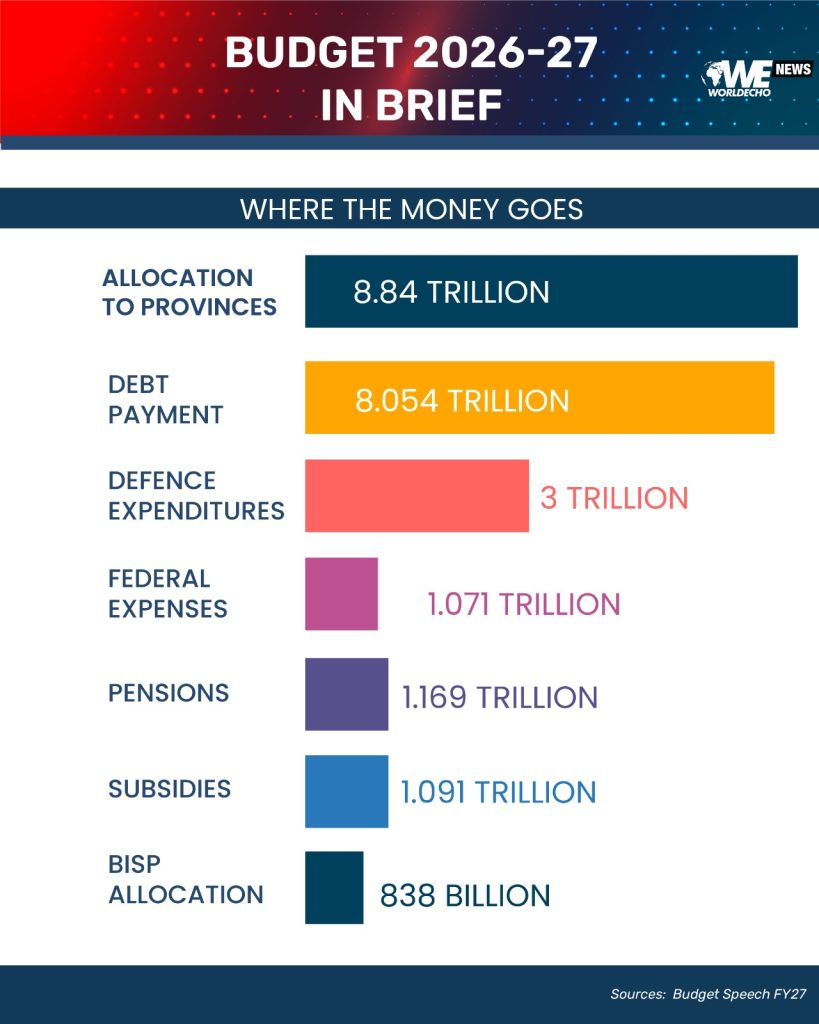
The allocation for the Benazir Income Support Programme, the flagship social safety net mechanism, has increased by 17 per cent to Rs 838 billion.
The government plans to extend coverage to 12 million families, strengthening support for households most vulnerable to food inflation and higher utility costs.
Women and families
Taxes on sanitary pads and women’s health products have been abolished. Although smaller than many of the headline measures, the step directly affects routine household expenses and access to essential products.
Youth and students
The budget allocates Rs 46 billion for higher education, up from Rs 34.9 billion last year, alongside Rs 3.6 billion for science and technology.
A separate Rs 18.1 billion Prime Minister’s Youth Programme includes funding for skills development, IT start-ups, innovation awards, sports leagues and e-sports facilities at universities.
These measures may create more opportunities for students and young professionals, although their effectiveness will depend on implementation and access beyond major cities.
Agriculture
The government expects agriculture to grow by 3.6 per cent during the upcoming financial year. While the budget does not announce a large, standalone relief package for farmers, development spending on water security may indirectly support the sector. The Finance Minister also announced support for farmer’s storage facilities across the country.
More than Rs 103 billion has been allocated for water-resource projects, including the Diamer Bhasha Dam, Mohmand Dam and Karachi’s K-IV water project.
The longer-term benefit for farmers will depend on whether these investments improve irrigation access and reduce losses caused by floods and water shortages.
Industry
The government is targeting 4.5 per cent industrial growth during the next financial year.
Infrastructure spending is intended to support manufacturing and construction, while electricity supply to Special Economic Zones has been identified as a priority.
Construction
Property-related withholding taxes have also been reduced for filers to stimulate construction activity. This could benefit industries related to housing and development, including cement, steel, transport and building materials.
In the words of the Finance Minister, this measure alone would benefit at least 40 industries allied to the construction and real estate sector. Prime Minister’s Apna Ghar soft home loan scheme is also expected to boost construction, the Finance Minister Muhammad Aurangzeb said in the budget speech.
Exporters
Exporters will see a reduction in advance income tax from 2 per cent to 1.25 per cent. For IT exporters, the existing 0.25 per cent tax regime has been extended until 2029.
The measures are intended to support export-led growth and provide greater predictability for freelancers, software companies and businesses selling products abroad.
Energy
Energy remains a major focus of the development budget. The government has earmarked Rs 116.2 billion for the power sector, with a focus on electricity transmission, supply to Special Economic Zones and infrastructure upgrades.
The Public Sector Development Programme also includes investments in hydroelectric projects, solar power, battery storage and wind-power evacuation infrastructure.
Small shopkeepers
Small retailers with annual sales of up to Rs 200 million will be brought under a fixed-tax scheme. They will pay a 1 per cent annual tax on sales, while the government says routine questioning and audits by tax officials will be restricted.
The scheme is intended to encourage businesses to enter the formal tax system without exposing small shopkeepers to repeated inspections.
Property buyers and overseas travellers
For tax filers, withholding tax on property purchases and sales has been reduced. The tax charged on the use of debit or credit cards abroad has also been cut from 5 per cent to 0.5 per cent.
These measures may benefit property investors, overseas travellers and people paying for international services online.
Infrastructure and housing
The federal Public Sector Development Programme has been set at Rs 1 trillion, with major allocations for roads, railways, water, energy transmission and digital transformation.
The government has also allocated Rs 71 billion for the Prime Minister’s Apna Ghar scheme. It has planned to support the construction of 150,000 low-cost housing units at the federal and provincial levels.
The bigger picture
The budget offers relief to selected groups, but the government has limited room to spend freely.
Debt servicing alone has been allocated Rs 8.054 trillion; defence spending has risen by 18 per cent to approximately Rs 3 trillion.
Federal development spending remains capped at Rs 1 trillion as Pakistan seeks to meet targets under its IMF programme.
For ordinary Pakistanis, the key question is not only whether a measure appears in the budget, but whether it improves daily life.
Tax cuts may increase disposable income for some employees and businesses, while higher BISP spending could support vulnerable households.
However, inflation, electricity costs and employment opportunities will determine how much relief people actually feel.
The announced measures remain proposals until the budget completes the parliamentary approval process.