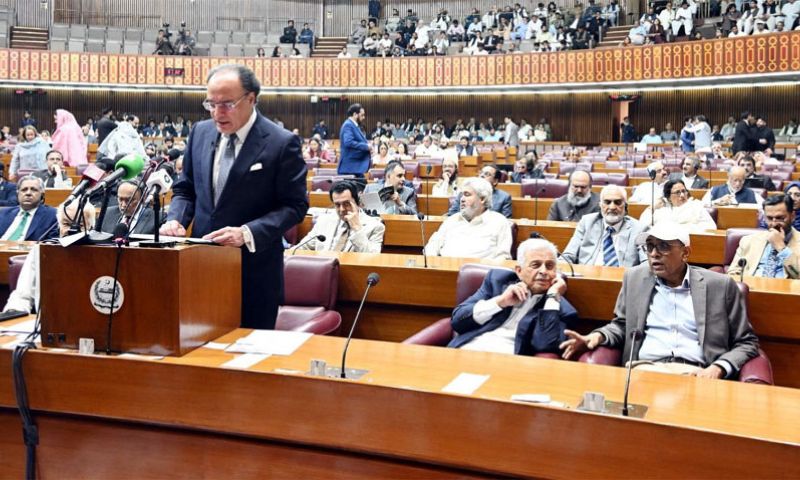
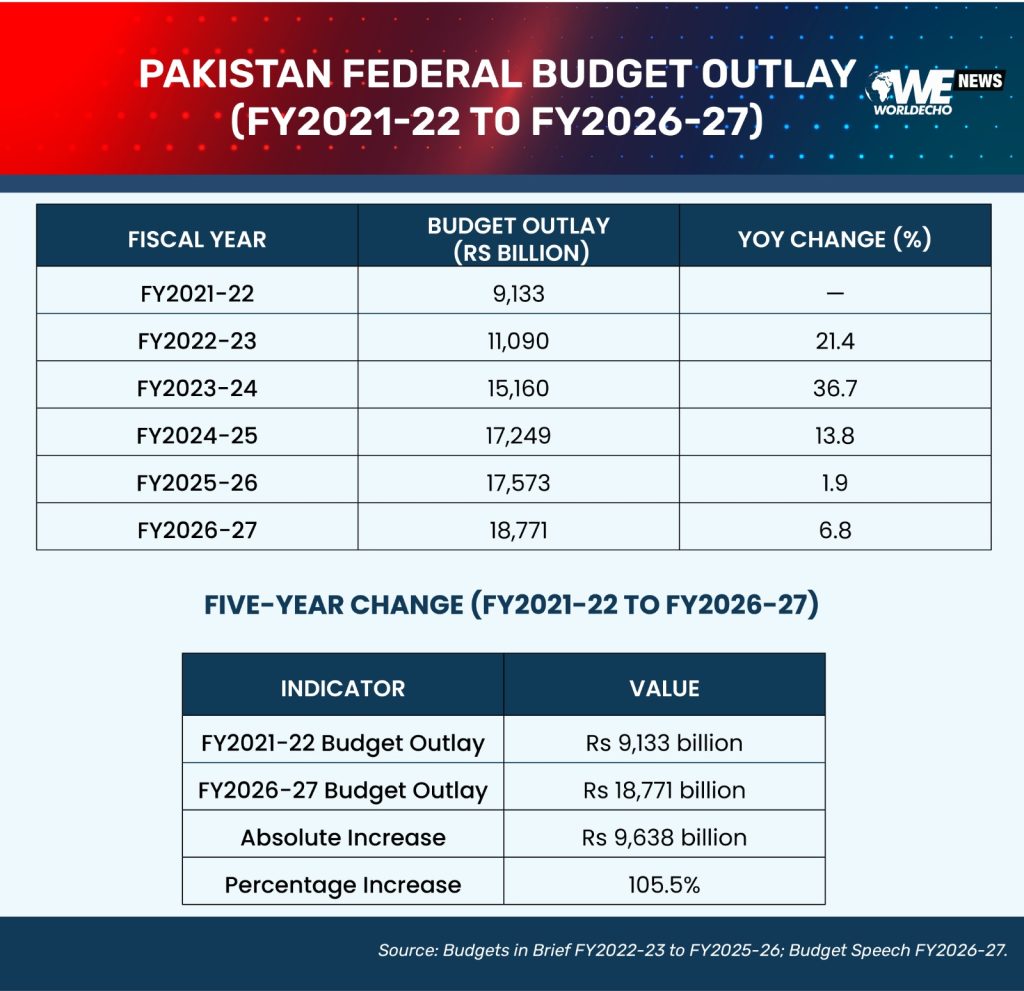
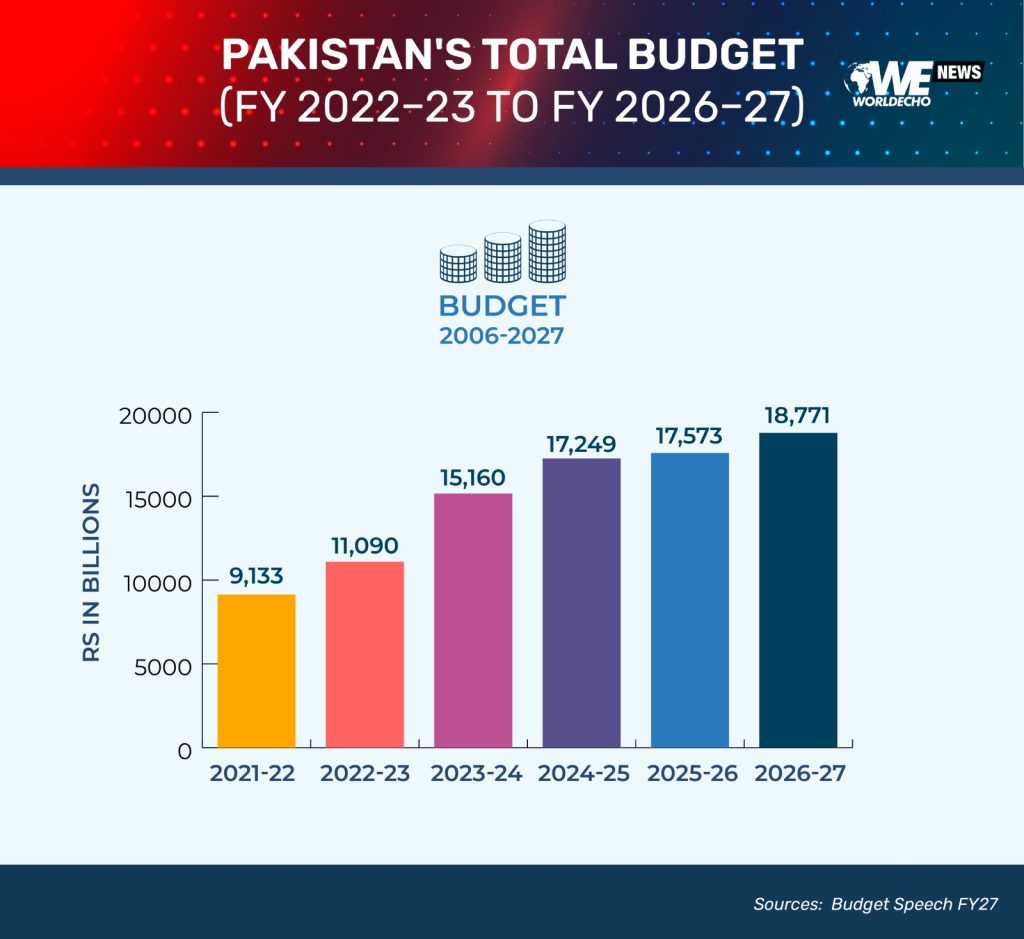
ISLAMABAD: Pakistan’s Finance Minister Muhammad Aurangzeb presented the crisis management budget in the National Assembly on Friday, with a total outlay of Rs18.7 trillion for the fiscal year 2026-27.
While unveiling his third budget in the National Assembly, Aurangzeb stated, “This budget is being presented at a time when Pakistan has earned recognition, both among its citizens and internationally, as a country whose voice is heard and whose friendship is valued.”
Aurangzeb said that this did not “happen by chance” and explained that after Pakistan handed a humiliating defeat to India during last year’s war, the entire world was “compelled to take notice”.
“Today, the world acknowledges Pakistan’s defensive strength,” he said, noting that the nation has also had the honour of brokering a ceasefire between Iran and the United States, putting the South Asian country in a strong position.
“This defence capability has reshaped our strategic partnerships not just in the region but in the world,” he said, mentioning a defence pact signed between Pakistan and Saudi Arabia last year.
The finance minister said that the “economic improvement” has also had a positive impact on the Pakistan Stock Exchange. He added that the improvement enhanced the performance of Pakistan’s corporate sector.
“In January–March 2026, the corporate sector earned 22% higher profits compared to the same period last year, while during the first nine (9) months of the current financial year, this profit growth stands at 9%,” he said.
The finance minister also elaborated on Pakistan’s efforts for peace between the US and Iran. “Pakistan’s efforts are directed towards establishing long-term peace in the region through an agreement and restoring the transit of oil through the Strait of Hormuz,” he said.
Aurangzeb said Pakistan had “complete support” of China in these efforts, further highlighting the importance of ties between Islamabad and Beijing.
“Pak-China relations are an important part of our foreign policy. China is Pakistan’s most important trading partner,” he said.
Syed Muhammad Ali, an Islamabad-based security analyst, said it was a crisis management budget, primarily aimed at protecting the common man from the enormous impact of the Trump administration’s aggressive tariff regime, a spike in oil and gas import prices due to the US-Iran conflict, lingering threats of Indian military buildup and terrorism.
Salaried Class Relief
In the budget, the government is reducing income tax rates across four salary slabs. For earners between PKR 22–32 lakh annually, the rate drops from 23% to 20%. For the PKR 32–41 lakh bracket, it goes from 30% to 25%. The PKR 41–56 lakh bracket sees a cut from 35% to 29%, and the PKR 56–70 lakh bracket moves from 35% to 32%. The annual surcharge on salaried individuals is also being fully abolished — it was reduced from 10% to 9% last year and is now eliminated entirely.
Super Tax Reduction
As per budget proposals, the super tax rate on business income above PKR 50 crore is being cut from 10% to 8%, across all four income slabs applicable to businesses. However, the existing surcharge on banks, oil & gas exploration companies, and fertiliser companies remains in place.
Construction Sector
To stimulate construction, the sales tax on wholesale building materials is being reduced from 2.5% to 1.25%, and on retail from 5.5% to 2.75%.
IT & Export Sector Relief
According to the budget proposals, the income tax on IT export earnings is being reduced to 0.25%. The FTR (Final Tax Regime) concession for IT, which was set to expire on 30 June 2026, is being extended to 30 June 2029. The Export Development Surcharge of 0.25% is being fully abolished, and the Export Facilitation Scheme markup is being reduced to 4.5% with the refund period extended from 9 to 18 months.
Small Retailers — Fixed Tax System
In the budget, a new Fixed Tax System under Section 99B is being introduced for small retailers with annual sales of PKR 10 crore or less. They pay 1% of annual sales as tax, can adjust input withholding tax, need no POS machine, and receive a green-card QR code for verification. A single-page brochure in Urdu and regional languages will explain the scheme.
Federal Excise Duty (FED) Changes
The government in the budget also proposed a FED levy on petroleum-based solvents (white spirit, petroleum naphtha, mineral turpentine oil) currently at only PKR 80/unit — these are used for fuel adulteration. FED on SUVs above 2000cc–3000cc is increasing, along with a PKR 2 crore FED on luxury EVs above 3000cc. Business-class international travel FED for privileged classes is being abolished.
Other Measures
In the budget 2026-27 the withholding tax on international credit/debit card transactions is being reduced from 5% to 0.5% per transaction to encourage formal financial channels. The Capital Value Tax on holding foreign assets is being eliminated to encourage Pakistanis to declare overseas assets and improve documentation. Sales tax on sanitary pads and contraceptives is being fully abolished.
The sales tax Third Schedule is being expanded to include FMCG categories to curb under-invoicing. Non-registered suppliers will now trigger withholding tax obligations on buyers (individuals and AOPs). Penalties are being inflation-adjusted for the first time in seven years, and digital integration fines are also proposed.
FBR New Operating Model
A National Faceless Centre is being established to separate discretionary and non-discretionary tax functions. All audits and assessments will operate in Single Blind and Double Blind modes — officers won’t know the taxpayer’s identity, and case assignment will be algorithmic. An Algorithmic Settlement Mechanism with a Central Data Hub will automate discrepancy detection and settlement via the IRIS portal, removing human intervention from the process.
Revenue & Macro Targets
FBR’s gross revenue target for FY27 is PKR 15,264 billion (up 17.6% YoY), with a non-tax revenue target of PKR 5,336 billion. The fiscal deficit target is 3.6% of GDP, GDP growth is projected at 4%, and average inflation is expected around 8.2%.