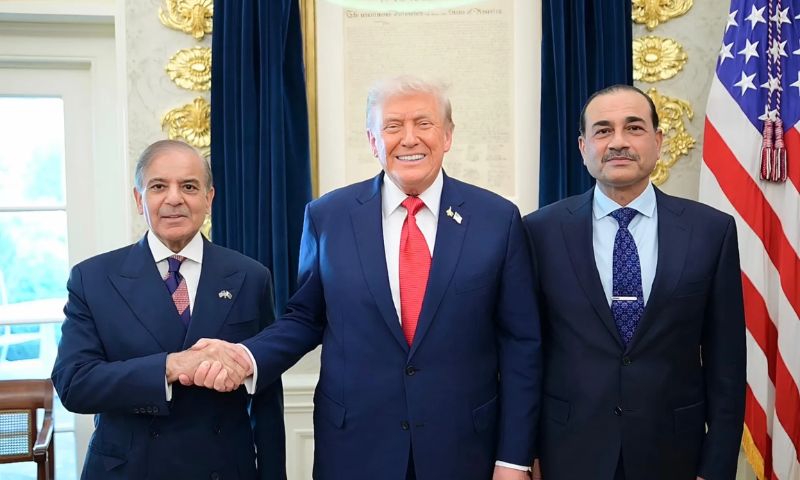
WASHINGTON: US President Donald Trump on Thursday described Pakistan’s Prime Minister Shehbaz Sharif and Chief of Army Staff and Chief of Defence Forces Field Marshal Syed Asim Munir as “great personalities,” while expressing optimism that a deal with Iran could be finalised in the coming days.
Speaking at the Oval Office, Trump called recent regional developments “a wonderful thing with a lot of spirit” and praised Pakistan’s role, saying, “Pakistan was fantastic.”
According to Geo News, referring to Pakistan’s leadership, he said, “The Prime Minister and the great General—I call him a Field Marshal, he’s that good—he’s a step above,” adding that “they’re all very happy.”
Trump also claimed that broader Middle Eastern countries welcomed the developments, saying, “The whole Middle East is happy, and long beyond the Middle East.” He expressed confidence that a key strategic strait would reopen “as soon as we have a sign.”
The US president further said American forces had been involved in clearing mines and securing shipping routes, claiming that many such operations had gone unnoticed. “We’ve been taking out many ships that nobody knew. Even the fake news didn’t know it,” he said.
Trump said he had reached a “great settlement” with Tehran and indicated that the agreement was in its final stages. “We have documents that are in a pretty final stage,” he said, adding that the deal could be signed soon, possibly in Europe.
The remarks add to a series of recent public statements in which Trump has praised Pakistan’s civilian and military leadership. He has previously credited Prime Minister Shehbaz Sharif and Field Marshal Syed Asim Munir for their role in facilitating communication with Tehran amid US-Iran tensions.
According to international media reports, Pakistan has emerged as an intermediary between Washington and Tehran during heightened regional tensions, with both leaders reportedly contributing to diplomatic efforts aimed at securing a breakthrough.
Trump’s latest comments highlight Pakistan’s growing visibility in regional diplomacy and reflect a notably warmer tone in his recent references to the country’s leadership.