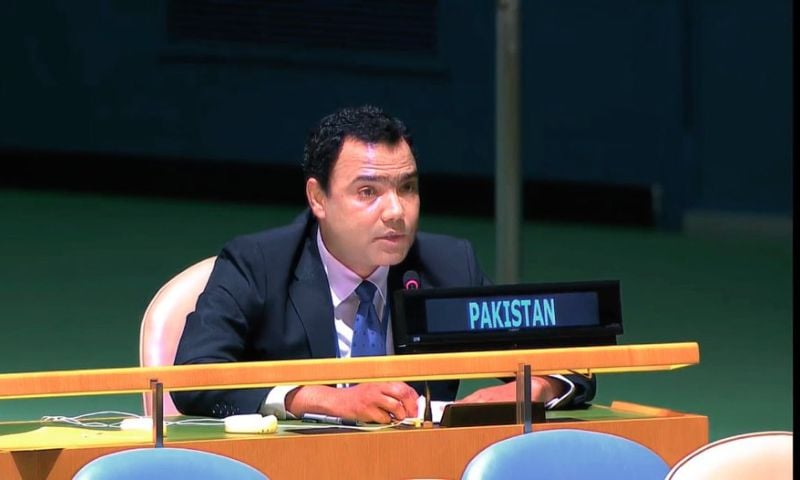



UNITED NATIONS: Pakistan has told the UN General Assembly that Indian Illegally Occupied Jammu and Kashmir (IIOJK) “never was, neither is, and nor will ever be” an integral part of India, rejecting New Delhi’s claims during a fresh diplomatic exchange over the disputed territory at the world body.
The remarks were made by Gul Qaiser Sarwani, who exercised Pakistan’s right of reply after India’s Permanent Representative to the UN, Parvathaneni Harish, asserted that Indian Illegally Occupied Kashmir was an integral part of India.
Sarwani reminded the 193-member General Assembly that Indian Illegally Occupied Jammu and Kashmir remains an internationally recognised dispute on the agenda of the UN Security Council.
“No amount of obfuscation can alter the historical, legal and international character of this dispute,” he said, adding that Jammu and Kashmir “never was, neither is, and nor will ever be” an integral part of India.
Right of Reply by Mr. Gul Qaiser Sarwani,
Counsellor/Political Coordinator at the Pakistan Mission,
In Response to Remarks of Indian Representative
During the UNGA Debate on the Annual Report of the UN Security Council
(5th of June 2026)
****Mr. President,
Pakistan takes the… pic.twitter.com/aCHUFWE9cI
— Permanent Mission of Pakistan to the UN (@PakistanUN_NY) June 6, 2026
The exchange came after Pakistan’s Permanent Representative to the UN, Ambassador Asim Iftikhar Ahmad, said the Security Council’s annual report highlighted the continued relevance of both the Jammu and Kashmir and Palestine disputes, which he said must be resolved in accordance with relevant UN resolutions.
Addressing the General Assembly, Ambassador Asim noted that more than 20 communications concerning the “India-Pakistan Question” were brought before the Security Council during the reporting period from January to December 2025.
Ambassador Asim also pointed out that the Security Council held closed consultations on the issue in May 2025, underscoring that the Kashmir dispute continues to engage the Council’s attention more than seven decades after it was first placed on its agenda.
Pakistan, he said, believes that durable peace in South Asia requires a just settlement of the Kashmir dispute under the relevant UN Security Council resolutions and the aspirations of the Kashmiri people, who must be allowed to exercise their right to self-determination.
Ambassador Asim also said the annual report highlights the continued relevance of long-standing disputes on the Security Council’s agenda, including the Question of Palestine and the Kashmir dispute, which have implications for regional and international peace and security, and which must be resolved.
On Palestine, the Pakistani envoy said the continuing tragedy, particularly in Gaza, remained high on the Council’s agenda. After repeated failures to halt the bloodshed, the Council adopted resolution 2803, endorsing the Gaza Peace Plan and offering a ray of hope.
“It is imperative that resolution 2803 be implemented fully and faithfully,” he said.
Pakistan, he added, reaffirms its unwavering support for the Palestinian people’s right to self-determination, for an independent, viable and contiguous State of Palestine, based on the pre-1967 borders, and Al-Quds Al-Sharif as its capital.
The report also underscores the indispensable role of United Nations peace operations and special political missions, Ambassador Asim Ahmad said.
Pakistan, he said, is committed to strengthening peacekeeping and ensuring that peace operations are effective, adequately resourced and responsive to evolving challenges.
The challenges confronting the international community underscore the need for a more democratic, representative and accountable multilateral system, he said, adding the use of veto remained a concern among Member States.
It was therefore clear that expansion of individual permanent members and veto runs counter to these shared objectives, Ambassador Asim said.