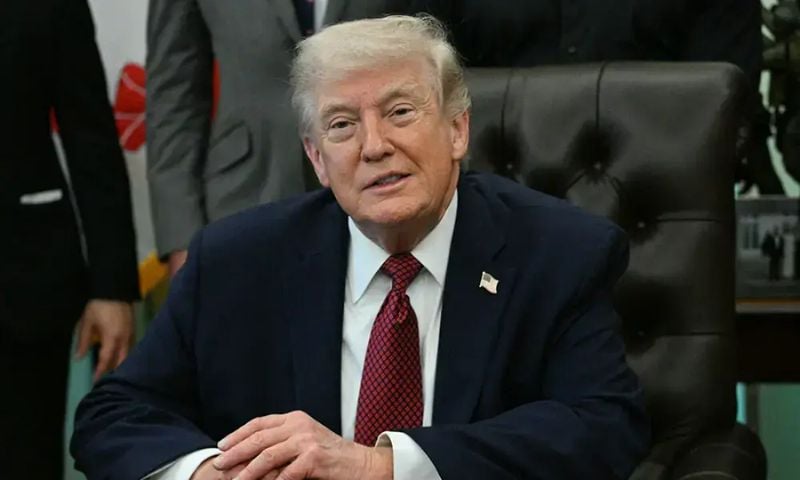



WASHINGTON: US President Donald Trump said on Thursday that negotiations with Iran were ongoing through mediator Pakistan, adding that Washington would secure a deal with Tehran to end the conflict, as Islamabad intensified diplomatic efforts for regional peace.
“I can’t tell you. Right now we’re negotiating, and we’ll see,” Trump told reporters at the White House when asked about possible accommodations in talks with Iran.
“We’re going to get it one way or another; they’re (Iran) not going to have a nuclear weapon,” he added.
Trump reiterated that the United States would not allow Iran to acquire a nuclear weapon, saying any outcome would ensure Tehran is denied such capability.
Trump claims total control of Hormuz
Trump said the United States maintained “total control” of the Strait of Hormuz through the US naval blockade.
“We want it free; we don’t want tolls. It’s an international waterway,” Trump said. “No ship is going to, or out of, Iran without our approval.”
On Iran’s nuclear programme, Trump ruled out allowing Tehran to retain highly enriched uranium.
“We will get it. We don’t need it, we don’t want it, we’ll probably destroy it after we get it,” he said. “But we’re not going to let them have it,” Trump added.
President Trump Participates in an Announcement with the Administrator of the EPA https://t.co/lZJTv7m8HJ
— The White House (@WhiteHouse) May 21, 2026
‘Some good signs’ in US-Iran talks
Earlier, US Secretary of State Marco Rubio said there were “some good signs” that a possible agreement with Iran could be reached.
Rubio said Washington remained open to diplomacy with Iran, while warning that other options were available if talks failed.
“The president’s preference is to do a good deal, that’s his preference. It’s always been his preference,” Rubio told reporters.
“There are some good signs, but … I don’t want to be overly optimistic.”
Rubio added that Pakistani officials were travelling to Tehran on Thursday. “So hopefully that will advance this further,” he said.
Rubio voiced hope that Pakistan’s ongoing diplomatic efforts would advance diplomacy on ending the US-Iran war, saying there has been progress.
Rubio also warned that any move by Iran to impose tolls in the Strait of Hormuz would make a deal “unfeasible”.
.@SecRubio on Iran: “@POTUS‘s preference is to do a good deal… I’m not here to tell you that it’s going to happen for sure, but I’m here to tell you that we’re going to do everything we can to see if we can get one. If we can’t get a good deal, @POTUS has been clear — he has… pic.twitter.com/dhah7hSlvV
— Rapid Response 47 (@RapidResponse47) May 21, 2026
The Strait of Hormuz remained central to the regional conflict.
Iran’s Islamic Revolutionary Guard Corps (IRGC) said on Thursday that 31 vessels had transited the waterway in the past 24 hours “with the coordination and security of the IRGC Navy”, according to a statement carried by the semi-official Tasnim News Agency.
Meanwhile, US Central Command (CENTCOM) said 94 commercial vessels had been redirected from Iranian ports and four others disabled as part of what it described as an American naval blockade, according to a post on X.
Pakistan’s diplomatic efforts
Pakistan continued its diplomatic engagement as part of mediation efforts to facilitate talks between Washington and Tehran.
Pakistan Interior Minister Mohsin Naqvi met Iranian President Masoud Pezeshkian in Tehran on Wednesday to discuss regional developments and indirect US–Iran negotiations, Iranian media reported.
According to Iran’s Fars News Agency, Pezeshkian expressed support for Pakistan’s role in promoting regional stability and cooperation, and praised its efforts in facilitating dialogue.
Naqvi also met senior Iranian officials during his visit, including Foreign Minister Abbas Araghchi, Parliament Speaker Mohammad Bagher Ghalibaf and Interior Minister Eskandar Momeni, Iranian media reported.
Iran’s state-run IRNA News Agency, citing diplomatic sources, said Naqvi’s visit formed part of ongoing engagement linked to mediation efforts between the two sides.
The visit comes as Pakistan continues diplomatic efforts to end the US–Iran conflict through dialogue and diplomacy.
On April 8, Pakistan brokered a ceasefire between the US and Iran and intensified mediation efforts to permanently end the conflict through negotiations.
Last month, Pakistan hosted direct talks between the US and Iranian negotiators in Islamabad.
The Islamabad Talks between the US and Iran concluded without reaching a final agreement; however, they paved the way for diplomacy to permanently end the conflict.