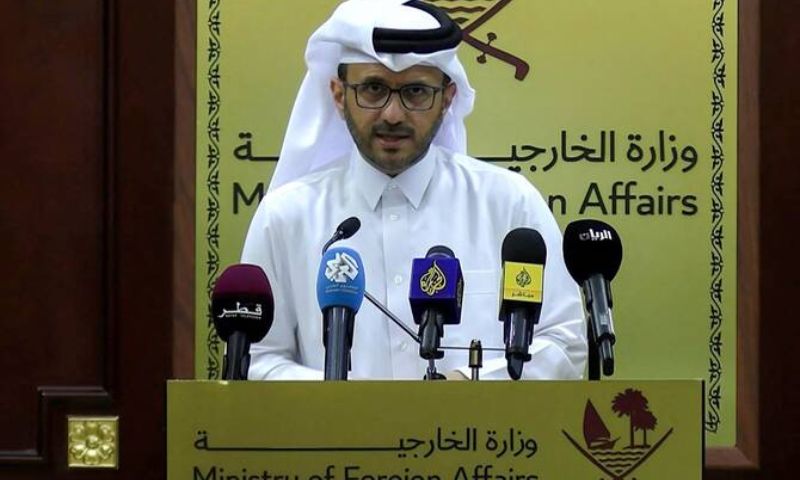
DOHA, Qatar: Qatar said on Tuesday that Pakistan-mediated negotiations between the United States and Iran required “more time” to reach a peace agreement, a day after US President Donald Trump said he had postponed planned military attacks on Iran to allow diplomacy to continue.
“We are supportive of the diplomatic effort by Pakistan that has shown seriousness in bringing parties together and finding a solution, and we do believe it needs more time,” Qatari Foreign Ministry spokesman Majed Al-Ansari told a press conference in Doha.
Ansari said Qatar wanted to protect the Middle East region from further escalation.
“We want to protect the people of the region from being basically the main losers of any escalation in the region,” he said.
The Qatari spokesman declined to comment further on Trump’s social media statement or publicly assess the prospects for a final agreement.
Dr. @majedalansari , Advisor to the Prime Minister and Spokesperson for the Ministry of Foreign Affairs, during the weekly media briefing:
Qatar’s position has been clearly stated to our partners in the United States: the region must not be engulfed again in war, and any… pic.twitter.com/tDWsMwQy7I
— Ministry of Foreign Affairs – Qatar (@MofaQatar_EN) May 19, 2026
Russia backs Pakistan’s mediation role
Meanwhile, Russia also expressed support for Pakistan’s diplomatic efforts aimed at resolving the conflict between Washington and Tehran.
Russian Ambassador to Pakistan Albert Khorev told a news conference in Islamabad that Moscow backed Pakistan’s mediation role in the conflict.
“We support Pakistan’s mediation role in the US-Iran conflict,” Khorev said.
The Russian envoy added that Moscow also welcomed other diplomatic initiatives intended to achieve a peaceful settlement.
‘Limited period of time’ for negotiations
Earlier on Tuesday, Trump said he would allow negotiations with Iran to continue for a “limited period of time”, saying Gulf leaders had informed him that progress was being made in Pakistan-brokered talks.
Speaking to reporters at the White House, Trump said he had postponed a planned military strike on Iran and would allow talks to continue for “two or three days, maybe Friday, Saturday, Sunday, something, maybe early next week”.
The US president said he had been close to authorising military action before deciding to delay the operation.
“I was an hour away from making the decision to go today,” Trump told reporters.
President Trump Visits White House Ballroom Construction https://t.co/5lx4lxmi1k
— The White House (@WhiteHouse) May 19, 2026
Trump said Gulf leaders had urged him not to proceed with the planned strike because negotiations were making progress towards a peace deal.
On Monday, Trump said a military attack on Iran scheduled for Tuesday had been suspended after appeals from Saudi Crown Prince and Prime Minister Prince Mohammed bin Salman Al Saud, Emir of Qatar Sheikh Tamim bin Hamad Al Thani and UAE President Mohamed bin Zayed Al Nahyan.
In a post on Truth Social, Trump said “serious negotiations” were taking place and expressed confidence that a deal acceptable to the United States and the wider Middle East could be achieved.
“This Deal will include, importantly, NO NUCLEAR WEAPONS FOR IRAN!,” Trump wrote.
The US president said he had instructed Defence Secretary Pete Hegseth, Chairman of the Joint Chiefs of Staff Daniel Caine and the US military to suspend the planned strike.
Exchanges continuing through Pakistan
Before Trump announced the suspension of military action, Iran confirmed that diplomatic exchanges with Washington were continuing through Pakistani mediation.
On Monday, Iranian Foreign Ministry spokesperson Esmaeil Baqaei said Tehran had conveyed its latest response to the United States through Pakistan.
“As we announced yesterday, our concerns were conveyed to the American side,” Baqaei told a weekly news briefing in Tehran.
“The process is continuing through the Pakistani mediator,” he added.
Baqaei defended Tehran’s demands, including the lifting of sanctions, the release of frozen Iranian assets and compensation for war-related damages.
Iran’s semi-official Fars News Agency reported on Sunday that Washington had proposed five key conditions for an agreement, including limiting Iran to a single operational nuclear facility.
According to Fars, the US also demanded the transfer of 400 kilograms of uranium to the United States, rejected compensation for war-related damages and proposed releasing only part of Iran’s frozen assets.
Iran, meanwhile, demanded a complete end to hostilities on all fronts, including Lebanon, lifting of sanctions, release of frozen assets, compensation for damages and recognition of its sovereignty over the Strait of Hormuz.
Iran’s Tasnim News Agency reported that Tehran had submitted its own proposal through Pakistan, focused on ending the war, lifting sanctions and rebuilding trust.
Pakistan continues diplomatic efforts
Meanwhile, Pakistan has continued diplomatic engagement with both Washington and Tehran in an effort to secure a permanent settlement to the conflict through dialogue.
Islamabad brokered a ceasefire on April 8 following weeks of escalating war involving Iran, the United States and Israel.
On April 11 and 12, Pakistan hosted direct negotiations between American and Iranian delegations in Islamabad.
Although those talks ended without a final agreement, they paved the way for continued diplomatic engagement.
Pakistan’s Deputy Prime Minister and Foreign Minister Ishaq Dar has repeatedly stressed the importance of sustained engagement and proactive diplomacy for regional peace and stability.
Pakistani minister visits Tehran
Meanwhile, Pakistan’s Interior Minister Mohsin Naqvi, who was in Tehran, met Iranian President Masoud Pezeshkian on Sunday and discussed mediation efforts and regional security.
Iran’s state-run IRNA reported that the meeting focused on bilateral relations and Pakistan’s diplomatic role in promoting regional stability.
Iranian Foreign Minister Abbas Araghchi and Interior Minister Eskandar Momeni also attended the discussions.
Earlier, Naqvi held talks with Iranian Parliament Speaker Ghalibaf as Pakistan continued shuttle diplomacy between Washington and Tehran.