


Key Points:
- Deal reached during Modi’s official visit to Abu Dhabi.
- Cooperation spans defence manufacturing, technology, training, and cyber security.
- ADNOC explores expanding India’s crude storage to 30 million barrels.
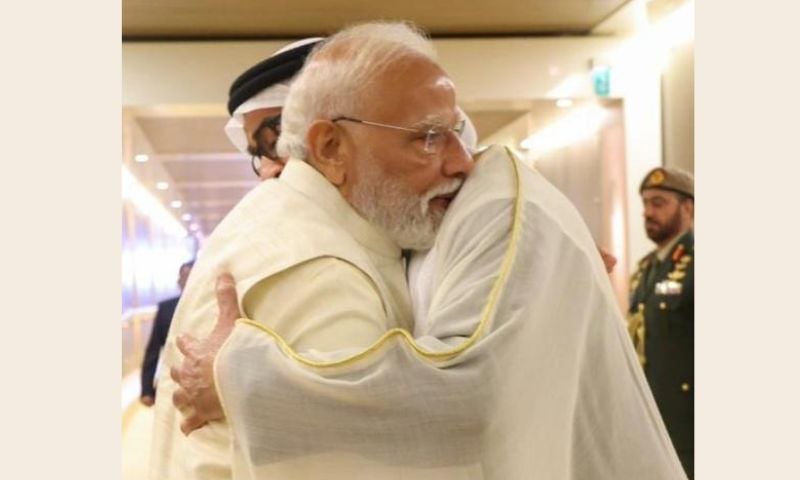
ISLAMABAD: India and the United Arab Emirates (UAE) on Friday agreed on a framework to establish a strategic defence partnership, marking a significant step in expanding bilateral ties during India’s Prime Minister Narendra Modi’s official visit to the Gulf state.
According to India’s foreign ministry, the agreement reflects a shared intent to deepen cooperation at a time of heightened regional instability — particularly amid ongoing tensions linked to the Iran conflict and its spillover effects on Gulf security dynamics.
Both sides also signed agreements covering strategic petroleum reserves and the supply of liquefied petroleum gas (LPG), underscoring the growing importance of energy security in the relationship.
Under the proposed defence framework, India and the UAE will enhance collaboration in defence manufacturing, innovation, and advanced technologies. The agreement also includes cooperation in military training, joint exercises, maritime security, cyber defence, secure communications, and intelligence-sharing mechanisms.
Brief in duration, significant in outcomes!
The visit of PM @narendramodi led to key outcomes and further deepening of India-UAE Comprehensive Strategic Partnership. Reflecting the warmth of bilateral ties, PM was seen off by President HH Sheikh Mohamed bin Zayed Al Nahyan at… pic.twitter.com/KKZ9WnttCZ
— Randhir Jaiswal (@MEAIndia) May 15, 2026
Analysts view this as part of a broader shift in India’s Gulf policy, moving from energy dependence to multi-sector strategic engagement.
Separately, Abu Dhabi National Oil Company (ADNOC) said the two countries are exploring the expansion of crude oil storage facilities in India, potentially increasing storage capacity to 30 million barrels. The deal also includes discussions on storing crude in Fujairah, strengthening India’s strategic reserves.
ADNOC added that it would explore expanded LPG supply arrangements and trading opportunities with Indian Oil Corporation.
“India’s scale and growth trajectory make it one of the defining energy markets of our time,” ADNOC Managing Director and CEO Sultan Ahmed Al Jaber said, noting that rising demand driven by population growth makes the UAE-India energy partnership increasingly critical.
Ahead of the visit, Indian officials had indicated that Modi would push for long-term energy agreements and seek UAE support in expanding India’s strategic oil reserves.
The UAE’s recent decision to exit the Organisation of the Petroleum Exporting Countries (OPEC) is expected to boost its production capacity, potentially benefiting major importers like India.
Expanding economic partnership
India and the UAE have steadily expanded cooperation in recent years. In January, the two countries signed a $3 billion deal for LNG supplies, alongside a preliminary agreement to advance defence ties.
In Friday’s statement, India’s foreign ministry also highlighted UAE investment commitments worth $5 billion. These include Emirates NBD’s acquisition of a 60 per cent stake in Ratnakar Bank Limited for $3 billion, and a $1 billion investment by Abu Dhabi’s International Holding Company in Sammaan Capital.