Key Points:
- Trump claims the US achieved a “total military victory in Iran.”
- The President asserts Iran will never acquire a nuclear weapon.
- Says China wants Iran to open the Strait of Hormuz.
- Trump may lift sanctions on Chinese companies buying Iranian oil.
- Iran says open to continuing negotiations with the US.
WASHINGTON: US President Donald Trump stated that the United States had agreed to the Iran ceasefire following appeals from other nations, particularly Pakistan.
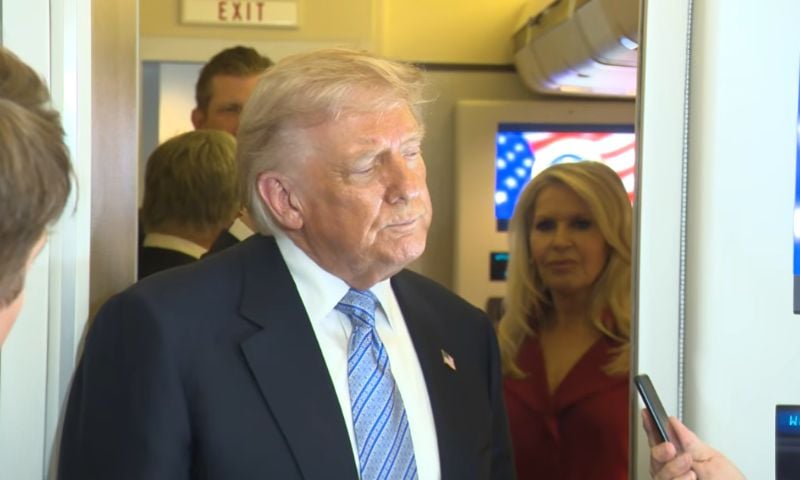
“I wouldn’t have really been in favour of it, but we did it as a favour to Pakistan,” he said while speaking to reporters aboard Air Force One on his return from China.
Trump praised Pakistan, adding, “We did it as a favour to Pakistan; they are terrific people, the field marshal, the prime minister.”
The US president also declared that the United States had achieved a “total military victory in Iran.”
Responding to a question, he asserted, “We knocked out their entire navy, we knocked out their air force, we knocked out their leaders in the second division, we knocked out their leaders in the third division.”
When asked whether hostilities could resume, Trump said, “I don’t want to say anything. I can only say with very, very strong conviction that Iran will never have a nuclear weapon.”
Pakistan has continued diplomatic efforts to facilitate dialogue between Tehran and Washington and to de-escalate the ongoing conflict through diplomacy and dialogue.
Pakistan brokered a ceasefire between Tehran and Washington on April 8 that halted the war involving the United States, Israel, and Iran.
On April 11, Pakistan hosted high-stakes direct talks between the US and Iranian negotiators in Islamabad.
The Islamabad Talks concluded without a final agreement; however, they paved the way for further negotiations between Washington and Tehran to permanently resolve the conflict.
The war started after the US and Israel launched strikes on Iran on February 28, prompting retaliatory action from Tehran against Israel and the Gulf countries.
The confrontation also contributed to disruptions in maritime traffic around the Strait of Hormuz.
Xi Wants Iran to ‘Open Up’ Strait of Hormuz
Trump noted that Chinese President Xi wants Iran to open the Strait of Hormuz. He added that he is considering lifting sanctions on Chinese companies that purchase Iranian oil and will make a decision soon, according to Reuters.
He also expressed that he is “okay” with Iran suspending its nuclear program for 20 years, provided there is a “real” commitment from Tehran.
Before his departure, Trump said he had made “fantastic trade deals” with Xi during the final talks of the summit and claimed China had offered support for keeping the Strait of Hormuz open.
“We’ve made some fantastic trade deals, great for both countries,” Trump said after walking with Xi among the rosebushes in the gardens of Zhongnanhai, the Chinese leadership compound located beside Beijing’s Forbidden City.
.@POTUS gives his signature fist pump and one final wave as he boards Air Force One following his historic state visit to China https://t.co/sWRnNmzLZM pic.twitter.com/HGXravRpMA
— Rapid Response 47 (@RapidResponse47) May 15, 2026
Trump had arrived in Beijing seeking agreements in agriculture, aviation and artificial intelligence, while also attempting to manage tensions over several major geopolitical disputes, particularly the Middle East conflict.
Trump’s Administration Open to Continuing Talks: Iran FM
Meanwhile, Iranian Foreign Minister Abbas Araghchi confirmed that his government received messages from the United States indicating the Trump administration’s willingness to continue talks aimed at ending the Middle East conflict.
“We received messages again from the Americans saying that they are willing to continue the talks and continue the interaction,” Araghchi told reporters in the Indian capital, New Delhi.
He added, “There is no solution to the US-Iran war, but a negotiated one,” and warned of “spoilers who try to derail diplomacy,” suggesting they might attempt to drag the US into another conflict.
Araghchi concluded with hope, stating that “wisdom and diplomacy will prevail and we go in line with diplomacy to find a negotiated solution.”