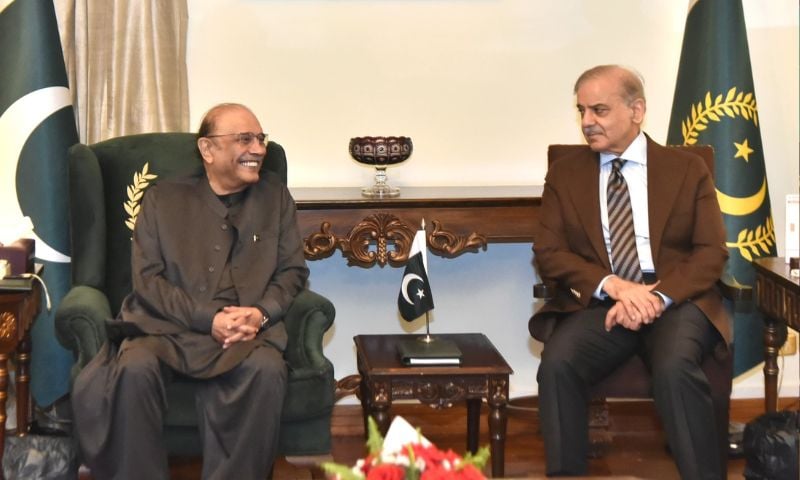
ISLAMABAD: Pakistan’s Prime Minister Shehbaz Sharif on Monday called on President Asif Ali Zardari at the President’s House and discussed the evolving regional situation amid Islamabad-led diplomatic efforts to end the US-Iran conflict through dialogue.
The meeting discussed the overall situation of the country, matters relating to Afghanistan, and the evolving regional situation, said an official statement.
During the meeting, tribute was paid to the martyrs of Marka-e-Haq (Battle of Truth) and to the professional capabilities of Pakistan’s Armed Forces, while reaffirming unwavering resolve towards national defence.
The President added that despite the challenging geographical and regional situation, tensions in the Middle East, and disruptions to supply chains, maximum possible relief should be provided to the public.
Prime Minister @CMShehbaz met President Asif Ali Zardari at Aiwan-e-Sadr. The meeting discussed the overall national & regional situation, including Afghanistan, paid tribute to the martyrs of Maarka-e-Haq, & reaffirmed commitment to national defence and public relief. pic.twitter.com/mC9WcnlGvw
— The President of Pakistan (@PresOfPakistan) May 11, 2026
The President also directed that all possible measures be taken to reduce inflationary pressure, ensure the availability of essential commodities, and provide relief to the common man.
Deputy Prime Minister and Foreign Minister Ishaq Dar, Speaker of the National Assembly Sardar Ayaz Sadiq, Federal Interior Minister Mohsin Naqvi, Federal Law Minister Azam Nazeer Tarar, Senator Saleem Mandviwalla, and Dr. Asim also attended the meeting, according to the statement.
On Sunday, Pakistan’s Prime Minister Shehbaz Sharif confirmed that Islamabad had received Iran’s response to a US proposal to end the war in the region.
Pakistan has continued diplomatic efforts to facilitate dialogue between Tehran and Washington and to de-escalate the ongoing conflict through diplomacy and dialogue.
Pakistan brokered a ceasefire between Tehran and Washington on April 8 that halted the war involving the United States, Israel, and Iran.
On April 11, Pakistan hosted high-stakes direct talks between the US and Iranian negotiators in Islamabad.
The Islamabad Talks concluded without a final agreement; however, they paved the way for further negotiations between Washington and Tehran to permanently resolve the conflict.
The war started after the US and Israel launched strikes on Iran on February 28, prompting retaliatory action from Tehran against Israel and the Gulf countries.
The confrontation also contributed to disruptions in maritime traffic around the Strait of Hormuz.
Meanwhile, the US President Donald Trump on Monday said he believed Iran would eventually “surrender”, adding that pressure on Tehran would continue until an agreement is reached.
The US President, in an interview with Fox News, said he has not yet made a decision on restoring “Project Freedom”, but is considering a revival of the initiative to keep the Strait of Hormuz open.
Trump reiterated that Iran must never be allowed to obtain a nuclear weapon.