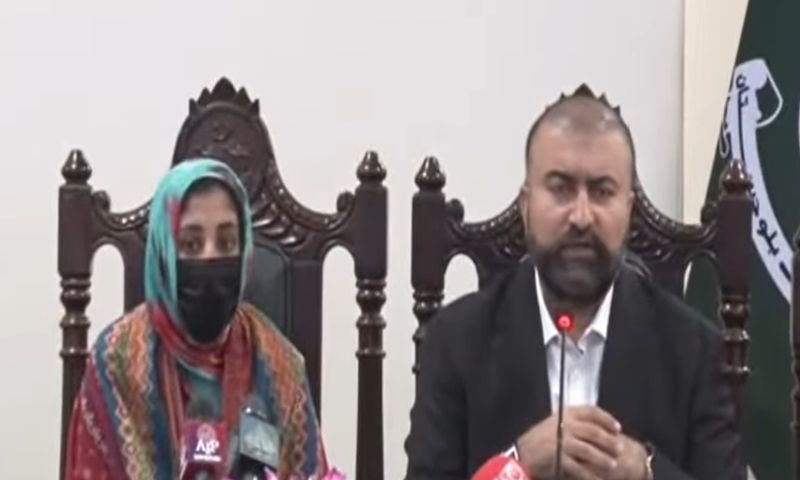



QUETTA: A young female student rescued from a suicide bombing network linked to the banned terrorist organization Balochistan Liberation Army (BLA) has revealed disturbing details of psychological manipulation, coercion, and threats used by terrorists to recruit vulnerable girls for terrorism.
In a statement, Khair-un-Nisa, a second-year student from a poor family, said she was forced into cooperating with BLA-linked operatives after her cousin threatened to kill her father if she refused to obey their orders.
“My parents are weak and poor, and my brothers and sisters are very young,” she said. “I was terrified they would harm my father, so out of fear I agreed.”
The Balochistan Liberation Army (BLA) is designated as a terrorist organization by Pakistan and several other countries, including the United States and the United Kingdom.
The group has been involved in armed insurgency, suicide bombings, attacks on civilians, security forces, and infrastructure in Pakistan.
The United States designated the BLA as a Specially Designated Global Terrorist (SDGT) organization in 2019, citing its involvement in terrorist violence. The UK has also banned the group under terrorism laws.
According to her account, she was gradually drawn into the network through seemingly small tasks, including sending mobile cards and preparing bread deliveries, without initially knowing they were being used for the banned terrorist organization.
She later discovered that the supplies were being delivered to BLA operatives.
The student alleged that her cousin twice blindfolded her and transported her to mountainous hideouts where commanders and female facilitators subjected her to systematic psychological conditioning.
“They would tell stories of women who carried out suicide attacks despite having children,” she said. “They wanted me to become like them.”
Security analysts say such tactics reflect the growing desperation of terrorist groups attempting to exploit women and young students for extremist violence in Balochistan.
Khair-un-Nisa said her fiancé and parents eventually learned about the situation and repeatedly urged her to cut ties with her cousin and stay away from the organization.
Despite their warnings, fear for her family’s safety kept her trapped.
While receiving medical treatment in Hub Chowki, she remained in contact with handlers who instructed her to complete her treatment before being “sent ahead” for the mission.
The situation changed dramatically after law enforcement agencies arrested her cousin.
“When he was arrested, I became frightened and broke my mobile phone,” she said. “I realized that if he had been caught, I could also be arrested.”
Pakistani police later took her into protective custody, where she said she was treated with dignity and respect. She subsequently cooperated with investigators and provided information about other individuals connected to the network.
Officials say the case highlights both the dangerous methods employed by terrorist organizations and the importance of timely intervention by security agencies.
“I never wanted to become a suicide bomber,” she said. “I was blackmailed, threatened, and psychologically manipulated.”
In an emotional appeal, the student urged girls and families across Pakistan not to fall victim to terrorists’ propaganda.
“I love studying and painting,” she said. “My dream is to become a doctor or a teacher and make my parents proud.”
She added that terrorism had nearly destroyed her future and warned others to stay away from such organizations.
Later, Balochistan Chief Minister Mir Sarfraz Bugti said intelligence agencies arrested the female suicide bomber while she was travelling from Turbat to Islamabad, saying she was planning to carry out a suicide attack in the Pakistani capital.
Speaking to journalists, Bugti said that India’s intelligence agency RAW was behind the plot.
He said security forces and law enforcement agencies were conducting raids to arrest facilitators and other individuals linked to the suicide bombing network.
Counterterrorism officials say the incident demonstrates the continuing threat posed by banned terrorist groups operating in Balochistan, while also underscoring Pakistan’s ongoing efforts to dismantle terror networks and rehabilitate vulnerable individuals before tragedy strikes.