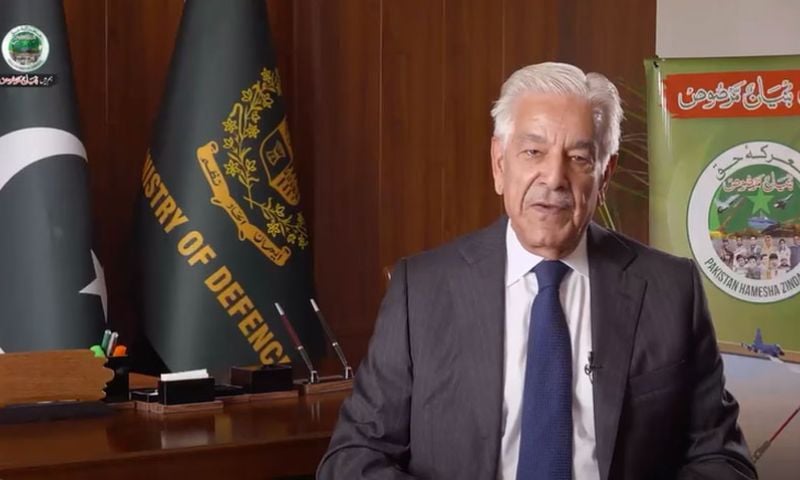



ISLAMABAD: Pakistan’s Defence Minister Khawaja Asif on Wednesday warned that any future aggression by India will be met with a response far more intense and decisive.
On 13 May 2025, Prime Minister Shehbaz Sharif announced that 10 May will be observed each year as Youm-e-Marka-e-Haq to commemorate the success of Operation Bunyanum Marsoos (last year’s war against India) and to demonstrate national solidarity.
In a video statement, the defence minister said the retaliatory capabilities of the Army, Navy, and Air Force are faster and more coordinated than the enemy can imagine.
Defence Minister @KhawajaMAsif says Marka-e-Haq has made it clear that any future aggression will be met with a response far more intense and decisive#RadioPakistan #News https://t.co/ECGZjNhaSV pic.twitter.com/JD33oyu2Yv
— Radio Pakistan (@RadioPakistan) May 6, 2026
He said the entire nation stands united with its armed forces as a steel wall. Asif said the insight and confidence of Pakistani youth are the nation’s true strength and that they know how to defend the country.
Speaking at the launch ceremony of The Battle of Truth (Marka-e-Haq)—a pictorial book published by the Ministry of Information and Broadcasting (MoIB) in collaboration with the military’s media wing, Inter-Services Public Relations (ISPR)—the minister said the entire nation stood united in the face of any form of aggression.
He stated that Pakistan had emerged stronger and more stable, becoming a symbol of resilience in the region. “We are prepared to respond to any form of Indian proxy warfare,” he added.
The minister further claimed that Pakistan’s armed forces had thwarted India’s “nefarious designs” during Marka-e-Haq and had successfully neutralised its S-400 air defence system.
He also asserted that no country in the region was safe from India’s Hindutva-driven policies, accusing it of repeatedly engaging in conflict with Pakistan to divert attention from its internal challenges.
Pahalgam Incident
The tensions between India and Pakistan escalated after a deadly attack in the Pahalgam area of Indian Illegally Occupied Jammu and Kashmir in April last year, which claimed the lives of 26 people.
India swiftly blamed Pakistan for the attack without presenting any credible evidence. Pakistan condemned the attack and strongly rejected the Indian government’s baseless accusations.
Pakistan also offered a neutral and transparent international investigation into the incident; however, India failed to respond to Islamabad’s offer and continued with its aggressive posture, jeopardising regional peace and security.
The four-day war between the two nuclear-armed neighbours began after India conducted missile strikes inside Pakistani territory, resulting in the deaths of multiple civilians and security personnel.
Pakistan gave a swift, strong, and decisive response to India. The Pakistan Air Force (PAF) shot down seven Indian aircraft, including Rafale jets, and successfully neutralised an S-400 air-defence system.
The conflict ended on May 10 when both countries agreed to a ceasefire mediated by the United States.