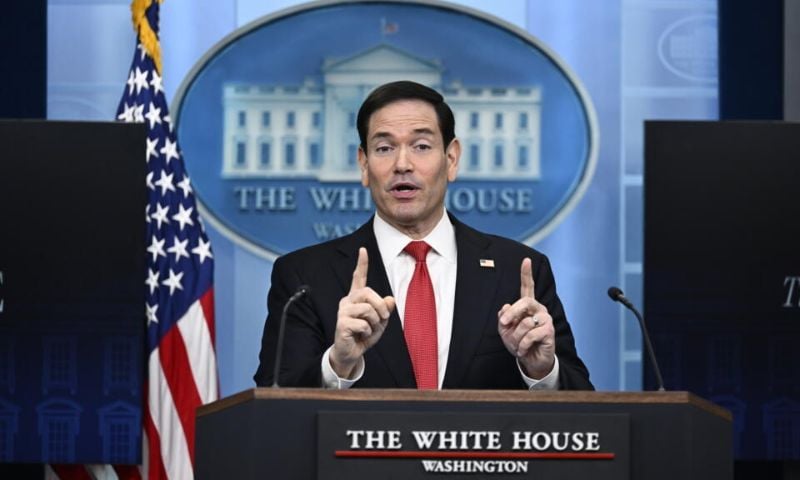



WASHINGTON: The United States has concluded the offensive phase of its military operation, Epic Fury, against Iran, Secretary of State Marco Rubio said on Tuesday, while warning that Washington remains ready to respond forcefully to any renewed threats to shipping in the strategically vital Strait of Hormuz.
Rubio’s remarks came as senior US military officials stressed that American forces remain on standby, capable of resuming combat operations at short notice if directed.
.@SecRubio: “Operation Epic Fury is concluded. We achieved the objectives of that operation. We’re not cheering for an additional situation to occur. We would prefer the path of peace. What @POTUS would prefer is a deal… that is, so far, not the route that Iran has chosen.” pic.twitter.com/blkqn3Bqdm
— Rapid Response 47 (@RapidResponse47) May 5, 2026
The warning follows a sharp escalation in tensions that has raised concerns about the stability of an ongoing ceasefire in the region.
General Dan Caine, the United States’ top military officer, said US Central Command is “ready to resume major combat operations immediately if ordered,” underscoring that Washington’s current restraint should not be interpreted as a lack of resolve.
The situation remains volatile, with Iran’s Revolutionary Guards naval forces warning they would respond decisively to any vessels deviating from routes authorised by Tehran through the strait.
Meanwhile, Iran’s chief negotiator signalled a defiant stance, stating that the country “had not even started yet” despite recent clashes.
The United Arab Emirates reported intercepting a second consecutive wave of missiles and drones allegedly launched by Iran, though Tehran firmly denied carrying out such operations.
Iran’s Khatam al-Anbiya air defence command dismissed the claims, insisting no missile or drone strikes had been conducted.
Hostilities intensified earlier this week when Iran fired missiles and drones targeting US forces. In response, Washington said it destroyed six Iranian vessels it accused of posing a threat to commercial shipping lanes – marking the most serious confrontation since a month-long truce had been in place.
US President Donald Trump urged Iran to pursue diplomacy, saying he preferred a negotiated settlement over further bloodshed.
While downplaying the confrontation as “a little skirmish”, he reiterated that Tehran stood little chance in a prolonged conflict.
Defence Secretary Pete Hegseth echoed a similar tone, stating that the United States was not seeking confrontation but warning that any further attacks would be met with a “devastating” and overwhelming response.
On the Iranian side, Parliament Speaker Mohammad Bagher Ghalibaf described the current situation as “intolerable”, asserting that the US presence in the region would eventually diminish.
Tehran has also reaffirmed its intention to maintain control over the Strait of Hormuz, a crucial artery for global energy supplies.
The latest flare-up came amid competing maritime strategies, with both sides effectively enforcing rival restrictions on shipping following Trump’s ‘Project Freedom’ to facilitate vessels safely through the Strait of Hormuz.
The ‘Project Freedom’, a naval initiative facilitating the movement of commercial shipping through the strategically vital Strait of Hormuz, however, was temporarily suspended on Tuesday following requests from Pakistan.
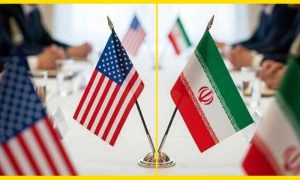
The decision came amid Pakistan-led diplomatic efforts between the US and Iran, with talks ongoing but no final agreement yet reached.
The broader conflict, which erupted more than two months ago following joint US-Israeli strikes, has already inflicted significant damage on the global economy despite now a ceasefire holds.
Israel has also signalled readiness to escalate. Air force chief Omer Tischler said the military could deploy its full aerial capabilities eastward if required, while Chief of Staff Eyal Zamir confirmed that forces remain on high alert.
Iran has denied suffering any naval losses in recent exchanges but accused the United States of killing five civilians aboard targeted vessels.
Despite ongoing tensions, global shipping activity has not entirely halted. Danish logistics giant Maersk confirmed that one of its ships successfully passed through the Strait of Hormuz under US naval escort a day earlier.
Regional and international reactions have underscored growing concern. The UAE described the developments as a “dangerous escalation”, while Saudi Arabia called for renewed diplomatic efforts to defuse the crisis.
Rubio sharply criticised Iran, accusing it of “holding the world’s economy hostage” by threatening shipping routes and laying sea mines. He revealed that the United States, in coordination with Gulf allies, has drafted a resolution for the United Nations Security Council.
.@SecRubio: “This is what Iran is saying: we will shut down the Straits… No country in the world can go through, unless we allow you to go through, and you have to pay us, but our ships can go through… That’s crazy. Who would agree to that?” pic.twitter.com/90t79vsLbV
— Rapid Response 47 (@RapidResponse47) May 5, 2026
The proposed resolution would demand that Iran halt attacks on maritime traffic, disclose the locations of naval mines, cease attempts to impose tolls on vessels transiting the strait, and facilitate a humanitarian corridor.
A vote on the measure is expected in the coming days, with Rubio describing it as a critical test of international unity and urging member states to avoid vetoing the proposal.
Financial markets have reacted cautiously to the evolving situation. While European and US equities posted gains, Asian markets remained under pressure amid fears that the ceasefire could collapse.
Diplomatic efforts are going on, with a single round of Pakistan facilitated US-Iran direct negotiations having taken place so far. Iranian President Masoud Pezeshkian indicated that Tehran remains open to dialogue but rejected Washington’s “maximum pressure” approach as unrealistic.
Rising energy prices, driven by uncertainty in the Gulf, are adding to global economic strain and presenting a domestic political challenge for Trump ahead of upcoming midterm elections.
European leaders have also voiced concern over the potential fallout. European Commission President Ursula von der Leyen warned that instability in the Gulf carries “direct consequences for Europe”, while German Chancellor Friedrich Merz called on Iran to return to negotiations.
Similar appeals were made by French President Emmanuel Macron and British Prime Minister Keir Starmer. As tensions persist, the risk of further escalation continues to cast a shadow over global security and economic stability, with the Strait of Hormuz once again at the centre of geopolitical uncertainty.