


WASHINGTON: Iranian attacks on US forces and commercial shipping since the ceasefire remain below the threshold required to trigger a resumption of major combat operations, the Pentagon said on Tuesday.
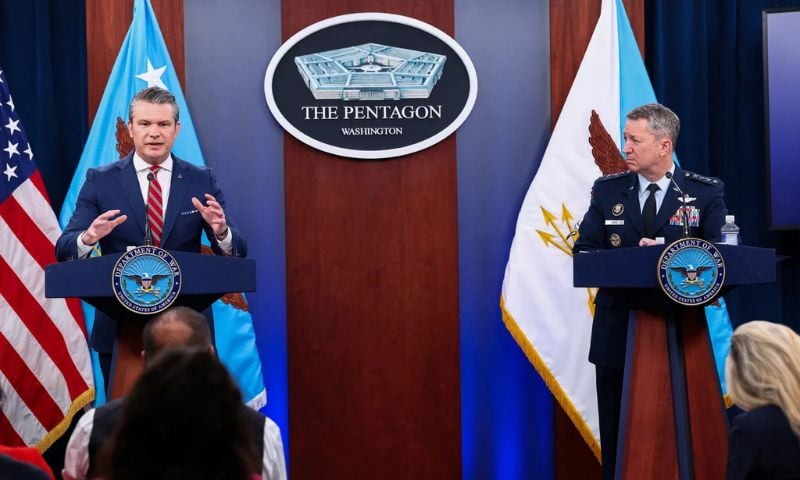
Speaking at a Pentagon briefing, Chairman of the Joint Chiefs of Staff General Dan Caine said Iran had carried out more than 10 attacks on US forces and targeted commercial vessels multiple times since the truce was announced.
“Since the ceasefire was announced, Iran has fired at commercial vessels nine times and seized two container ships, and they have attacked US forces more than 10 times, all below the threshold of restarting major combat operations at this time,” General Caine said.
Caine said the United States had launched “Project Freedom” on Sunday under orders from President Donald Trump to ensure safe passage for international shipping through the Strait of Hormuz.
“CENTCOM initiated Project Freedom with the objective of facilitating the safe passage of international commercial shipping through the Strait of Hormuz,” he said.
He accused Iran of repeatedly threatening and attacking vessels in recent weeks to disrupt global trade and damage the international economy.
Highlighting operational details, General Caine said US forces were monitoring multiple sites of attacks in the Strait of Hormuz and the Gulf of Oman.
Limited scope operation
US Secretary of Defence Pete Hegseth described the operation as defensive, limited in scope and temporary in duration.
“To be clear, this operation is separate and distinct from Operation Epic Fury. Project Freedom is defensive in nature, focused in scope and temporary in duration, with one mission: protecting commercial shipping from Iranian aggression,” Hegseth said.
He added that US forces would not need to enter Iranian waters or airspace.
Hegseth said Washington was not seeking conflict but would respond decisively to any attacks.
“We’re not looking for a fight. But Iran also cannot be allowed to block innocent countries and their goods from an international waterway,” he said.
“If you attack American troops or innocent commercial shipping, you will face overwhelming and devastating American firepower,” he added.
He also confirmed that the United States was communicating with Iran “overtly and quietly” to ensure the operation could proceed.
“There are some actions that the IRGC takes sometimes that are outside the bounds of what maybe Iranian negotiators would like; that’s their job to rein that in, and ultimately create a condition for a deal,” he said.
Ceasefire holds despite tensions
Despite continued hostilities, US officials said the ceasefire remains in place.
“The threshold of restarting is a political decision above my pay grade,” Caine said, adding that current Iranian actions amounted to “low harassing fire”.
“It feels like Iran is grasping at straws to try to do something across the southern flank,” he said.
“No adversary should mistake our current restraint with a lack of resolve,” he added, warning that US forces remain ready to resume major combat operations if ordered.
Admiral Brad Cooper, the US commander responsible for the region, said American forces had intercepted missiles and drones launched by Iran and destroyed six small boats that threatened shipping.
Hegseth said six Iranian vessels attempting to breach the US naval blockade had been turned around.
Disruption in Strait of Hormuz
The Strait of Hormuz, a critical route for global oil and gas exports, has been at the centre of the crisis since Iran closed it following the start of war on February 28 between US-Israeli forces and Iran.
Caine said about 22,500 mariners aboard more than 1,550 commercial vessels remain stranded in the Arabian Gulf due to the disruption.
US officials said they were not directly escorting ships but had established a safe transit corridor supported by multi-layered defences, including naval, air and electronic capabilities.
However, Iranian media have raised concerns about alternative routes.
According to the semi-official Fars news agency, vessels attempting to use waters near Oman face navigational risks.
“The waters near the coast of Oman are rocky, and the vessels are unable to leave or return from this part,” Fars quoted an unnamed military source as saying.
It added that the southern corridor near the Musandam and al-Khail islands was “rocky, shallow, and risky” for maritime transit.
Diplomatic efforts
The conflict remains unresolved despite a Pakistan-brokered ceasefire initially announced for two weeks and later extended indefinitely by President Trump.
Iranian Foreign Minister Abbas Araghchi will visit to China on Wednesday for talks, according to the Chinese foreign ministry, as diplomatic efforts continue.
Meanwhile, Iran’s Parliament Speaker Mohammad Ghalibaf said a “new equation” in the Strait of Hormuz was taking shape.
“The security of shipping and energy transit has been jeopardised by the United States and its allies through the violation of the ceasefire and the imposition of a blockade,” he said on social media platform X.
US officials have indicated that Project Freedom is not open-ended.
“We’re stabilising the situation so commerce can flow again, but we expect the world to step up,” Hegseth said. “At the appropriate time, and soon, we will hand responsibility back.”