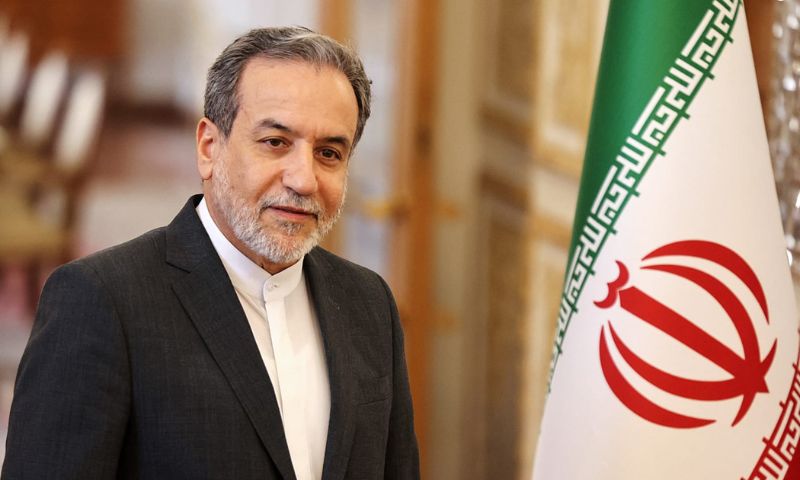



BEIJING: Iran’s Foreign Minister Abbas Araghchi will visit China on May 6 (Wednesday) at the invitation of Beijing, China’s foreign ministry said on Tuesday, as diplomatic efforts intensify to resolve the Middle East conflict.
A Chinese foreign ministry spokesperson said Araghchi would hold talks with Chinese Foreign Minister Wang Yi during his visit.
Minister of Foreign Affairs of Iran Seyyed Abbas Araghchi will visit China upon invitation on May 6.
Member of the Political Bureau of the CPC Central Committee and Minister of Foreign Affairs Wang Yi will hold talks with him. pic.twitter.com/36gnYiIN7u
— CHINA MFA Spokesperson 中国外交部发言人 (@MFA_China) May 5, 2026
Iran’s semi-official Mehr news agency also reported that Araghchi would travel to Beijing for consultations, where he is expected to discuss bilateral relations as well as regional and international developments with his Chinese counterpart.
The visit comes ahead of US President Donald Trump’s visit to China.
Trump is scheduled to meet Chinese President Xi Jinping for a two-day summit beginning May 14.
His visit had originally been planned for late March but was postponed due to the US-Israel war with Iran.
US-Iran talks
Araghchi’s trip comes amid stalled negotiations between Tehran and Washington aimed at ending the regional conflict.
Speaking at a Pentagon press conference on Tuesday, US Secretary of Defence Pete Hegseth said Washington was communicating with Iran both “overtly and quietly” to facilitate operations in the Strait of Hormuz.
“There are some actions that the IRGC takes sometimes that are outside the bounds of what maybe Iranian negotiators would like; that’s their job to rein that in, and ultimately create a condition for a deal,” he said.
In a statement posted on X, Araghchi stressed that recent developments in the Strait of Hormuz highlighted the lack of any military solution to the crisis.
“Events in Hormuz make clear that there’s no military solution to a political crisis,” he said, urging continued diplomatic engagement.
He also referred to ongoing talks, noting that they were making “progress with Pakistan’s gracious effort”.
Araghchi cautioned the United States against escalation, warning it should not be “dragged back into quagmire by ill-wishers”.
Pakistan’s mediation role
On Monday, Iran confirmed it had received Washington’s response to a 14-point proposal aimed at ending the conflict, signalling potential progress in communication facilitated by Pakistan.
Foreign Ministry spokesman Esmaeil Baqaei said Tehran was reviewing the response and would convey its position through Pakistani mediators once the process was complete.
“We have received the American side’s response and are reviewing it, and we will definitely announce our views through the Pakistani mediation as soon as we reach a conclusion,” Baqaei said at a news conference, according to the state-run IRNA news agency.
A two-week ceasefire was announced on April 8 through Pakistani mediation, followed by direct talks in Islamabad on April 11. However, no agreement was reached on a lasting truce.
US President Trump later extended the ceasefire without setting a new deadline, following a request from Pakistan.
Pakistan’s diplomatic efforts
Meanwhile, Pakistan has remained actively engaged in facilitating dialogue between Washington and Tehran, including hosting the first high-level contact between the two sides in decades last month in Islamabad.
However, efforts to convene a second round of talks have faced delays.
Trump said discussions were currently being conducted by phone after he called off a planned visit by US envoys to Pakistan.
“I have great respect for Pakistan and for the Field Marshal (Syed Asim Munir) and the Prime Minister (Shehbaz Sharif),” he said.
On Monday, Pakistan handed over crew members of an Iranian container vessel that had been seized by the United States.
The MV Touska vessel was intercepted by US forces last month for allegedly violating a naval blockade of Iranian ports near the Strait of Hormuz. Its crew was later flown to Pakistan for repatriation.
Islamabad has described such steps as confidence-building measures, reiterating its commitment to supporting dialogue and diplomacy.