
PARIS: The ongoing conflict involving Iran, coupled with the closure of the Strait of Hormuz and persistent insecurity in the Red Sea, is dramatically altering global shipping patterns, turning Africa into a central artery for international maritime trade, according to logistics and shipping industry sources.
Over the past two months, the disruption has compelled shipping companies to abandon traditional sea routes into Gulf countries.
In response, they are increasingly relying on alternative corridors, including land-based transport systems, to ensure the delivery of essential goods such as food and manufactured products.
Alternative supply routes to the Gulf
With maritime access to several Gulf destinations severely restricted, Saudi Arabia’s Red Sea port of Jeddah has emerged as a critical logistics hub.
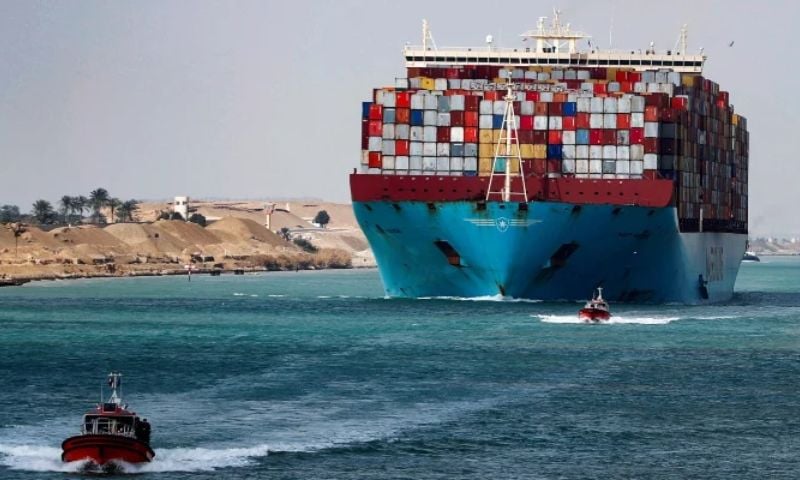
Major global shipping firms, including MSC, CMA CGM, Maersk and Cosco, are now routing vessels through the Suez Canal to Jeddah, according to AFP.
From there, cargo is transported overland by truck across desert highways to destinations such as Sharjah, Bahrain and Kuwait – regions that have effectively been cut off from direct sea deliveries for weeks.
However, the sudden surge in traffic has strained infrastructure. Industry experts warn that Jeddah is struggling to cope with the increased volumes, leading to mounting congestion.
Recent maritime data indicates that vessels are facing significantly longer waiting times before unloading, highlighting the growing bottleneck.
To bypass the Strait of Hormuz, shipping operators are also utilising alternative ports outside the choke point. These include Sohar in Oman and the UAE ports of Khorfakkan and Fujairah, all of which are linked to inland transport networks.
Further north, Jordan’s Aqaba port has become a gateway for goods heading into Iraq, particularly Baghdad and Basra. Additionally, a Turkish land corridor is facilitating the movement of cargo into northern Iraq.
Why ships are avoiding the Red Sea route
The diversion away from the Red Sea is not a new phenomenon but has intensified significantly due to recent geopolitical tensions.
The shift began in late 2023 following attacks on commercial vessels by Iran-aligned Houthi forces operating from Yemen.
Since then, shipping companies have increasingly avoided the Bab Al-Mandeb Strait and the Suez Canal, opting instead for longer routes around the African continent.
Vessels now typically sail down Africa’s eastern coastline, round the Cape of Good Hope in South Africa, and then head north towards Europe.
Industry analysts note that this rerouting has now become standard practice. A substantial majority of cargo that once passed through the Red Sea is now being diverted via southern Africa.
Recent tracking data shows a sharp increase in vessel traffic around the Cape of Good Hope, while activity through the Red Sea has dropped significantly.
Daily ship movements around the Cape have more than tripled compared to levels seen just a few years ago, whereas Red Sea transits have declined to a fraction of their former volume.
Economic and logistical consequences
The impact of these disruptions is being felt across global supply chains. Shipping times between Asia and Europe have increased by an average of two weeks, significantly delaying deliveries. Costs have also surged.
Longer routes require substantially more fuel – estimated at 30 to 50 percent higher consumption – and additional vessels are needed to maintain regular service schedules. This has driven up freight rates, with container shipping costs rising notably compared to last year.
The effects are unevenly distributed. Some African ports are benefiting from increased traffic and handling record volumes of containers. In contrast, countries heavily dependent on traditional maritime routes are suffering losses.
Egypt, for instance, has seen a steep decline in revenues from the Suez Canal, a vital source of national income. Estimates suggest billions of dollars in losses due to reduced transit traffic.
A reshaped global trade map
As tensions persist in key maritime corridors, the restructuring of global shipping routes appears likely to continue. Africa’s role as a pivotal transit region is expanding, while traditional chokepoints such as the Strait of Hormuz and the Red Sea remain vulnerable to geopolitical instability.
The evolving situation underscores the fragility of global trade networks and the far-reaching consequences of regional conflicts on international commerce.