TOKYO: Saudi Arabia and Japan are expanding their partnership beyond traditional energy ties into technology, investment, and emerging sectors, officials said after a high-level parliamentary meeting in Tokyo.
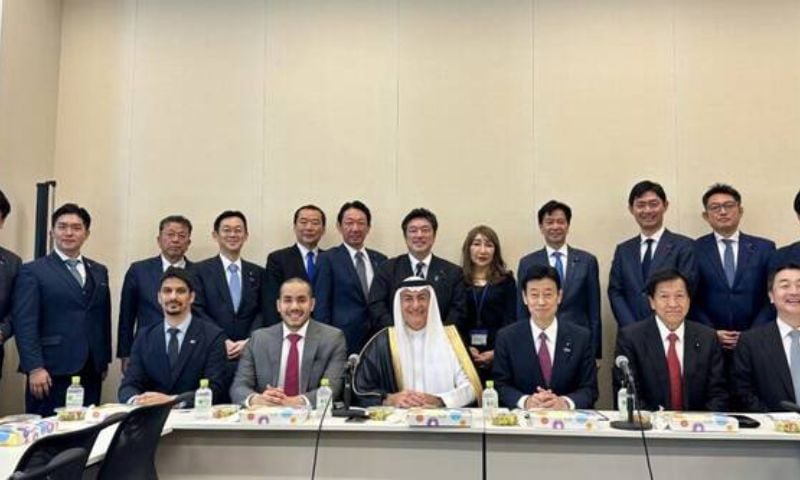
A session of the Japan–Saudi Arabian Parliamentary Friendship League was held in Tokyo, which brought together Saudi Ambassador to Japan Dr Ghazi Faisal Binzagr and former Japanese Minister of Economy, Trade and Industry Yasutoshi Nishimura, the Arab News reported on Thursday.
It also included 21 members of parliament, among them SASAKI, Secretary General of the League and Vice Minister of Land, Infrastructure, Transport and Tourism. Senior officials from both sides were also present at the meeting.
The meeting underscored growing momentum in Saudi–Japan relations, with discussions highlighting a gradual shift from conventional exchanges to a wider and more integrated strategic partnership encompassing multiple sectors of mutual interest.
Ambassador Binzagr described the parliamentary league as more than a platform for dialogue, characterising it instead as a practical mechanism for advancing cooperation and shaping the long-term direction of bilateral ties.
He stressed that the partnership is now defined by shared responsibility in building long-term resilience and developing stable, future-oriented value chains across energy, economic development, and regional stability.
He further noted that since the launch of the Saudi–Japan Vision 2030 initiative in 2017, collaboration between the two countries has expanded significantly beyond traditional energy cooperation.
According to him, engagement now spans integrated value chains in industry, technology, investment, and culture, reflecting a deeper convergence in ambition and strategic outlook.
The Ambassador also highlighted the importance of human capital in sustaining this progress, pointing to Saudi professionals with experience in Japan and Japanese experts familiar with the Arab region as key facilitators of future collaboration.
He described such individuals as essential “bridges between societies” who contribute not only to dialogue but also to execution and joint innovation.
Addressing global energy dynamics, Dr Binzagr said energy security should be viewed not merely as a short-term concern but as an opportunity to strengthen cooperation across the entire value chain, including supply chains, logistics, innovation, and future energy systems.
He reiterated Saudi Arabia’s commitment to ensuring stable energy supplies while also contributing to regional stability, stressing that stability in the Middle East is closely linked to global stability.
The discussions also reflected a growing understanding that resilience, prosperity, and stability are increasingly interconnected, particularly as both nations broaden cooperation into advanced and emerging sectors.
Former minister Yasutoshi Nishimura expressed appreciation for Saudi Arabia’s continued role in maintaining energy stability, especially during periods of regional tension.
He acknowledged the Kingdom’s consistent efforts in ensuring reliable crude oil deliveries through key routes such as Yanbu and the East-West pipeline.
Nishimura noted that bilateral cooperation is evolving beyond crude oil into areas such as hydrogen, ammonia, and advanced materials.
He reaffirmed Japan’s commitment to strengthening corporate partnerships within the framework of the Japan–Saudi Vision initiative.
He also referred to the strong public response to the Saudi Pavilion at Expo 2025 Osaka and expressed interest in expanding cooperation into new and emerging fields including e-sports, gaming, animation, space, and advanced industrial sectors.
During the meeting, Nishimura recalled a recent conversation between Japanese Prime Minister TAKAICHi Sanae and Crown Prince Mohammed bin Salman, in which both sides reaffirmed their commitment to expanding collaboration in innovation-driven sectors.
IWAMOTO Keiichi, Director of the Middle East Division at Japan’s Ministry of Foreign Affairs, presented an overview of bilateral relations, emphasising Saudi Arabia’s central role in global energy security while also highlighting the widening scope of cooperation across multiple domains.
A question-and-answer session further enriched the dialogue, with participants identifying future opportunities in areas such as animation, sports, gaming, cultural industries, advanced technologies, and even potential defence cooperation, alongside continued expansion in traditional economic sectors.
Participants collectively noted that these developments reflect a shared recognition of the importance of broader collaboration in promoting global peace, security, prosperity, and improved quality of life.
The meeting concluded with a consensus that parliamentary engagement will play a crucial role in translating strategic alignment into practical outcomes, further advancing a comprehensive and future-oriented Saudi–Japan partnership.