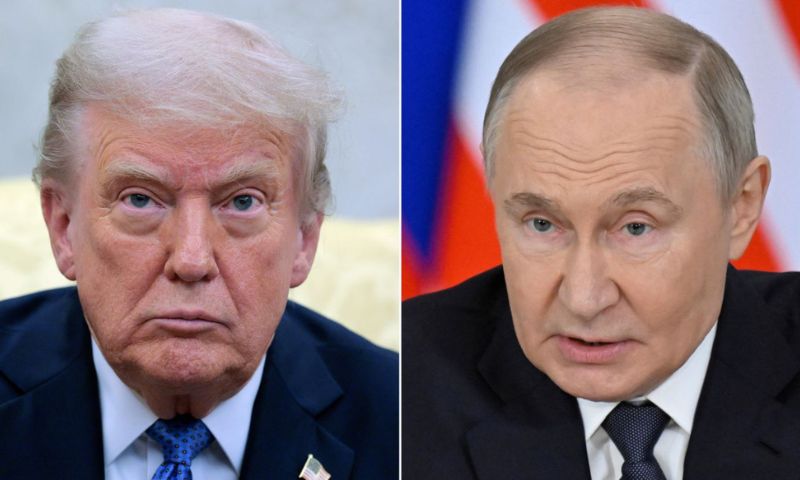
MOSCOW: US President Donald Trump and Russian President Vladimir Putin spoke by phone, Putin’s diplomatic advisor Yuri Ushakov told reporters Wednesday, adding that the two leaders focused primarily on the Iran war.
“The presidents paid particular attention to the situation regarding Iran and in the Gulf,” Ushakov said.
“Vladimir Putin considers Donald Trump’s decision to extend the ceasefire with Iran to be the right one, as this should give negotiations a chance and, overall, help to stabilise the situation.”
The Kremlin aide added Russia was “firmly committed to providing every possible assistance to diplomatic efforts” on the Iran war, and said the call was held at Moscow’s initiative.
Ushakov described the call as friendly and businesslike.
Wednesday’s hour-and-a-half-long, “frank and businesslike” discussion included an in-depth exchange on the Strait of Hormuz crisis, Ukraine, and Trump’s assessment on the possibility of a peace agreement, Russia’s Sputnik news agency reported.
Putin praised Trump’s decision to extend the ceasefire with Iran, saying it was the “correct” move, and that it “should open the door to negotiations and generally help stabilise the situation,” Ushakov said.
“Donald Trump outlined his assessment on the outcome of the military confrontation that has ended, as well as his views on the difficult situation Iran and its leadership currently find themselves in,” the Russian presidential aide added.
Russia will continue its active contacts with Iran, Israel and the leaders of the Gulf countries, as well as the American negotiating team, Ushakov said.
Putin’s first words to Trump during the talks were in expressing his support to Trump following Saturday’s assassination attempt at the White House Correspondents’ Dinner, Ushakov said.
“The Russian leader strongly condemned the crime, emphasising the unacceptability of any form of politically motivated violence.”
Russia ready for Ukraine ceasefire
During the phone conversation, Putin informed Trump of Russia’s readiness to declare a ceasefire during the upcoming Victory Day celebrations, the Kremlin aide said.
“Of course, we would prefer that this be the result of a negotiation process, for which [Ukraine’s Volodymyr] Zelensky must respond positively to the well-known proposals that have been presented repeatedly, including by the US side,” Ushakov said.
Trump expressed his belief that “a deal that would end the conflict in Ukraine is close,” Ushakov said.
Putin and Trump’s telephone conversation came two days after Iranian Foreign Minister Abbas Araghchi’s visit to Moscow on April 27.
Trump says Iran blockade effective
Earlier, Trump told Axios that he would keep Iran under a naval blockade until Tehran agreed to a deal addressing US concerns over its nuclear program.
“The blockade is somewhat more effective than the bombing,” Trump was quoted as saying.
“It is going to be worse for them. They can’t have a nuclear weapon.”
Trump said Iran wanted a deal to lift the blockade, but added he did not want to do so unless Tehran was prevented from obtaining a nuclear weapon.
“They want to settle. They don’t want me to keep the blockade. I don’t want to [lift the blockade], because I don’t want them to have a nuclear weapon,” he said.
US maintains communication with Iran
Earlier today, the White House said that US negotiators are continuing communication with Iranian officials.
“US negotiators continue to engage with the Iranians, who are struggling to sort out their leadership situation following Operation Epic Fury,” White House spokesperson Anna Kelly said in a statement to the media.
The spokesperson added that President Trump would only accept an agreement that “puts US national security first” and reiterated Washington’s position that Iran must never obtain a nuclear weapon.
The remarks came after Trump urged Iran, in a post on his Truth Social platform, to “get smart soon” and agree to a deal, warning: “No more Mr. nice guy!”
Pakistan pushes diplomatic efforts
Meanwhile, Pakistan’s Prime Minister Shehbaz Sharif said Islamabad continues to pursue diplomatic efforts to de-escalate tensions between Washington and Tehran.
Chairing a federal cabinet meeting in Islamabad, the prime minister recalled the first round of US-Iran talks hosted in the Pakistani capital on April 11–12.
“Unprecedented number of diplomatic efforts were made,” PM Sharif said, adding that the initiative contributed to a ceasefire extension announced on April 21 by Trump.
Pakistan has positioned itself as a key mediator since the war started, facilitating dialogue despite the initial round of talks ending without an agreement.
Prime Minister Sharif also highlighted the role of Pakistan’s Chief of Defence Forces and Chief of Army Staff Field Marshal Syed Asim Munir and Deputy Prime Minister and Foreign Minister Ishaq Dar in advancing diplomatic outreach.
PM Sharif referred to recent visits by Iranian Foreign Minister Abbas Araghchi, who held meetings with Pakistani leaders in Islamabad and indicated Tehran would respond after internal consultations.
Pakistan working to find ‘new formula’
Meanwhile, Pakistan is working silently to break the ongoing deadlock between the US and Iran, focusing on finding a new formula for a long-awaited agreement on the Strait of Hormuz and Tehran’s nuclear programme, Anadolu news agency reported on Wednesday, citing two government sources familiar with the matter.
“Both sides are actively engaged in back-channel diplomacy, conveying formulae and counter-formulae through Pakistan to reach an agreement,” Anadolu quote a source as saying.
The source added that the current negotiations were focused on the nearly closed Strait of Hormuz and the nuclear issue.
The sources said that Pakistan’s focus was on finding a “middle way” on the two simmering issues.
US continues blockade of Iranian ports
On the ground, the United States has continued its naval blockade of Iranian ports, restricting Iran’s oil exports and exerting economic pressure.
The US military said late Tuesday that Marines boarded another commercial vessel but allowed it to proceed.
Trump told Axios that he will maintain a naval blockade on Iran until the Islamic republic agrees to a deal addressing Washington’s concerns about its nuclear programme.
“The blockade is somewhat more effective than the bombing. They are choking like a stuffed pig. And it is going to be worse for them. They can’t have a nuclear weapon,” Trump tells the outlet.
“They want to settle. They don’t want me to keep the blockade. I don’t want to [lift the blockade], because I don’t want them to have a nuclear weapon,” he adds.
The blockade, introduced after talks stalled, targets ships entering or leaving Iranian ports and has significantly disrupted maritime traffic through the Strait of Hormuz.