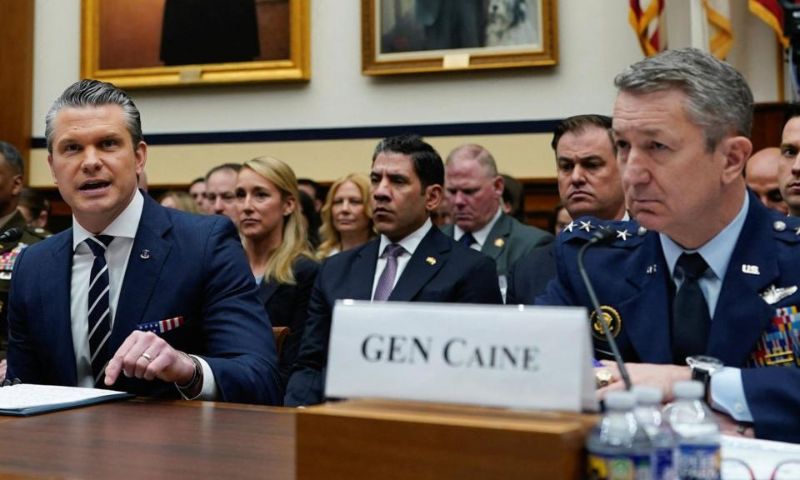



WASHINGTON: The United States has spent approximately $25 billion on its military campaign against Iran, a senior defence official told lawmakers on Wednesday, as a congressional hearing exposed divisions over the cost, strategy and objectives of the war.
Jay Hurst, the War Department’s Chief Financial Officer, told the House Armed Services Committee that “most of that is in munitions”, referring to spending under Operation Epic Fury, the US military campaign against Iran.
Meanwhile, Jules Hurst III, acting undersecretary of war for finances, also told lawmakers the conflict had cost $25 billion so far, with additional funds spent on operations and replacing equipment.
The hearing marked the first time Defence Secretary Pete Hegseth faced questioning from lawmakers since the war began on February 28.
Pentagon claims ‘astounding success’
Hegseth strongly defended the campaign, describing it as an “astounding military success” and insisting the United States was “absolutely” winning the war.
He said Iran’s nuclear facilities had been “obliterated” in a 2025 strike, but added that Tehran had not abandoned its nuclear ambitions.
Pressed on whether the US had anticipated Iran’s move to restrict shipping through the Strait of Hormuz, Hegseth said the War Department had “looked at all aspects of this risk”.
He also defended a proposed $1.5 trillion defence budget, saying it would place the US defence industrial base “back on a wartime footing” and ensure the country maintains “the world’s most powerful and capable military”.
“This reflects the urgency of the moment,” Hegseth told the committee, criticising what he described as “underinvestment and mismanagement” under former president Joe Biden.
Tense exchanges with Democrats
Democratic lawmakers strongly criticised the Iran war, questioning its justification, cost and impact on US interests.
Representative John Garamendi called the conflict “a geopolitical calamity”, a “strategic blunder” and a “self-inflicted wound to America”.
“You have been lying to the American public about this war from day one,” Garamendi told Hegseth, citing rising fuel prices and economic pressures.
Hegseth rejected the criticism and accused opponents of undermining US troops.
“The biggest challenge, the biggest adversary we face at this point are the reckless, feckless and defeatist words of congressional Democrats and some Republicans,” he said.
Representative Adam Smith questioned the administration’s rationale for launching the war, noting that Hegseth had said Iran’s nuclear facilities were previously destroyed.
“We had to start this war… because the nuclear weapon was an imminent threat. Now you’re saying that it was completely obliterated?” Smith said.
Hegseth responded that Iran continued to pursue nuclear ambitions and possessed thousands of missiles.
Three aircraft carriers’ deployment to Middle East
Chairman of the Joint Chiefs of Staff Dan Caine told the committee that the president deploys military force based on assessed risks and readiness considerations.
Responding to questions about the deployment of three aircraft carrier strike groups to the Middle East, Caine said he was confident that such decisions were made after careful evaluation of global military requirements.
“I’m confident that the president always carefully considers these readiness trade-offs,” he said.
Caine also defended the proposed defence budget increase, calling it a “historic down payment on future security” that would help the US keep pace with rapidly evolving military technologies.
War powers and political divisions
Lawmakers also raised concerns that the war was launched without congressional approval.
Efforts by Democrats to pass resolutions requiring President Donald Trump to halt the conflict have so far failed.
Republicans largely backed Trump’s approach, citing concerns over Iran’s nuclear programme and the broader strategic risks of disengagement.
However, some Republican lawmakers signalled unease about the duration of the conflict and indicated that future votes could test support if the war drags on.
Committee chairman Mike Rogers warned that the US faces growing threats from global rivals and lacks sufficient military resources.
“We don’t have enough munitions, ships, aircraft or autonomous systems to ensure dominance against every adversary,” he said.