UNITED NATIONS: Pakistan told the United Nations Security Council on Monday that it remains firmly committed to a peaceful resolution of escalating tensions between Iran and the United States, warning that continued disruption of the Strait of Hormuz could trigger serious global economic and security consequences.
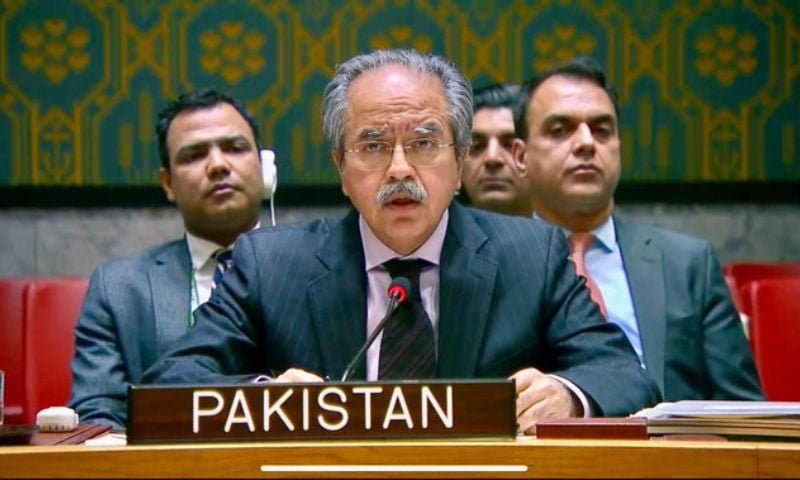
Speaking at a high-level debate on “The Safety and Protection of Waterways in the Maritime Domain,” Pakistan’s Permanent Representative Asim Iftikhar Ahmad stressed the urgent need to restore maritime stability and ensure uninterrupted global trade flows.
“Any disruptions to the routine traffic at sea gravely impact international trade with negative repercussions for the global economy, and breed volatility that imperils international peace and security,” he said, describing the Strait of Hormuz crisis as “a case in point”.
The global governance order is coming under increasing strain with wide-ranging consequences. Even international waterways have not been able to escape these impacts. The rules and norms that we had collectively and painstakingly put in place to precisely avoid such contestations… pic.twitter.com/desutZt28p
— Permanent Mission of Pakistan to the UN (@PakistanUN_NY) April 27, 2026
He cautioned that if the crisis persists, its immediate effects on energy supplies and essential commodities would ripple outward. “The first order impacts… will increasingly translate into second and third order impacts on inflation, growth, current account and balance of payment issues — no doubt, developing countries will be most affected,” he warned.
Pakistan has emerged as an active diplomatic interlocutor in recent weeks, maintaining contacts with both Tehran and Washington while coordinating with key regional actors.
Officials say Islamabad has leveraged its ties with Gulf states, as well as its strategic partnership with China, to encourage de-escalation and explore pathways for reopening the critical waterway.
Ambassador Ahmad highlighted these efforts, noting that “Pakistan, supported by brotherly countries including China, Saudi Arabia, Türkiye and Egypt, has spearheaded constructive diplomatic efforts for de-escalation and the broader pursuit of stability between the United States and Iran.”
Statement by Ambassador Asim Iftikhar Ahmad,
Permanent Representative of Pakistan to the UN,
At the High-Level Open Debate of UN Security Council on “The Safety and Protection of Waterways in the Maritime Domain”
(27 April 2026)
******Mr. President,
I wish to congratulate… pic.twitter.com/Nci3SxLN5T
— Permanent Mission of Pakistan to the UN (@PakistanUN_NY) April 27, 2026
He reiterated Islamabad’s commitment to dialogue, adding that Pakistan “remains firm in its faith in diplomacy and dialogue” and will continue efforts to help secure a lasting resolution.
The Strait of Hormuz, through which a significant share of the world’s oil passes, has remained effectively closed amid rising hostilities, raising alarm in global markets and prompting calls for urgent international action.
Ahmad said the situation has exposed deeper vulnerabilities in the global system, warning that the resilience of global governance and strategic stability is now being tested by the safety of maritime waterways.
He also cautioned against the erosion of established international norms. “The rules and norms that we had collectively and painstakingly put in place… are being challenged or set aside. This is an untenable situation,” he told the council.
Pakistan’s diplomatic push comes amid growing international concern over the risk of a broader regional conflict, with diplomats noting Islamabad’s quiet role in facilitating contacts and encouraging dialogue.
Reaffirming Pakistan’s position, the envoy emphasised the importance of international law, particularly the United Nations Convention on the Law of the Sea, as a cornerstone of maritime order, and called for collective action based on cooperation and diplomacy.
“As a maritime state with unwavering faith in international law and diplomacy, Pakistan would continue to engage … for preserving the hard-won gains,” he said, urging unity to safeguard peace and stability.