
Key Points
- Pakistan consumes around 440,000 barrels of oil daily
- Domestic production stands near 90,000 barrels per day
- Import dependence remains close to 80 per cent
- Short-term savings estimate at nearly $1 billion annually
- Five-year potential savings projected at $3–4 billion yearly
ISLAMABAD: Pakistan’s rising petroleum production, combined with planned renewable energy expansion, could reduce the country’s annual oil import bill by up to $4 billion over the next five years.
As of now, the nation will remain heavily dependent on imported crude in the near term.
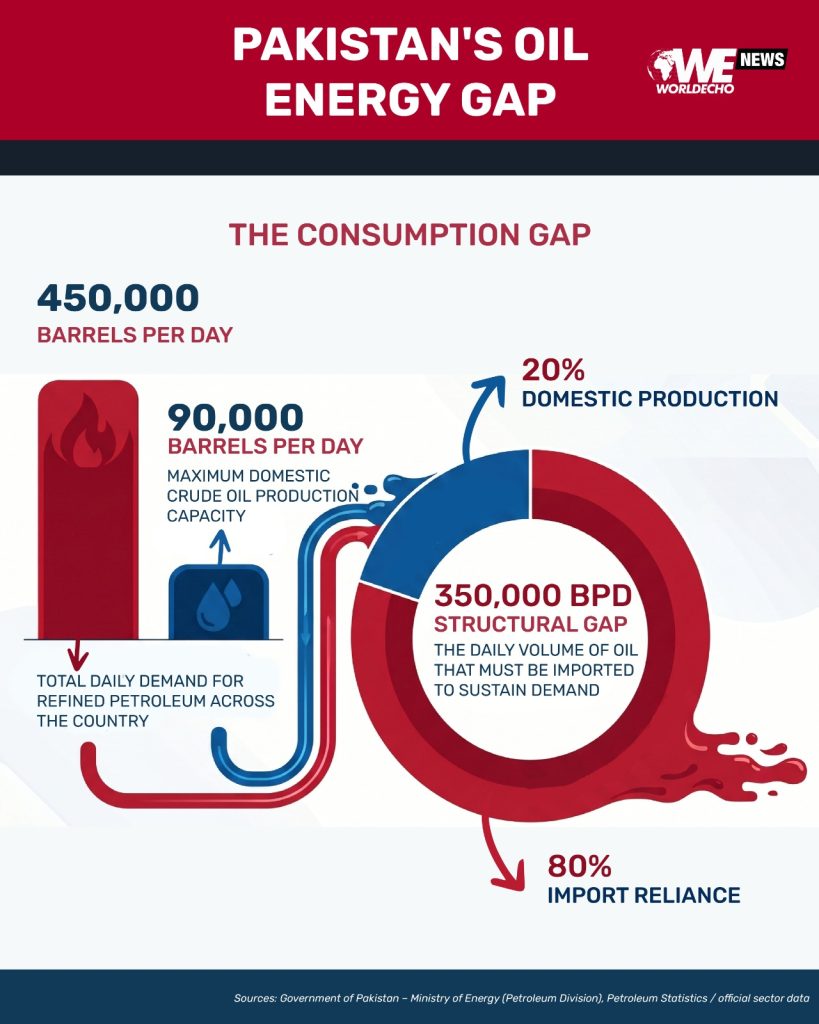
Pakistan currently consumes approximately 440,000 barrels of oil per day. Domestic production has recently increased to nearly 90,000 barrels per day, according to industry estimates and operational disclosures from local exploration companies.
This leaves Pakistan dependent on imports for roughly 350,000 barrels per day, or nearly 80 per cent of total demand.
At an average international crude price of $75–80 per barrel (pre-Iran war annual projections), Pakistan’s annual oil import bill is estimated at $10–12 billion. That makes petroleum one of the country’s largest external payment burdens.
Limited near-term fiscal relief
In the short term (next 12 months), incremental increases in domestic output are projected to reach around 110,000 barrels per day. Adding renewable energy to the displacement of oil-based generation could reduce imports by approximately 30,000 barrels per day.
This translates into:
- Annual import reduction of roughly $0.8 billion to $1.0 billion
- Import dependence falling from approximately 80 per cent to about 73–75 per cent
Demand outpacing indigenous production
Energy analysts say this reflects efficiency gains rather than structural change, as demand continues to outpace domestic supply.
Recent production uptick and emerging acceleration trend
In recent months, Pakistan’s domestic crude output has shown a gradual but notable upward trajectory, rising from the low-to-mid 80,000 barrels/day range to near 90,000 barrels/day.
This increase is being driven by incremental output from existing fields, improved recovery rates, and renewed focus on upstream exploration by local operators. Industry observers note that this momentum has coincided with heightened regional risk perceptions following tensions around the Strait of Hormuz, a critical chokepoint for global oil flows.
As a result, exploration approvals, field optimisation efforts, and drilling activity have shown signs of acceleration compared to earlier cycles.
Record single-well output adds momentum
Alongside the broader production uptick, Pakistan has also recorded a notable milestone in individual well performance, reinforcing short-term output gains.
Recent industry disclosures indicate that a single well in the Kohat region, operated by Oil and Gas Development Company Limited (OGDCL), achieved output levels of around 40,000 barrels per day, marking one of the highest single-well production rates in the country’s history.
This development is being viewed as a significant operational achievement, particularly after a gap of more than six years in comparable high-yield output.
However, energy experts caution that single-well records, though encouraging, do not yet indicate a sustained structural shift in Pakistan’s upstream capacity.
Five-year transformation scenario
A more substantial impact is expected over a five-year horizon if current exploration and energy transition policies continue.
Under a realistic growth pathway:
- Domestic production rises to 150,000–170,000 barrels per day
- Renewables displace 60,000–80,000 barrels per day equivalent (mainly in power generation)
- Net reduction in imports reaches 120,000–150,000 barrels per day
This would result in:
- Annual savings of approximately $3–4 billion
- Import dependence declining to 55–60 per cent
- Oil import bill reduced by nearly 30–35 per cent
Structural constraints remain
Despite recent production gains, Pakistan’s long-term oil outlook remains constrained.
The country’s proven reserves are estimated at around 243 million barrels, equivalent to roughly one year of current consumption, underscoring the structural nature of import reliance.
In addition, most renewable energy expansion would minimise only the electricity generation fuel mix, not transport fuels, and consumption other than power generation, limiting immediate substitution effects in oil demand.
Strategic implication
Recent high-output wells and improved recovery rates provide a short-term cushion against external shocks, particularly amid volatility in global energy markets and shipping routes such as the Strait of Hormuz.
However, analysts caution that only sustained exploration, refinery upgrades, and accelerated electrification of transport can materially shift Pakistan’s import profile.
A breather far from self-reliance
Pakistan’s increased petroleum production, combined with renewable energy expansions, presents a measurable fiscal opportunity. With near-term savings remaining under $1 billion annually, a coordinated energy transition could unlock up to $4 billion in yearly import savings over five years. Still, import dependence will remain a defining feature of Pakistan’s energy security, backed by a self-sustaining supply chain.