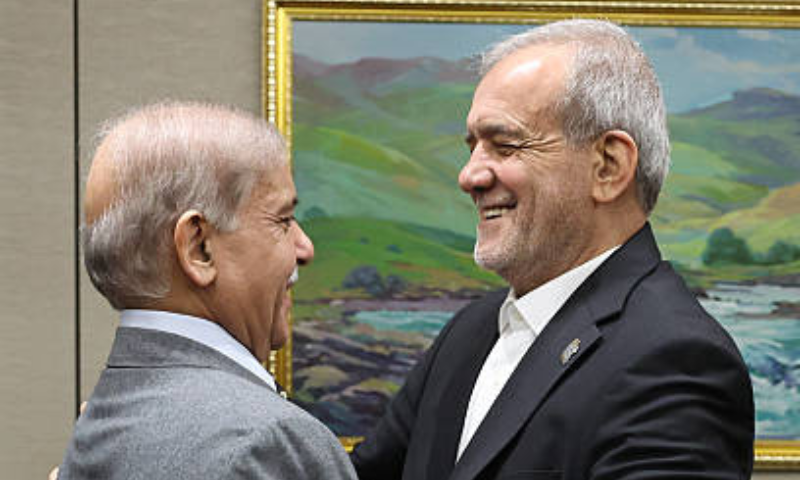
ISLAMABAD: Prime Minister Shehbaz Sharif and Iranian President Masoud Pezeshkian discussed efforts to advance peace between the United States and Iran, as Pakistan stepped up diplomacy ahead of a new round of talks expected in Islamabad this week.
The “warm and cordial” conversation lasted around 45 minutes and focused on recent developments following talks between the United States and Iran facilitated by Pakistan, the Prime Minister’s Office said.
According to the Prime Minister’s Office, Prime Minister Sharif thanked the Iranian leadership for sending a high-level delegation to Islamabad earlier this month.
The delegation was led by Iran’s Parliament Speaker Mohammad Bagher Ghalibaf and Foreign Minister Abbas Araghchi for talks with the US held on April 11–12.
Prime Minister Sharif also briefed President Pezeshkian on his recent engagements with leaders from Saudi Arabia, Qatar and Turkiye, stating that these interactions had helped build consensus in support of dialogue and diplomacy.
PM Sharif said Pakistan remained committed to facilitating a sustained process aimed at achieving lasting peace in the war-ravaged region.
The prime minister also appreciated Iran’s engagement with Pakistan’s Chief of Defence Forces, Field Marshal Syed Asim Munir, during his recent visit to Tehran.
PM Sharif reiterated that Pakistan would continue to act as an “honest broker” in efforts to de-escalate tensions, with the support of international partners.
He also conveyed his regards to Iran’s Supreme Leader Ayatollah Mojtaba Khamenei.
Islamabad: 19 April 2026.
Prime Minister Shehbaz Sharif Holds Telephone Conversation with President of the Islamic Republic of Iran.
Prime Minister Muhammad Shehbaz Sharif held a telephone call with His Excellency Dr. Masoud Pezeshkian, President of the Islamic Republic of… pic.twitter.com/QeoLwXEFlC— Prime Minister's Office (@PakPMO) April 19, 2026
Iran appreciates Pakistan’s mediation role
During the telephone conversation, President Pezeshkian thanked Prime Minister Sharif and Field Marshal Munir for Pakistan’s strong commitment to the success of the peace efforts.
President Pezeshkian affirmed that relations between Iran and Pakistan would continue to grow stronger in the days ahead.
US delegation set for Islamabad Talks
US Vice President JD Vance will lead the US delegation for talks with Iran in Pakistan, a White House official said Sunday.
Vance, special envoy Steve Witkoff and Trump’s son-in-law Jared Kushner will attend the talks, a White House official told AFP on condition of anonymity when asked about the makeup of the delegation after Trump’s comments.
CNN also cited a White House official as saying that Vance is travelling to Pakistan for talks, along with Witkoff and Kushner.
A delegation from Tehran will arrive in Pakistan on Tuesday and work toward announcing a ceasefire extension with the US the following day, CNN reported, citing Iranian sources.
The sources expect the team will be the same as in the last round, which included Foreign Minister Abbas Araghchi and parliament speaker Mohammad Bagher Ghalibaf, according to CNN.
Early in the day, Trump announced he was sending negotiators to Islamabad for meetings with Tehran about ending the conflict.
Trump said on his Truth Social platform that he was offering Iran “a reasonable deal”.
US-Iran talks progressing positively
Meanwhile, Pakistani government sources said that the talks between the US and Iran were progressing positively, with both sides demonstrating a clear intent to reach a negotiated settlement.
However, the sources cautioned that key contentious issues remain unresolved and would require further deliberation in the upcoming round of talks in Islamabad.
The sources reiterated that Pakistan was continuing to act as an “honest broker and trusted mediator”, facilitating dialogue between Washington and Tehran to end the conflict.
Officials noted that much of the tough rhetoric seen in public discourse was aimed at domestic audiences, although some differences remain.
They also pointed to attempts by “spoilers”, particularly Israel and India, to shape negative perceptions around the talks and undermine progress.
According to the sources, the second round of talks in Islamabad is expected to move the process closer to a formal agreement.
Trump leaves door open to Islamabad visit
Earlier, President Trump, in a phone interview with the New York Post on Sunday, left the door open to coming to Islamabad if an agreement is reached.
When told that officials from Qatar were spotted in Islamabad hoping to receive him should he come to Pakistan’s capital city, Trump didn’t sound surprised — and left the door open to coming to Islamabad if an agreement is reached, the New York Post reported.
“I would say maybe at a little bit later date. We have to see how it works out tomorrow,” he said.
Pressed on whether he could show up in Pakistan, Trump made clear he’s not getting ahead of the process — reiterating that he would “probably come at a later date.”
US reviewing US proposals for deal
Earlier, Iran’s state media reported that Tehran is reviewing fresh proposals from the US as diplomatic engagement continues under a carefully maintained ceasefire.
According to Iranian state media, the proposals were conveyed during a recent visit to Tehran by Pakistan’s Chief of Defence Forces, Field Marshal Syed Asim Munir.
The Secretariat of Iran’s Supreme National Security Council confirmed that Tehran is assessing the proposals but has yet to issue a formal response.
While diplomatic channels remain open, Iran has reimposed restrictions in the Strait of Hormuz, warning that the waterway would remain closed until the United States lifts what Tehran describes as an unlawful naval blockade on its ports.
Tehran maintains that Washington has violated the ceasefire by continuing its maritime restrictions.
Trump says ‘very good conversations’ ongoing
Meanwhile, Trump struck an optimistic tone on Saturday, telling reporters that “very good conversations” were underway with Iran.
“We’re talking to them… we’re taking a tough stand,” Trump said at the White House, suggesting that negotiations were progressing while reaffirming a firm US position.
He indicated that further updates on the talks could emerge soon but declined to take detailed questions.
Iran’s chief negotiator, Mohammad Bagher Ghalibaf, on Sunday acknowledged “measured progress” in ongoing discussions with the US.
In a televised address, Ghalibaf, who is also Iran’s Parliament Speaker, said that although dialogue had advanced, “a significant distance” still separates the two sides.
His remarks come amid continued diplomatic efforts following recent high-level talks held in Islamabad, which ended without a formal agreement but kept communication channels open.
Pakistan intensifies diplomatic efforts
Pakistan had earlier secured a 14-day ceasefire between the United States and Iran on April 8, helping stabilise a situation that had severely disrupted global energy supplies and maritime traffic.
Tehran on Friday declared the Strait of Hormuz “completely open” for commercial shipping for the first time since the war began, a move seen as a significant confidence-building measure.
The strategic waterway had been restricted by Iran following the launch of US and Israeli military operations on February 28, raising concerns over global oil flows and supply chains.
Pakistan has continued high-level engagement with regional stakeholders, including recent meetings in Tehran between Army Chief Field Marshal Asim Munir and Iran’s top leadership, aimed at sustaining dialogue and narrowing differences.
Pakistan’s role as a mediator has drawn increasing international attention, with officials and analysts noting its ability to maintain communication with both sides and facilitate talks at a time of heightened tensions.
As negotiations continue, Islamabad has positioned itself at the centre of diplomatic efforts to transform the fragile ceasefire into a lasting peace agreement, with Dar reiterating that flexibility from both sides will be key to ending the conflict permanently.
Pakistan seeks ‘permanent’ end to war
Pakistan has called for a “permanent termination” of the US-Israeli war on Iran, urging both Washington and Tehran to demonstrate flexibility as diplomatic efforts move closer to a potential agreement.
Speaking at the Antalya Diplomacy Forum in Türkiye, Foreign Minister Ishaq Dar said Islamabad’s objective goes beyond extending the current ceasefire, focusing instead on securing a durable and comprehensive end to the conflict, reports Turkish news agency Anadolu.
Pakistan wants a “permanent termination” of the US-Israeli war on Iran, Foreign Minister Ishaq Dar told Antalya Diplomacy Forum on Friday, calling on Washington and Tehran to “show flexibility.”
Pakistan has been actively mediating between the United States and Iran since the war began on February 28, hosting the highest-level talks between the two sides since they severed diplomatic ties in 1979.
Islamabad’s “objective is not ceasefire extension. Our main objective is the permanent termination of war,” Dar said, stressing the need for a formal agreement between the parties.
Providing an update on the progress of negotiations, Dar expressed confidence that a breakthrough could be within reach.
About Pakistan’s ongoing mediation, Dar said: “More than 80% of the work has been done. And a couple of things are (remaining)… both parties have to show flexibility.”