
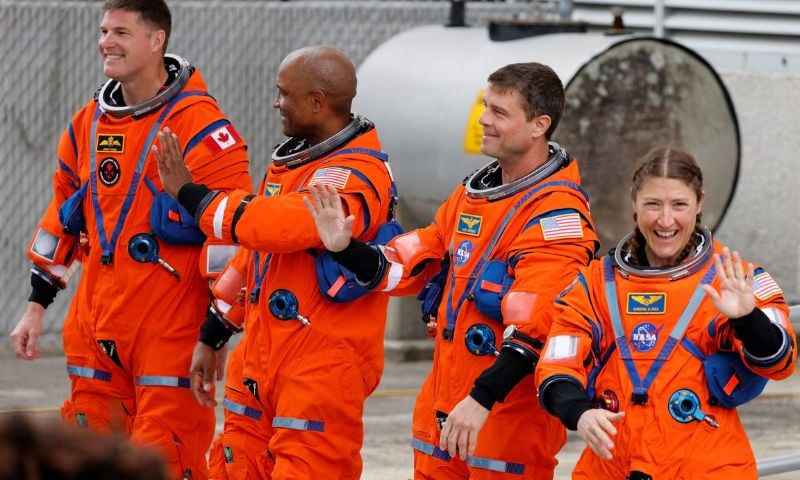



ISLAMABAD: NASA’s Artemis II astronauts have travelled farther from Earth than any humans in history, reaching a record distance of 252,756 miles during a landmark mission around the Moon. The four-member crew achieved the milestone as they conducted a rare flyby of the Moon’s far side, a region never visible from Earth.
The six-hour pass over the shadowed hemisphere allowed astronauts to observe the lunar surface in detail, including flashes caused by meteors striking the heavily cratered terrain.
Scientists at NASA’s Johnson Space Center monitored the event closely, recording the observations as the Orion spacecraft circled the Moon at a distance of about 402,000 kilometres from Earth.
The mission marks the first time astronauts have ventured into lunar orbit since the Apollo era more than 50 years ago.
Artemis II, considered a crucial step towards future Moon landings, aims to support NASA’s broader goal of establishing a sustained human presence on the lunar surface and eventually enabling missions to Mars.
Historic achievement
During the journey, the crew — Reid Wiseman, Victor Glover, Christina Koch and Canadian astronaut Jeremy Hansen — also identified and suggested names for previously unnamed lunar features. One crater was proposed to honour Wiseman’s late wife, while another was linked to the Orion capsule’s name, Integrity.
The astronauts experienced a temporary communications blackout lasting around 40 minutes as they passed behind the Moon, losing contact with Earth before re-emerging with striking images of Earth rising over the lunar horizon.
US President Donald Trump congratulated the crew, calling the mission a historic achievement that has captured global attention and inspired audiences worldwide.