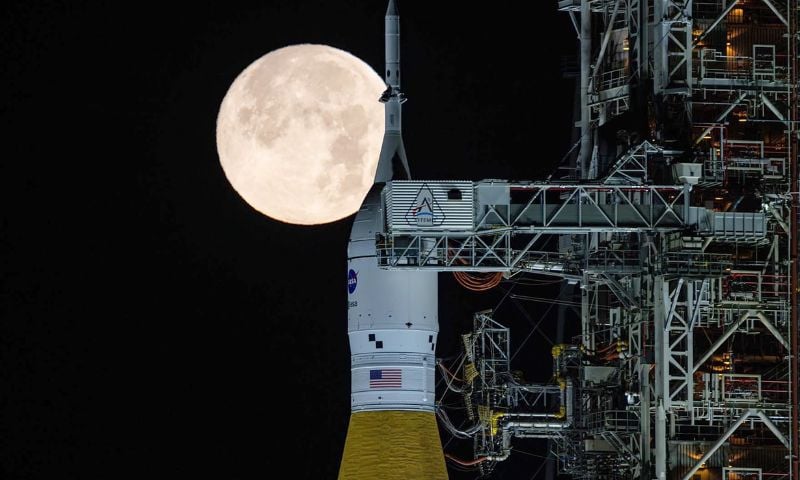



WASHINGTON: NASA is preparing to launch its first crewed mission to the Moon in more than five decades, as the Artemis II flight aims to send four astronauts on a lunar orbit in a major step toward returning humans to deep space.
The Artemis II mission, scheduled for launch as early as April 1, will send four astronauts on a journey around the Moon, marking the first crewed lunar flight since the Apollo era.
The mission will carry three American astronauts—Reid Wiseman, Victor Glover, and Christina Koch—alongside Canadian astronaut Jeremy Hansen.
The goal is not just to reach the Moon, but to stay. 🌘 https://t.co/b24OqEEQb9 pic.twitter.com/5WPHYRNmeO
— The White House (@WhiteHouse) March 24, 2026
The approximately 10-day mission will not involve a lunar landing but will instead replicate the historic 1968 Apollo 8 mission, orbiting the Moon before returning to Earth. Artemis II represents several historic milestones.
It will be the first time a woman, a person of colour, and a non-American astronaut participate in a mission to the Moon.
It will also mark the first crewed flight of NASA’s powerful new Space Launch System (SLS), a next-generation rocket designed to support sustained lunar exploration.
According to AFP, the mission is part of NASA’s broader Artemis program, which aims to establish a long-term human presence on the Moon and use it as a stepping stone for future missions to Mars.
Officials see the effort as critical not only for scientific advancement but also in the context of growing global competition, particularly with China targeting a crewed lunar landing by 2030.
Despite technological advances since the Apollo era, the mission carries inherent risks. The spacecraft has never previously carried humans on a lunar journey, and the distance—over 384,000 kilometers from Earth—poses significant challenges.
To return Americans to the Moon, NASA is shifting to an iterative, execution-focused approach – just as we did during Apollo.
We are standardizing rocket architecture, embedding NASA expertise across industry, and increasing launch cadence to support sustained lunar operations.…
— NASA Administrator Jared Isaacman (@NASAAdmin) March 24, 2026
NASA officials have emphasized rigorous safety checks and mission preparedness to minimize potential dangers. If successful, Artemis II will pave the way for future missions, including a planned crewed Moon landing later this decade.
However, the timeline remains ambitious, with key components such as the lunar lander still under development by private aerospace companies.
The Artemis program has faced delays and rising costs, but NASA hopes the mission will rekindle the sense of unity and inspiration that defined the Apollo era.
Nearly 60 years after Apollo 8 captivated the world, Artemis II aims to once again capture global imagination and reaffirm humanity’s pursuit of exploration beyond Earth.