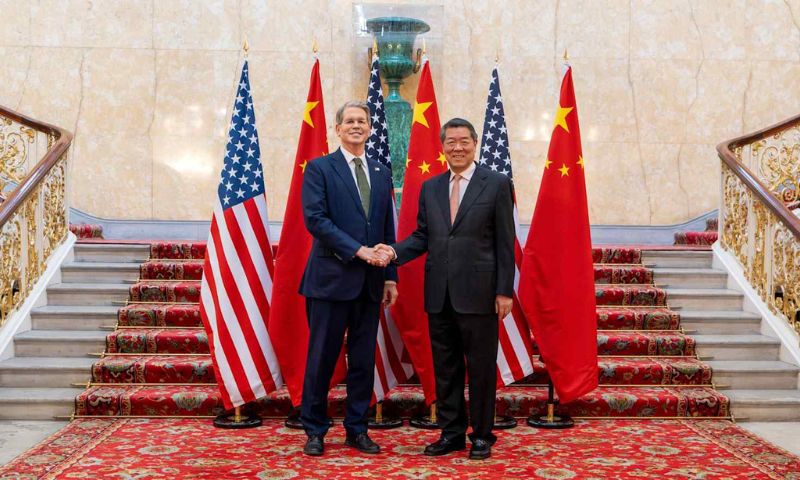
PARIS: Senior economic officials from the United States and China are set to launch a new round of negotiations in Paris on Sunday, seeking to smooth trade tensions and lay the groundwork for a possible meeting between US President Donald Trump and Chinese President Xi Jinping in Beijing later this month.
The talks are being led by US Treasury Secretary Scott Bessent and Chinese Vice Premier He Lifeng, with US Trade Representative Jamieson Greer also participating. The discussions are taking place at the headquarters of the Organisation for Economic Cooperation and Development (OECD).
According to Reuters, negotiators are expected to focus on several key economic issues, including US tariffs on Chinese imports, access to Chinese rare-earth minerals and magnets, American restrictions on advanced technology exports, and China’s commitments to purchase US agricultural products.
The meeting continues a series of diplomatic efforts held in European cities last year that were designed to prevent a breakdown in trade between the world’s two largest economies.
However, analysts say expectations for a major breakthrough remain modest. Scott Kennedy, a China economic specialist at the Center for Strategic and International Studies in Washington, said the primary objective may simply be to maintain stability in bilateral relations.
“Both sides appear to be aiming for a meeting that keeps dialogue alive and prevents tensions from escalating again,” Kennedy said.
According to analysts, Trump may seek major commitments from China during a potential summit in Beijing, including new orders for Boeing aircraft and increased purchases of US liquefied natural gas and soybeans. In return, Washington could face pressure to ease some of its export restrictions on advanced technologies.
Despite the diplomatic push, experts believe any progress from the upcoming summit could be largely symbolic, leaving most trade issues unresolved in the short term.
Trump and Xi are also expected to have additional opportunities to meet later this year, including during the Asia-Pacific Economic Cooperation (APEC) summit hosted by China in November and the G20 summit scheduled to be held in the United States in December.
Impact of Iran conflict on talks
Geopolitical tensions are also likely to feature in the Paris discussions. The ongoing US-Israeli conflict with Iran and its impact on global energy markets has raised concerns, particularly after disruptions in the Strait of Hormuz — a key oil transit route that supplies about 45 percent of China’s oil imports.
In response to supply concerns, Bessent recently announced a temporary 30-day waiver allowing the sale of Russian oil currently stranded in tankers, a move intended to stabilize global energy markets.
Reviewing the 2025 trade truce
The talks will also assess progress under the October 2025 trade truce reached by Trump and Xi in Busan, South Korea. That agreement reduced US tariffs on Chinese imports and temporarily suspended China’s strict export controls on rare-earth materials for one year.
China also pledged significant purchases of US soybeans — 12 million metric tons for the 2025 marketing year and 25 million tons for the 2026 season.
US officials say Beijing has largely met its early commitments, particularly regarding soybean imports. However, some American industries — including aerospace and semiconductor manufacturers — are still experiencing shortages of critical rare-earth elements such as yttrium, which is used in heat-resistant coatings for jet engines.
New trade investigations add tension
Complicating the negotiations, Washington has launched new “Section 301” investigations targeting China and several other trading partners over alleged unfair trade practices and industrial overcapacity. These probes could result in additional tariffs in the coming months.
Another investigation is examining alleged forced-labour practices in dozens of countries, including China, which could lead to import restrictions.
Beijing has strongly criticized these measures, warning that it may respond with counteractions. Chinese state media described the investigations as unilateral steps that risk undermining negotiations.
China’s official Xinhua news agency said the talks represent both “an opportunity and a test” for bilateral economic relations, emphasizing that meaningful cooperation could help stabilize the global economy.