BEIRUT: The escalating Israeli strikes in Lebanon have triggered a major humanitarian crisis, forcing nearly 700,000 people to flee their homes across the country, according to the United Nations Children’s Fund (UNICEF). As the violence enters its second week, aid agencies warn that children are among the most vulnerable victims of the ongoing hostilities.
UNICEF Regional Director Edouard Beigbeder said the widespread displacement includes around 200,000 children, many of whom are now living in temporary shelters under harsh conditions.
“Children are being killed and injured at a horrifying rate,” Beigbeder said, adding that thousands of families have fled in fear as airstrikes and military operations intensify. “Many children are sleeping in overcrowded shelters, exposed to cold weather and uncertainty.”
Lebanon, a country with a population of about six million, is struggling to accommodate the sudden surge in displaced families. Authorities have converted Beirut’s largest sports venue, the Camille Chamoun Stadium, into an emergency shelter to house people forced from their homes.
According to officials, Beirut alone has registered more than 517,000 displaced individuals. On Monday, families gathered at the stadium to search through donated clothing and essential supplies as humanitarian organizations worked to meet urgent needs.
According to media reports, the latest escalation followed retaliatory attacks by Hezbollah, which said its operations were in response to the assassination of Iran’s Supreme Leader. Israel subsequently launched a series of air and ground operations targeting Hezbollah positions.
Lebanese authorities report that at least 486 people have been killed, with 1313 people injured, children and women, since the conflict intensified.
The Israeli military has issued evacuation orders for residents in Beirut’s southern suburbs, southern Lebanon, and the eastern Bekaa Valley, areas believed to host Hezbollah infrastructure.
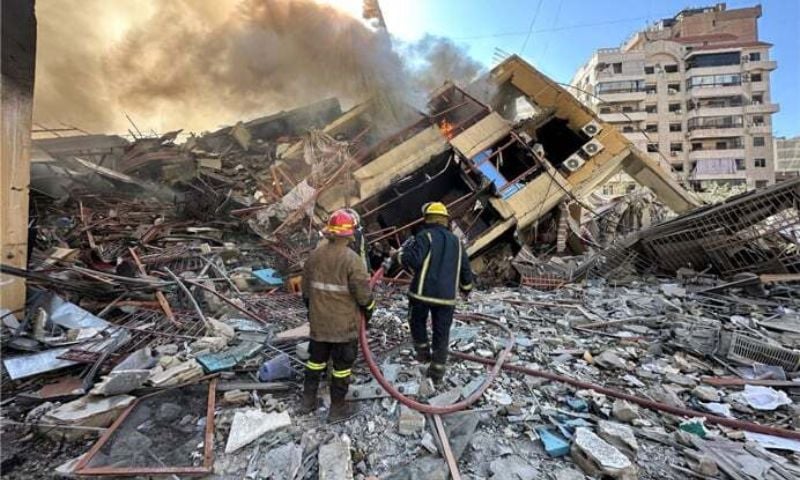
On Monday, Israeli airstrikes targeted several branches of Al-Qard Al-Hassan, a financial institution affiliated with Hezbollah, sending thick smoke over Beirut’s southern suburbs. At least one person was killed in the strikes.
Israel also announced a “targeted and limited raid” in southern Lebanon aimed at locating Hezbollah fighters and destroying militant infrastructure. Additional Israeli troops have been deployed to establish defensive positions near the border.
Meanwhile, Hezbollah said it carried out attacks against Israeli forces and launched rockets toward the northern Israeli town of Kiryat Shmona. The Israeli military confirmed that two soldiers were killed in southern Lebanon on Sunday.
Civilian casualties have continued to mount. In southern Lebanon, an Israeli tank strike reportedly killed Father Pierre al-Rai, a parish priest. Separate strikes on the Islamic Health Committee resulted in the deaths of two paramedics.
Amid the growing instability, Lebanon’s political leadership has taken extraordinary measures. The country’s parliament convened on Monday and voted to postpone legislative elections by two years, citing the ongoing conflict.
“Parliament approved the extension of its term for two years,” Speaker Nabih Berri said in an official statement. Lebanese President Joseph Aoun has blamed Hezbollah for pushing the country toward state collapse.
In an effort to end the conflict, he proposed a comprehensive ceasefire, logistical steps toward disarming Hezbollah, and direct negotiations with Israel under international supervision.
However, Hezbollah leaders have signaled that the group will continue its campaign. Senior official Mohammed Raad stated that the organization would defend its existence “no matter the price.”
As fighting continues, humanitarian agencies warn that the situation could worsen dramatically if hostilities expand further, leaving hundreds of thousands more at risk.