Key Points
• Modi’s Israel visit came days before US-Israel strikes on Iran
• Commentary warns India’s alignment could strain ties with Tehran and Gulf states
• Risks highlighted for millions of Indian workers in the Middle East
• Remittances and key connectivity projects seen as potentially exposed
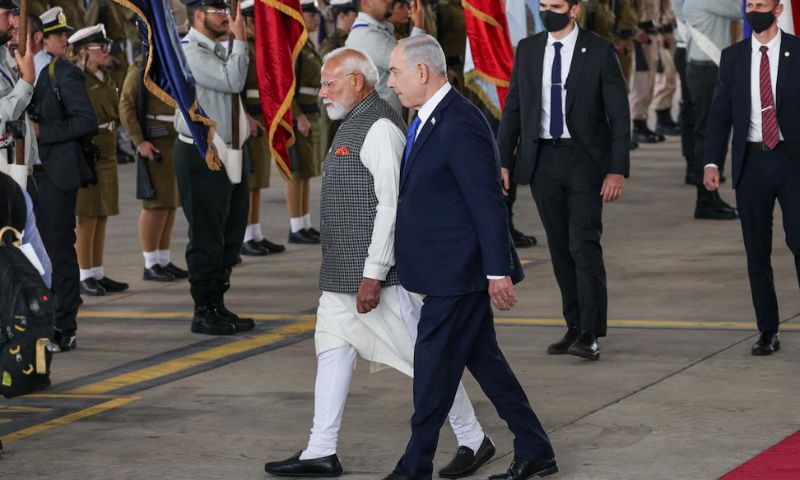
ISLAMABAD: Indian Prime Minister Narendra Modi is facing criticism at home and abroad over his recent visit to Israel, with a US policy publication warning that New Delhi’s visible tilt toward Tel Aviv could endanger its diaspora, ties with Iran and Gulf countries, and expose key economic interests in West Asia.
A commentary published by the Washington-based DC Journal said the timing and symbolism of Modi’s Israel visit, days before joint United States-Israeli strikes on Iran, could undermine India’s long-standing effort to balance relations across rival powers in the region.
“India’s full embrace of Israel under Prime Minister Benjamin Netanyahu went far beyond diplomatic courtesy. This is alignment. It is choosing sides,” the publication said.
During the visit, Modi attended official ceremonies and addressed the Israeli parliament, the Knesset, alongside Israeli Prime Minister Benjamin Netanyahu, highlighting solidarity with Israel and expanding defence cooperation.
Shortly after the strikes on Iran, Modi said he had spoken with Netanyahu by phone but did not publicly mention outreach to Iranian leaders, reinforcing perceptions that New Delhi is leaning more openly toward Israel.
Analysts say such a shift could complicate India’s ties with Iran, which for years has been a strategic partner for regional connectivity and energy cooperation.
A central pillar of that partnership is the development of Chabahar Port in southeastern Iran, a project designed to give India access to Afghanistan and Central Asia while bypassing Pakistan.
The port operates under a United States sanctions waiver that currently runs until April 2026. Analysts warn that if geopolitical pressure intensifies, India could face financial losses and strategic setbacks after investing more than $120 million in the project.
Beyond diplomatic ties, observers say the most immediate vulnerability lies in India’s vast diaspora across the Gulf region.
Millions of Indian workers live in countries such as the United Arab Emirates and Saudi Arabia, forming one of the world’s largest expatriate communities and a crucial pillar of India’s economy as they send back billions in remittances.
According to World Bank estimates, India received about $129 billion in remittances in 2024, the highest total globally, with a significant portion originating from Gulf economies.
The commentary warned that geopolitical perceptions can translate into social and economic risks for expatriate communities even without official government action. It also mentioned the imminent pressure from the US on India over Chabahar and the procurement of Russian oil.
It noted that public anger in the region over conflicts involving Israel and Iran could make Indian workers more vulnerable to social backlash, workplace discrimination or stricter visa scrutiny.
Analysts say India has long been viewed in the Middle East as a pragmatic economic partner rather than a political actor in regional rivalries.
However, a stronger association with Israel’s security framework could complicate that image, particularly during periods of escalating war with Iran.
Indian officials have consistently described ties with Israel as centred on defence technology, innovation and counterterrorism cooperation. New Delhi also continues to emphasise its support for stability and dialogue across West Asia.
Nevertheless, the debate triggered by Modi’s visit reflects growing questions among the political opposition and analysts alike about whether India’s evolving strategic posture in the region could carry broader diplomatic and economic costs.