ISLAMABAD: The war triggered by the joint United States and Israeli offensive on Iran entered its fifth day with fighting intensifying across several fronts, including Iran, Lebanon, and the Gulf region, while global markets and shipping routes faced mounting disruption.
Here are the key developments from day five of the conflict.
Naval clash leaves sailors missing
A submarine attack on the Iranian frigate IRIS Dena near Sri Lanka left at least 101 crew members missing and 78 wounded in one of the most serious naval incidents since the conflict began.
Sri Lankan forces rescued about 30 sailors from the waters, while search-and-rescue operations are continuing.
The vessel sank just outside Sri Lanka’s territorial waters.
Tehran described the attack as a major escalation and vowed a response.
The strike has pushed the US-Israeli war on Iran into more dangerous waters, with more than 100 sailors missing and dozens wounded after the incident off the coast of Sri Lanka.
The escalation comes as cross-border attacks widen, global markets react nervously, and warnings grow about the risk of an expanded regional war.
Officials across the Global South have called for immediate de-escalation, raising concerns over international law, global energy supplies, and regional stability.
Markets shaken by oil supply fears
Global markets reacted sharply to the intensifying war as concerns grew over energy supply disruptions.
Oil prices surged to multi-month highs as traders factored in the risks to supply routes and possible disruptions to the Strait of Hormuz, a chokepoint through which roughly one-fifth of the world’s oil passes.
Stock markets in Asia and Europe slid as investors moved toward safer assets amid fears of rising inflation and market volatility.
Iran signals prolonged conflict
Iranian officials said the country was prepared for a prolonged war.
Mohammad Mokhber, a senior aide to the late Supreme Leader Ali Khamenei, said Iran had no intention of negotiating with the United States.
“We can continue the war for as long as we want,” Mokhber said in remarks to state television.
Iran’s judiciary chief warned that anyone cooperating with Iran’s enemies would “be dealt with decisively and severely,” after Washington and Israel urged Iranians to rise against the government.
Meanwhile, Israel’s military said it had launched a fresh wave of air strikes on Tehran, targeting dozens of locations, including security command centres.
The Israeli army also said it had shot down an Iranian fighter jet over the capital.
Following the announcement of funeral arrangements for Khamenei, Israel’s defence minister warned that any successor could become a “target for assassination”.
Global South calls for restraint
Several countries across the Global South urged restraint and diplomacy.
Chinese Foreign Minister Wang Yi told his Israeli counterpart that military operations against Iran should stop immediately, warning that the use of force would only deepen regional instability.
Pakistan’s Deputy Prime Minister and Foreign Minister Ishaq Dar said Islamabad had communicated with Iran and other regional partners while monitoring developments closely.
Russia also condemned the US-Israeli campaign, describing it as a “preplanned and unprovoked act of armed aggression” against a sovereign state.
Moscow urged an immediate halt to the fighting and warned that the conflict could trigger nuclear proliferation across the region.
Iraq’s top cleric, Ali Sistani, also denounced what he described as an “unjust war” against Iran and called on Muslims worldwide to show solidarity with the Iranian people.
Shipping disruptions widen
Major shipping companies have begun suspending operations through the Gulf.
Chinese shipping giant Cosco announced it was halting services to and from Gulf countries, including the United Arab Emirates, Bahrain, Saudi Arabia, Iraq, and Kuwait.
The Shanghai-based state company said it would suspend all new bookings through the Strait of Hormuz until further notice.
Several international shipping groups have taken similar measures as security concerns grow in the vital energy corridor.
Iran claims control of Hormuz
Iran’s Revolutionary Guards said their forces had gained “complete control” of the Strait of Hormuz.
They warned that vessels attempting to pass through the strategic waterway could be at risk from missiles or drones.
The Guards also said they had launched more than 40 missiles at US and Israeli targets in a new wave of strikes.
US President Donald Trump said earlier that the US Navy was prepared to escort oil tankers through the crucial shipping route if necessary.
Israel expands strikes in Lebanon
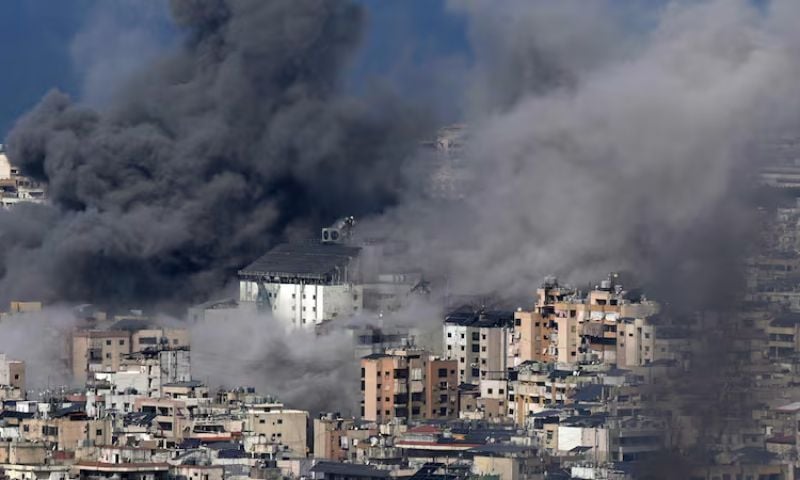
The conflict also intensified in Lebanon, where Israel expanded air strikes against Hezbollah positions.
Israeli attacks targeted areas near the presidential palace in Beirut as well as Hezbollah strongholds south of the capital.
At least 11 people were killed in the strikes, according to officials and state media.
Hezbollah said it had launched a drone attack against the headquarters of Israel Aerospace Industries in central Israel and fired a missile at a drone control base.
US evacuates staff amid regional tensions
The United States ordered non-emergency staff at its consulates in Pakistan to leave the country because of security concerns.
Washington also authorised staff departures from diplomatic missions in Saudi Arabia and Oman.
Drone attack targets Saudi oil facility
Saudi Arabia said it intercepted a drone attack aimed at its massive Ras Tanura oil refinery.
The defence ministry said the attempted strike followed an earlier attack on the complex earlier in the week.
Death Toll in Iran
Iran’s Health Ministry said the death toll from joint US and Israeli attacks on the country has risen to 926.
Health Ministry spokesperson Hossein Kermanpour said 6,186 people had been wounded in strikes.
In a statement posted on X, Kermanpour said 2,054 of the wounded were currently receiving treatment in hospitals.
Another 3,545 people had been treated and discharged, while 552 received medical care at the scene of the attacks.
He added that doctors had performed 502 surgical operations on the wounded so far.
Number of US Troops and Jets
The head of US Central Command said that more than 50,000 troops, 200 fighter jets, and two aircraft carriers are taking part in joint US-Israeli attacks on Iran.
General Brad Cooper said in a video message that the operation — now in its fifth day — marks the largest US military buildup in the Middle East in a generation.
US and Israeli forces have struck nearly 2,000 targets across Iran using more than 2,000 munitions since the campaign began, Cooper said.