DUBAI: Israel said it launched a fresh wave of strikes on Iran on Sunday, hours after Iranian state media confirmed that Supreme Leader Ali Khamenei had been killed in joint US–Israeli attacks.
Iranian state television announced early Sunday that Khamenei, 86, was killed at his compound in Tehran during a US–Israeli air strike.
The judiciary’s Mizan news portal reported that armed forces chief of staff Abdolrahim Mousavi, Islamic Revolutionary Guard Corps commander Mohammad Pakpour, senior security official Ali Shamkhani and Defence Minister Aziz Nasirzadeh were also killed during a Defence Council meeting targeted on Saturday.
The semi-official Fars News Agency reported that Khamenei’s daughter, son-in-law and granddaughter were killed in the strikes.
The Iranian news agency reported that the deaths were confirmed after contact was established with informed sources within the supreme leader’s residence.
Iran declared 40 days of public mourning.
Israeli strikes, Iranian retaliation
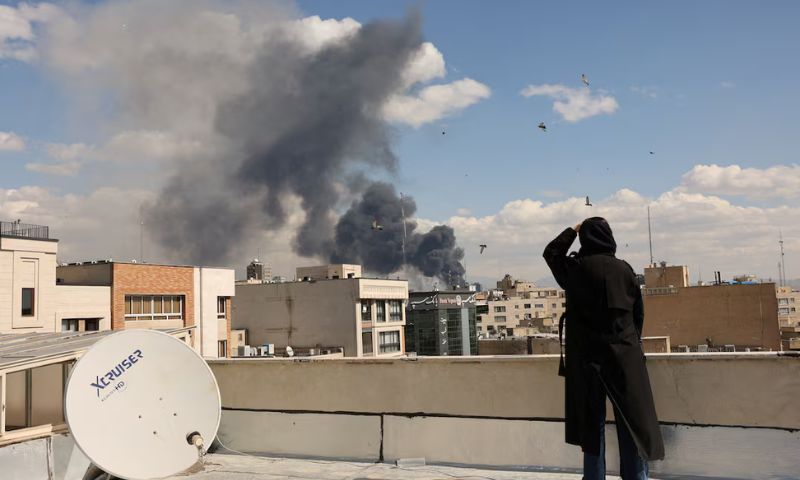
Israel’s military said its latest strikes on Sunday morning targeted Iran’s ballistic missile and air defence systems. Iranian state media reported explosions in Tehran.
On Saturday, Iran launched hundreds of missiles and drones in retaliation, targeting US troops in the region as well as cities in Israel.
Air raid sirens sounded across Israel shortly after 6:00 am (0400 GMT), and explosions were heard in Tel Aviv as air defences intercepted incoming projectiles.
In the Israeli city of Beit Shemesh, first responders said at least nine people were killed in a direct hit on a building.
The Magen David Adom emergency service said 28 others were injured. Rescue workers were removing bodies from the rubble as search operations continued, AFP reported.
Footage of Iran's retaliatory missile strike on Tel Aviv pic.twitter.com/Yaxpyp16Gk
— IRAN MILITARY ☫ (@IranMilitaryEN) February 28, 2026
Iran’s Islamic Revolutionary Guard Corps (IRGC) said US bases in the Middle East had been targeted.
It claimed 27 US installations were attacked, including areas near Erbil International Airport in Iraq. The Pentagon said there were no US deaths or injuries.
A senior US intelligence official told Reuters that the main threat was to US personnel in the region.
Flights suspended
Meanwhile, fresh explosions were reported in Dubai, Abu Dhabi, Doha and Manama on Sunday.
Dubai International Airport and the Burj Al Arab hotel sustained damage, with four people injured.
Emirates Airlines said it had suspended operations to and from Dubai until 1100 GMT on Monday. Much of the region’s airspace remained closed.
Tehran said that the Strait of Hormuz — through which about a fifth of global oil consumption passes — had been closed.
We have closed the Strait of Hormuz until further notice.
Let the Orange Pig open it if he can! pic.twitter.com/Fmr4c0l0cE
— Iran Military Monitor (@IRIran_Military) February 28, 2026
Oil prices rose to $73 per barrel, their highest level since July.
OPEC+ later announced a production increase of 206,000 barrels per day from April, citing stable market fundamentals.
Trump issues fresh warning
US President Donald Trump said the strikes aimed to prevent Iran from developing a nuclear weapon.
“We have started an extensive military operation in Iran; we will destroy the threat,” Trump said in a video statement.
He later warned on social media: “THEY BETTER NOT DO THAT … BECAUSE IF THEY DO, WE WILL HIT THEM WITH A FORCE THAT HAS NEVER BEEN SEEN BEFORE!”
International reaction
UN Secretary-General Antonio Guterres called for an immediate cessation of hostilities, saying he deeply regretted that diplomacy had been “squandered”.
Russia’s President Vladimir Putin described Khamenei’s killing as “cynical murder” in a message to Iranian President Masoud Pezeshkian.
China condemned what it called a serious violation of Iran’s sovereignty.
North Korea labelled the strikes an “illegal act of aggression”.
Lebanon’s Hezbollah movement vowed to confront the United States and Israel.
Pakistan President, PM Condole with Iran
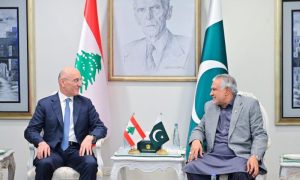
Pakistan’s President Asif Ali Zardari and Prime Minister Shehbaz Sharif on Sunday extended condolences to the government and people of Iran over the death of Khamenei.
President Zardari, in a statement, said he was profoundly grieved over the death of Ayatollah Khamenei and other members of Iran’s senior leadership who were killed alongside him.
He stated that Pakistan stands with the Iranian nation in this moment of grief and shares in their loss.
He prayed for the departed souls and asked Almighty Allah to grant patience and fortitude to the people of Iran during this difficult time.
President Asif Ali Zardari expressed deep sorrow over the martyrdom of Ayatollah Khamenei and senior Iranian leaders, conveying heartfelt condolences and prayers for patience and strength to the Government and people of Iran during this period of grief.
— The President of Pakistan (@PresOfPakistan) March 1, 2026
Meanwhile, Pakistan’s Prime Minister Shehbaz Sharif extended condolences to Iran following the death of Khamenei.
In a post on X, PM Sharif said: “The Government and the people of Pakistan join the people of Iran in their hour of grief and sorrow and extend the most sincere condolences on the martyrdom of His Eminence Ayatollah Seyyed Ali Khamenei.”
He also expressed concern over violations of international norms.
“It is an age-old convention that the Heads of State/Government should not be targeted,” PM Sharif wrote. “We pray for the departed soul. May Allah Almighty grant patience and strength to the Iranian people to bear this irreparable loss.”
The Government and the people of Pakistan join the people of Iran in their hour of grief and sorrow and extend the most sincere condolences on the martyrdom of His Eminence Ayatollah Seyyed Ali
Khamenei.Pakistan also expresses concern over violation of the norms of…
— Shehbaz Sharif (@CMShehbaz) March 1, 2026
Interim Leadership Council formed
Iran’s state media reported that a temporary Leadership Council would assume the supreme leader’s duties under Article 111 of the constitution until the Assembly of Experts elects a successor.
Ayatollah Alireza Arafi was appointed as the jurist member of the council, alongside President Masoud Pezeshkian and Chief Justice Gholamhossein Mohseni Ejei.
The IRGC confirmed the death of its commander Mohammad Pakpour and later announced Brigadier General Ahmad Vahidi as the new commander-in-chief.
Ali Larijani, head of the Supreme National Security Council, warned against attempts to divide the country and said any secessionist activity would face a harsh response.
Internet connectivity in Iran dropped to around 1% of normal levels, according to Netblocks, limiting access to information during the crisis.