WASHINGTON: The United States on Wednesday imposed fresh sanctions on Iran, stepping up what it calls a “maximum pressure” campaign just a day before American and Iranian officials are due to meet in Geneva for a new round of nuclear talks.
The US Treasury Department said the measures target more than 30 individuals, entities and vessels accused of enabling “illicit Iranian petroleum sales” and supporting Tehran’s weapons production.
In a statement, the department said vessels operating as part of Iran’s “shadow fleet” — used to transport petroleum and petroleum products to foreign markets — were being sanctioned to curb revenue flows to the Iranian government.
“Iran exploits financial systems to sell illicit oil, launder the proceeds, procure components for its nuclear and conventional weapons programmes,” US Treasury Secretary Scott Bessent said.
He added that the administration of President Donald Trump would continue to pursue “maximum pressure on Iran to target Tehran’s weapons capabilities”.
US military build-up and threats
The sanctions come as Washington reinforces its military presence in the Middle East and warns of possible strikes if negotiations fail.
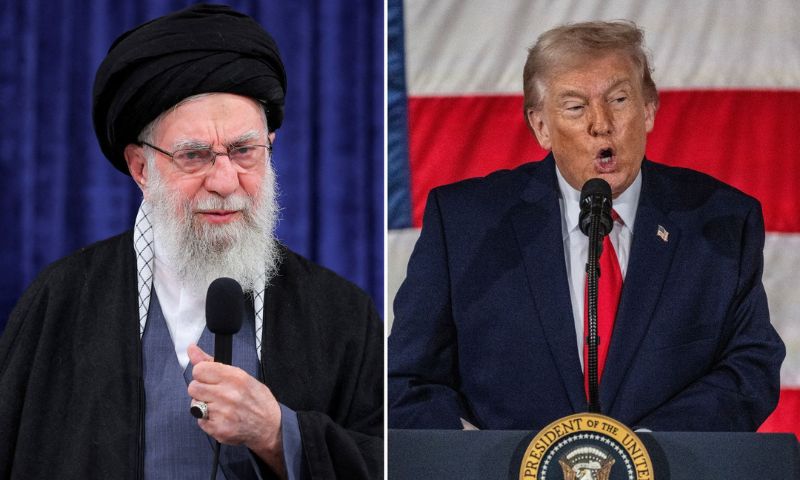
In his State of the Union address on Tuesday, Trump accused Tehran of harbouring “sinister nuclear ambitions” and claimed Iran was developing missiles that could eventually strike the United States.
“They’ve already developed missiles that can threaten Europe and our bases overseas, and they’re working to build missiles that will soon reach the United States of America,” he said.
Trump said on February 19 that he was giving Tehran 10 to 15 days to reach a deal on its nuclear programme.
The United States has deployed two aircraft carriers, more than a dozen other ships and additional warplanes to the region in recent weeks.
Iran optimistic before talks
Despite the sanctions and military build-up, Iran signalled optimism ahead of Thursday’s meeting in Geneva.
President Masoud Pezeshkian said Tehran saw the chance of a positive outcome from the third round of talks with Washington.
“In relation to the talks, we see a good outlook,” Pezeshkian said in remarks carried by state media.
He added that Iran was seeking, “with the guidance of the supreme leader”, to move beyond what he described as a “no war, no peace situation”.
Foreign Minister Abbas Araqchi is leading the Iranian delegation.
He said on Tuesday that a deal with the United States was “within reach, but only if diplomacy is given priority”.
A senior US official said earlier this week that envoy Steve Witkoff and Trump’s son-in-law Jared Kushner would meet the Iranian delegation in Geneva.
The talks follow two earlier rounds aimed at resolving the long-running dispute over Iran’s nuclear programme.
Trump withdrew from a 2015 nuclear accord during his first term and has pushed for a new agreement.
Washington has repeatedly demanded that Iran halt uranium enrichment entirely.
Tehran rejects that condition, insisting its programme is purely for civilian purposes.
Iran dismisses Trump’s allegations
Iran’s foreign ministry dismissed Trump’s missile claims.
Spokesman Esmaeil Baqaei described US allegations about Iran’s nuclear and missile activities as “big lies”.
According to the US Congressional Research Service, Iran possesses short- and medium-range ballistic missiles with ranges of up to about 3,000 kilometres.
The continental United States lies more than 6,000 miles from Iran.
A 2025 assessment by the US Defense Intelligence Agency said Iran could potentially develop a militarily viable intercontinental ballistic missile by 2035 if it chose to pursue that capability, but did not conclude that such a decision had been made.
Deputy Foreign Minister Majid Takht-Ravanchi warned that any war with Iran would be “a real gamble” and would not be containable.
Speaking to NPR, he said there was no military solution to the nuclear dispute and urged Washington to prioritise diplomacy.
However, he cautioned that Iran would strike US assets in the region if attacked.