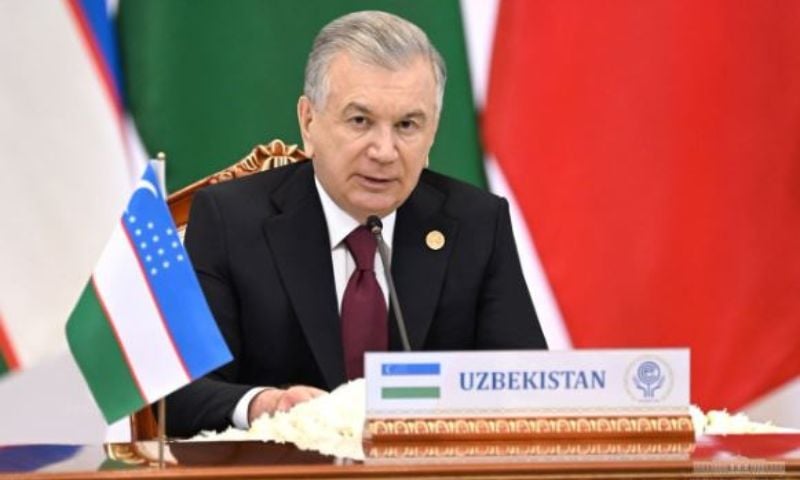



ISLAMABAD: Uzbekistan’s President Shavkat Mirziyoyev will visit Pakistan from February 5–6, aiming to strengthen trade, economic cooperation, and regional connectivity.
The Uzbek leader is visiting Pakistan at the invitation of Prime Minister Shehbaz Sharif, according to a statement issued by the Foreign Office on Wednesday.
A high-level delegation, comprising senior Cabinet Ministers and business leaders, will be accompanying the Uzbek president.
“During his stay, the Uzbek President would meet the President, hold delegation-level talks with the Prime Minister, and address the Pakistan-Uzbekistan Business Forum,” it said.
🔊PR No.3️⃣4️⃣/2️⃣0️⃣2️⃣6️⃣
Curtain Raiser: Visit of the President of the Republic of Uzbekistan to Pakistan https://t.co/S1g2Llr1m2
🔗⬇️ pic.twitter.com/X2p3Xi3669— Ministry of Foreign Affairs – Pakistan (@ForeignOfficePk) February 4, 2026
Discussions will focus on reviewing the full spectrum of bilateral relations and exploring new opportunities to strengthen cooperation across key sectors, including trade, energy, defence, education, people-to-people exchanges, and regional connectivity.
This is the second visit of Shavkat Mirziyoyev to Pakistan, underscoring the growing momentum in Pakistan-Uzbekistan relations and the deep-rooted brotherly ties between the two nations, founded on a shared history, faith, and mutual aspirations for peace and prosperity in Central and South Asia.
Over the years, the relationship between Pakistan and Uzbekistan has strengthened due to high-level interactions, increased economic partnership, and collaboration in regional and international forums.
The two countries held the 10th Session of the Pakistan-Uzbekistan Intergovernmental Commission on Trade, Economic, and Scientific-Technical Cooperation held in Islamabad on Monday.
During the meeting, they agreed to strengthen their economic partnership by expanding cooperation in trade, investment, and connectivity, reflecting a shared commitment to deeper bilateral engagement.
The parties expressed their resolve to expedite relevant institutional mechanisms to achieve the mutually agreed target of $ 2 billion in bilateral trade.