Special Correspondent
- Finance Minister warns climate shocks are accelerating and costly for Pakistan
• Calls for faster global climate financing and stronger multilateral support
• Says Reko Diq, AI systems and World Bank partnership are shaping Pakistan’s resilience
• Highlights “and-and” approach to China, US, GCC for diversified investment
• Stresses that Pakistan’s adaptation needs far exceed domestic fiscal capacity
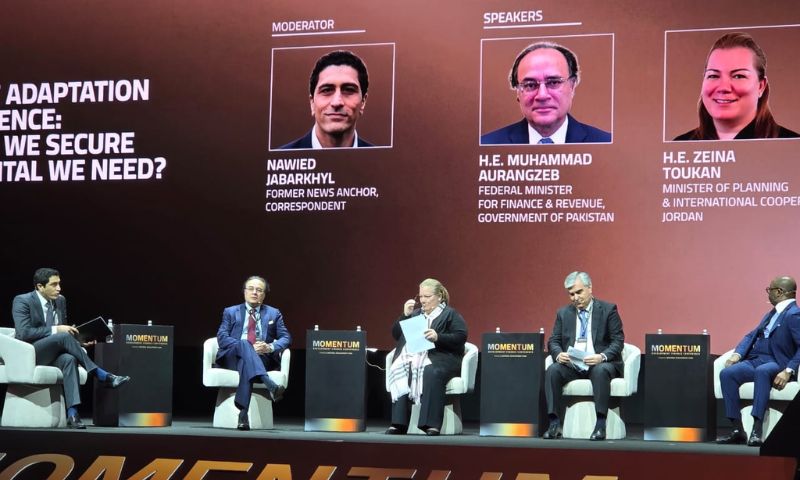
RIYADH: Pakistan’s government has urged global financial institutions to put climate resilience at the core of development planning as Finance Minister Muhammad Aurangzeb outlined the country’s widening vulnerability at a high-level panel in Riyadh on Thursday.
Addressing the Global Development Finance Conference – Momentum 2025, the Minister said Pakistan is facing a rapidly intensifying climate burden that demands urgent, predictable and scaled-up financing. He recalled that the 2022 floods caused an estimated $30 billion in losses and noted renewed flooding this year that is expected to shave roughly half a percentage point off Pakistan’s GDP growth.
He said Pakistan’s efforts to stabilise the macroeconomy have enabled short-term buffers for rescue and relief operations, yet reconstruction needs remain far beyond domestic resources. He pointed to the government’s new AI-enabled early warning system at the National Emergency Centre, which provides monthly climate forecasts to support better preparedness, yet stressed that adaptation financing remains the decisive challenge.
Aurangzeb identified the government’s ten-year Country Partnership Framework with the World Bank Group as a critical pillar, with nearly twenty billion dollars allocated, one-third reserved for climate resilience and decarbonisation. He said Pakistan must urgently prepare high-quality, bankable projects to unlock these funds.
The Minister voiced concern that global climate financing mechanisms continue to move slowly, noting the Green Climate Fund and Loss and Damage Fund have long accreditation timelines that make access difficult for climate-vulnerable countries. In contrast, Pakistan has begun securing multilateral support, including the first two hundred million dollars under the IMF’s new Climate Resilience and Sustainability Facility.
Responding to questions on investment and climate-aligned growth, Aurangzeb said finance ministries must lead the process of aligning national budgets with climate priorities to ensure coherent action across governments.
He noted that the International Finance Corporation is leading syndication for the project, with the US EXIM Bank participating, marking a key milestone ahead of commercial operation in 2028. Reko Diq is projected to generate export receipts equivalent to ten percent of Pakistan’s current exports in its first full operational year.
Aurangzeb said Pakistan’s investment outlook is attracting interest from US, Chinese and GCC investors, supported by the government’s efforts to maintain balanced ties across major powers. He said Pakistan’s longstanding partnership with China through CPEC is now entering Phase 2.0, designed to shift from government-led infrastructure to business-to-business ventures.
The session closed with panelists stressing that regional cooperation, financing innovation and long-term partnerships will determine how emerging economies navigate rising climate threats and sustain growth.