
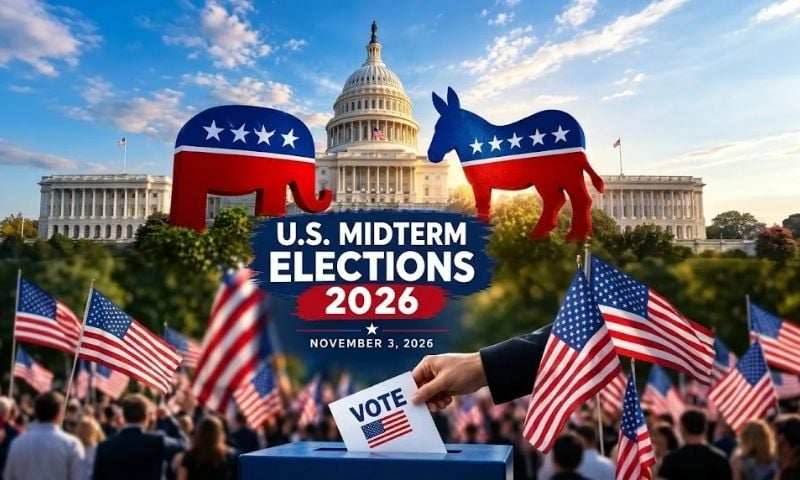
WASHINGTON: US President Donald Trump faces a crucial political test as Americans prepare to vote in the November 3 midterm elections, with rising living costs, healthcare concerns, immigration disputes and his declining approval ratings threatening Republican control of Congress.
The elections will determine whether Trump’s Republican Party retains its narrow majorities in the House of Representatives and Senate or whether the opposition Democratic Party gains the power to challenge his administration’s policies, investigate its decisions and block parts of its legislative agenda.
The contest is also a referendum on the president’s leadership halfway through his four-year term. Although Trump is not seeking election in the midterms, he has made himself a central figure in the campaign, urging voters to support Republican candidates and warning that a Democratic victory would undermine his administration’s programme.
According to a Reuters report published in October, Trump’s approval rating had fallen to 31 per cent in a Reuters/Ipsos poll, while affordability had emerged as a leading concern among voters. These factors have intensified Republican worries about losing seats in competitive districts and states.
Read Also: How US Midterm Elections Work and Why They Matter
What is at stake?
The November 3 elections will decide control of the two chambers of the US Congress, which shares legislative authority with the president and plays a central role in federal spending, taxation, oversight and national policy.
The principal contests are:
US House of Representatives: All 435 voting seats are up for election.
US Senate: Thirty-five seats are being contested, including 33 regularly scheduled elections and two special elections.
Governorships: Thirty-nine gubernatorial elections are scheduled, according to the European Parliament’s research briefing.
State and local contests: Voters will also decide numerous state legislative races, ballot initiatives and local offices.
Republicans enter the election with a 219–214 advantage in the House, alongside two vacancies, according to the European Parliament’s October briefing. In the Senate, Republicans hold a 53–47 majority, with the Democratic caucus including two independents.
It shows the latest polls the day before the election in the United States One is what the polls point to – another is what reality is.
The agent before the midterm elections in the United States, many polls point the same way – and even more and more clearly towards a victory for Democrats.
In the midterm elections, Americans must elect new members to the two chambers of Congress – the House of Representatives and the Senate, respectively. Today, Republicans are in power in both chambers.
Across polls, Democrats have long seemed to be winning a comfortable majority in the House of Representatives. In turn, there appears to be far more tension in control of the Senate.
— benny 🇩🇰 🇫🇴 🇬🇱 🇪🇺 🇺🇦 (@benny0692698414) November 2, 2026
Democrats need a net gain of four seats in either chamber to establish a majority under the current political alignment. Winning control of even one chamber would significantly increase their ability to scrutinise Trump’s administration and influence legislation.
How many voters and states are involved?
The elections cover all 50 US states and the District of Columbia for the relevant federal and local contests, although not every state will hold every type of election.
The United States does not have one single, uniform national registered-voter figure that can be treated as the definitive number for every election. Registration systems and eligibility rules are administered at state level, and the number of people eligible to vote differs from the number registered.
More than 51 million people had already voted before Election Day, according to a Reuters report published on October 31, setting a record for that point in the midterm election cycle. Early voting has become an increasingly important feature of American elections, allowing millions of people to cast ballots before November 3.
The election map is particularly important because congressional districts vary significantly in population, political affiliation and competitiveness. While many districts are considered relatively safe for one party, a limited number of closely contested races could determine control of the House.
On the eve of the election, Democrats appear within striking distance of winning the Senate majority, but many seats in play are in toss-up territory in deep-red states that could still break in either party’s direction. https://t.co/vPuWSX9Zil https://t.co/YdIkDWQlca
— CNN (@CNN) November 2, 2026
Trump’s biggest political challenges
Cost of living and economic frustration
Affordability is one of the most significant challenges facing Republicans. Voters are concerned about the prices of groceries, fuel, housing and healthcare, as well as the pressure on household budgets.
Trump campaigned on promises to improve the economy and reduce financial pressures on American families. Democrats are seeking to turn dissatisfaction over everyday expenses into votes against Republican candidates.
The dispute is particularly important because voters may judge the administration not only on headline economic indicators but also on whether their wages cover ordinary household expenses.
Healthcare and federal spending
Healthcare has become another major battleground.
Republicans point to tax-cut legislation as a central achievement of their governing agenda. Democrats, however, have criticised spending reductions affecting Medicaid and other health programmes, arguing that these policies could place additional pressure on lower-income households.
The healthcare debate could influence voters who depend on public assistance, affordable insurance and access to medical services. It also presents Republicans with a difficult political challenge: defending their fiscal priorities while responding to concerns about the affordability of treatment and insurance.
Immigration and border enforcement
Immigration remains a defining issue in Trump’s political identity.
Republicans are campaigning on border security, stricter enforcement and efforts to reduce unauthorised immigration. The administration’s supporters argue that stronger controls are necessary to enforce immigration laws and protect national security.
Democrats have criticised aspects of the administration’s enforcement policies and raised concerns about their humanitarian consequences, the treatment of migrants and the use of federal enforcement powers.
Although border apprehensions have fallen sharply under Trump, disputes over enforcement practices and the powers of federal agencies continue to fuel political divisions.
Trump’s personal popularity
Trump’s decision to place himself at the centre of the campaign is a double-edged strategy.
His rallies and endorsements can energise Republican supporters, encourage turnout and help candidates attract national attention. However, his low approval rating may also mobilise Democratic voters and independents who oppose his leadership.
The central question is whether Trump’s loyal electoral base will be large enough to overcome dissatisfaction among voters concerned about the economy, immigration and the administration’s wider policies.
Political polarisation and election disputes
The election is unfolding amid disputes over voting procedures, voter registration records, redistricting and election administration.
The mid-decade redrawing of congressional districts has altered the political landscape in several states, while litigation over election procedures has added to the uncertainty.
These disputes are particularly significant because control of Congress could turn on a small number of closely contested races. For both parties, winning individual competitive districts may prove more important than securing a decisive nationwide popular-vote advantage.
Terrible news for us on the Right. Tuesday is shaping up to be a blue tsunami. All Trump had to do was work on fixing the cost of living crisis & not start a new war — as he promised. He started a war that continues to screw up the economy for most people. Great, just great. https://t.co/Zsobp0JyF3
— Rod Dreher (@roddreher) November 2, 2026
What do Republicans promise?
The Republican Party’s campaign is closely associated with Trump’s America First agenda, which emphasises national sovereignty, border security, tax reductions and a stronger focus on domestic economic priorities.
Its principal political objectives include:
Tax policy: Defend and extend tax cuts that Republicans describe as beneficial to households and businesses.
Immigration: Strengthen border enforcement and pursue stricter immigration policies.
Public spending: Promote fiscal priorities favoured by the party while defending its approach to federal spending and taxation.
Energy: Support domestic energy production and policies intended to increase energy security.
National security: Emphasise military strength, law enforcement and a more restrictive approach to immigration-related security concerns.
Government policy: Preserve Trump’s legislative programme and prevent Democratic efforts to reverse key administration policies.
Republicans argue that maintaining congressional control would allow the president to continue implementing his agenda without facing sustained opposition from a Democratic-controlled chamber.
Their challenge is to persuade voters that the administration’s policies will deliver tangible improvements in household finances while addressing concerns about healthcare costs and other essential expenses.
Read Also: Trump Faces Midterm Test as Americans Vote on Tuesday
What do Democrats promise?
Democrats are campaigning on affordability, healthcare protection, accountability and resistance to policies they consider harmful to ordinary Americans.
Their central objectives include:
Lower living costs: Prioritise the cost of housing, food, energy and other essential goods and services.
Healthcare: Oppose cuts to public health programmes and seek to protect access to affordable medical care.
Government accountability: Use congressional oversight powers to investigate the administration’s decisions and scrutinise executive actions.
Immigration: Challenge enforcement policies they regard as excessive or harmful while advancing their own approach to border management.
Economic fairness: Emphasise the financial pressures facing working families and argue for policies that distribute economic benefits more broadly.
Democratic institutions: Scrutinise the administration’s use of executive authority and defend voting rights and electoral processes.
Democrats see the midterms as an opportunity to regain institutional power even without winning the presidency. A House majority would give them control of committees and greater authority to investigate federal agencies, question administration officials and influence legislation.
Their immediate objective is to turn voter dissatisfaction into victories in enough competitive districts and states to break Republican control of Congress.
Major candidates and battleground races
Unlike a presidential election, the midterms do not feature one national contest between two candidates. Instead, voters choose representatives, senators, governors and other officials in separate state and district races.
Several contests have emerged as important tests of the parties’ national strategies.
Georgia: Jon Ossoff versus Mike Collins
Democratic Senator Jon Ossoff is defending his seat against Republican Representative Mike Collins.
The race is significant because Georgia has become a major battleground in national politics. A Republican victory would help the party defend its Senate majority, while an Ossoff victory would protect an important Democratic position.
Texas: James Talarico versus Ken Paxton
Democrat James Talarico is challenging Republican Ken Paxton in a closely watched Senate contest in Texas.
The race has attracted attention because a Democratic victory in the traditionally Republican-leaning state could dramatically improve the party’s prospects of gaining Senate control.
A University of Houston survey conducted in October placed Talarico at 48 per cent and Paxton at 46 per cent among likely voters, illustrating how competitive the contest had become at the time of the poll. These figures represent a survey snapshot, not a prediction or confirmed election result.
Alaska: Mary Peltola versus Dan Sullivan
Former Democratic Representative Mary Peltola is challenging Republican Senator Dan Sullivan in Alaska.
The contest is being closely watched as Democrats seek opportunities to gain Senate seats in states where Republicans have traditionally enjoyed an advantage. The race has also attracted attention because of allegations involving candidate recruitment, which the people accused have denied.
Other competitive states
The Senate battle also includes important contests in Iowa, Maine, Michigan, New Hampshire, North Carolina and Ohio.
These states could help determine whether Democrats can overcome the Republican advantage in the Senate. The outcome will depend on individual candidates, state-level political conditions, turnout and the issues that resonate most strongly with voters.
The House contest is similarly concentrated in competitive districts across states including California, Iowa, Pennsylvania and New York. Because the majority margin is narrow, relatively small shifts in voting patterns could determine which party controls the chamber.
What happens if Democrats win?
A Democratic victory in the House would represent a major setback for Trump during the second half of his presidency.
Democrats would gain control of House committees and could intensify investigations into the administration, challenge its spending priorities and block legislation that requires congressional approval.
However, winning the House would not automatically allow Democrats to implement their entire agenda. Legislation would still have to pass the Senate where necessary, and the president would retain his veto power.
If Democrats also gained control of the Senate, the balance of power would shift further. Senate control affects committee leadership, the consideration of presidential nominations and the chamber’s legislative priorities.
Even then, the party would face constraints. Many major legislative measures require agreement between both chambers and presidential approval, while ending a Senate filibuster generally requires 60 votes. Some categories of legislation can pass through procedures that require only a simple majority.
A Democratic victory in either chamber would therefore strengthen congressional oversight but would not, by itself, remove Trump from office or end his presidency.
What happens if Republicans retain control?
A Republican victory would strengthen Trump’s position for the remainder of his term and allow his party to continue setting the congressional agenda.
It would also weaken Democratic efforts to investigate the administration through committee-led inquiries and make it easier for Republicans to advance legislation aligned with the president’s priorities.
However, retaining Congress would not automatically resolve public dissatisfaction over the economy, healthcare or immigration. Republicans would still need to demonstrate that their policies are improving voters’ lives, particularly if affordability remains a dominant concern.
The result would also shape both parties’ strategies ahead of the 2028 presidential election.
1/. In summary, three days before Election Day, Democrats are clear favorites to reclaim at least the House and have solid (but not guaranteed) chances in the Senate, in a cycle driven more by …
@usembassyve @SecRubio @POTUS @FoxNews @newyork1073 https://t.co/hA7NVxrdGF— ANTHONYNEWS 🇺🇸 (@AlfidioValera) October 31, 2026
Why the election matters to the world
Although the midterms are primarily a domestic political contest, their consequences extend well beyond the United States.
The balance of power in Congress can influence American foreign policy, defence spending, international assistance, trade legislation and the funding of federal agencies.
For countries dealing with Washington on security, economic or diplomatic matters, the election could affect the political environment in which US policies are debated and financed.
A Congress controlled by Democrats could produce more vigorous scrutiny of Trump’s foreign policy and increase pressure on the administration over its international decisions. Continued Republican control would give the president greater legislative support, although Congress would remain divided over some issues.
For international markets and governments, the outcome will offer an important indication of the limits of Trump’s domestic political authority during the final two years of his presidency.
Read Also: Trump Faces Midterm Test as Americans Vote on Tuesday
A defining test for Trump’s presidency
The November 3 midterms are more than a contest for congressional seats. They are a test of whether Trump’s political influence can overcome public frustration over household expenses, healthcare, immigration and the broader direction of the country.
Republicans are seeking to preserve the congressional majorities that have helped advance the president’s agenda. Democrats are attempting to turn opposition to his policies into control of at least one chamber.
The decisive factor may not be which party wins the most attention nationally, but which one persuades voters in a relatively small number of competitive districts and states.
For Trump, retaining Congress would provide a stronger platform for the remainder of his term. For Democrats, winning either chamber would offer a powerful means of challenging his administration.
The election’s outcome will therefore shape not only the domestic political landscape of the United States but also the legislative and diplomatic environment in which Washington engages with the rest of the world.