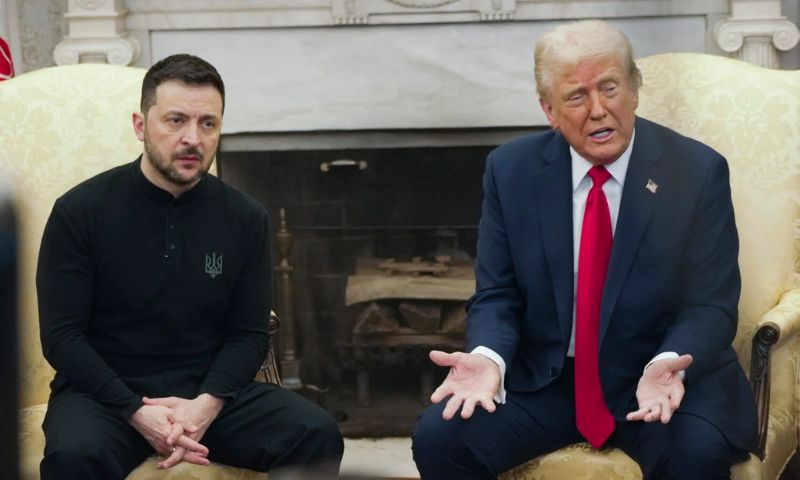



PARIS: Ukrainian President Volodymyr Zelenskyy has said that the emerging peace outline under discussion with Washington has improved, while warning that the “territorial issue is the most difficult” as Moscow continues to demand concessions in eastern Donbas — a red line for Kyiv.
Speaking in Paris alongside French President Emmanuel Macron, Zelenskyy revealed that Ukrainian and American negotiators spent more than six hours on territorial questions “only on individual points,” underscoring the depth of disagreement.
He stressed that financial recovery, reconstruction guarantees, and security assurances will require strong European involvement. “We need to be very careful here, but the plan looks better,” he added, expecting a detailed briefing from his delegation after their stop in Ireland.
Europe Seeks a Seat at the Table
European leaders — including those of France, the UK, Germany, Poland and Italy — joined the Paris discussions as Europe pushes for greater involvement in any potential settlement. Macron reiterated that no finalised peace plan exists and emphasised that issues such as frozen Russian assets, security guarantees and EU market access “must involve European nations”. He underlined that decisions on territory “can only be finalised by President Zelensky”.
Meanwhile, US and Ukrainian teams concluded two days of talks in Florida aimed at reshaping a draft widely criticised for leaning toward Moscow’s demands. The White House projected optimism, with Press Secretary Karoline Leavitt noting that Washington feels “very optimistic” about progress. Zelensky, in a post on X, described the talks as “very constructive” while acknowledging “tough issues” ahead.
US special envoy Steve Witkoff — who engaged with Zelensky, Macron, UK Prime Minister Keir Starmer and Ukrainian chief negotiator Rustem Umerov — is now travelling to Moscow to brief Russian President Vladimir Putin. He will be joined by Donald Trump’s adviser and son-in-law Jared Kushner.
Putin recently indicated that a US-drafted proposal could serve as a “basis” for a future agreement, though Moscow has rejected ceasefire overtures multiple times. “They don’t seem in a rush,” Macron noted.