KEY POINTS
- France and Saudi Arabia co-host summit in New York on Palestinian statehood.
- UK, Canada, Australia, and Portugal formally recognise Palestine; France and others may follow.
- US calls recognition “premature.”
- Germany and Italy oppose recognition, citing annexation concerns.
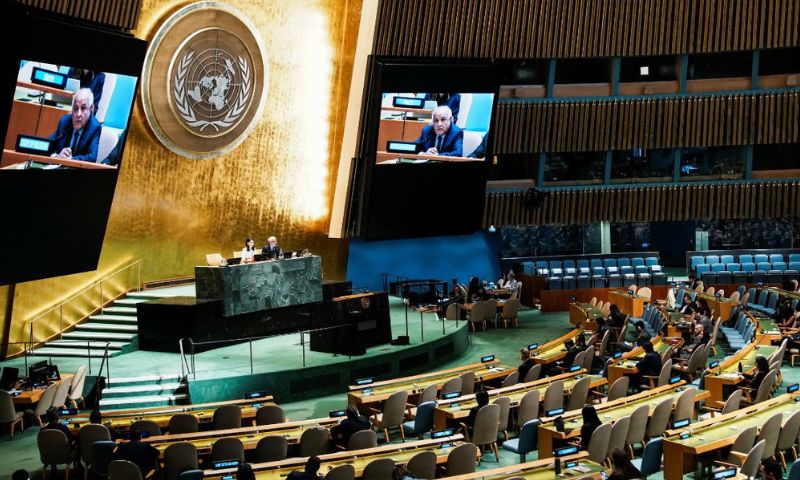
NEW YORK: France and Saudi Arabia are co-hosting a high-level summit in New York on Monday, bringing together dozens of world leaders to push for a two-state solution on the Palestinian cause.
On Sunday, the United Kingdom, Canada, Australia, and Portugal formally recognised the State of Palestine at the UN meeting, in what observers described as a historic turning point.
Britain and Canada became the first G7 members to extend recognition, with France, Belgium, Luxembourg, and Malta expected to follow during the week.
While the summit may offer a symbolic boost to Palestinian morale, it is unlikely to bring any immediate changes on the ground. Israel’s most far-right government in history has firmly rejected the idea of a Palestinian state and continues its military campaign against Hamas in Gaza.
The two-state solution, once the foundation of the US-backed peace process launched by the 1993 Oslo Accords, has faced sustained opposition from both sides and is now largely defunct. Both Israel and the United States plan to boycott the summit.
While the majority of European states now recognise a Palestinian state, both Germany and Italy have signalled they are unlikely to make such a move soon.
The German government spokesperson said on Monday, however, that there must be no further annexations in Israeli-occupied territory. Italy said recognising a Palestinian state could be “counterproductive”.
Israeli Prime Minister Benjamin Netanyahu denounced the recognition moves, vowing to fight them at the UN.
The United States also cautioned against what it called “premature recognition,” insisting Palestinian statehood should come only through direct negotiations with Israel.
Saudi Arabia’s Foreign Minister Faisal bin Farhan arrived in New York on Saturday to lead the Kingdom’s delegation at the United Nations’ 80th session of the General Assembly.
Meanwhile, Iranian Foreign Minister Abbas Araghchi arrived in New York on Monday as the head of a diplomatic delegation to attend the 80th UNGA session.
During his stay, Araghchi will join President Masoud Pezeshkian at the General Assembly, attend related UN meetings, and outline Iran’s positions on key issues on the agenda.
He is also scheduled to hold bilateral and multilateral talks with counterparts from various countries on regional, international, and bilateral matters.
The 80th UN General Assembly session opens on Tuesday, bringing together leaders and representatives from all 193 UN member states.
Syria’s President Ahmed al-Sharaa has also reached New York for the United Nations General Assembly (UNGA), becoming the first Syrian head of state to attend the annual gathering in almost six decades.
Al-Sharaa arrived in New York on Sunday, leading a large delegation of Syrian officials, in what state media described as a “landmark trip”.
Turkish President Recep Tayyip Erdogan arrived in the US. “For us, every step taken in the Middle East is vital, and of course, we need to discuss these with President (Donald) Trump,” he said.
Before heading to New York, Erdogan said he would address the assembly on Tuesday, the first day of the high-level talks.
“On the occasion of the General Assembly, I will once again emphasize our stance that reflects the conscience of humanity, solves problems, and contributes to the solution of problems…In my speech, I will bring up the humanitarian disaster and atrocities in Gaza,” he told reporters.
Pakistan’s Deputy Prime Minister Mohammad Ishaq Dar has also reached New York to attend the high-level segment of the 80th Session of the UN General Assembly. The Pakistan delegation will be led by the Prime Minister Shehbaz Sharif.