


PARIS: The world is confronting a “major energy and economic challenge” as oil prices surge amid the Middle East conflict, the head of the International Energy Agency said on Thursday.
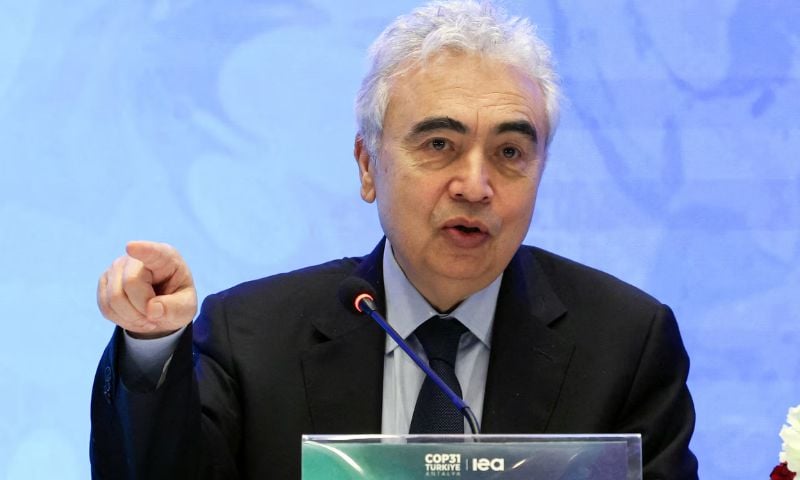
Fatih Birol, Executive Director of the IEA, said global energy markets were under severe strain as geopolitical tensions disrupt supply chains.
“The world is facing the biggest energy crisis in history,” Fatih Birol said at a high-level energy transition meeting at IEA headquarters in Paris.
He added that rising oil prices were “putting a lot of pressure on many countries”.
Birol reiterated that oil and gas markets were experiencing significant disruptions, warning that the global economy faces mounting risks as prices remain elevated.
🔴 WATCH NOW | We’re LIVE from our HQ in Paris for the 1st COP31-IEA High-Level Dialogue@fbirol is joining #COP31 President @murat_kurum, Amb Stephen Jones of 🇦🇺, which is President of Negotiations; Presidents of past COPs; & others for the discussion 👇 https://t.co/0WPYuHDYVo
— International Energy Agency (@IEA) April 30, 2026
Oil prices surge
Global oil markets have surged to multi-year highs amid concerns over prolonged supply disruptions linked to tensions involving Iran.
Brent crude futures climbed above $125 per barrel in recent trading, marking their highest level in more than four years, according to market data.
US West Texas Intermediate (WTI) also rose to around $109–110 per barrel, reflecting broad upward pressure across benchmarks.
Earlier, Brent futures for June delivery reached $117.15 per barrel, up more than 5 per cent in a single session.
The spike follows warnings from US President Donald Trump that a naval blockade of Iranian ports could last for months.
Speaking after a meeting with oil executives, Trump said such a strategy could be more effective than direct military strikes.
A White House official told AFP that discussions focused on stabilising global energy markets while maintaining pressure on Tehran with minimal domestic impact.
Strait of Hormuz disruption
The disruption at the Strait of Hormuz, a narrow waterway through which roughly one-fifth of the world’s oil supply typically passes, has intensified the crisis.
Iran has tightened control over shipping in the strait following military actions by the United States and Israel, disrupting maritime traffic for weeks.
Tehran has warned that vessels approaching the area could be targeted, while Washington has said its forces would intercept or turn back ships travelling to or from Iranian ports.
According to a report by the IEA, the conflict has significantly altered the global natural gas market outlook, with a major supply shock disrupting market fundamentals.
The United States is now pushing for a new international coalition to restore commercial shipping in the strait.
The Wall Street Journal reported that the State Department has urged governments to join a proposed “Maritime Freedom Construct” to coordinate responses and enforce sanctions.
Energy transition
At the Paris meeting, global leaders stressed the urgency of shifting towards cleaner energy systems to reduce vulnerability to fossil fuel shocks.
Murat Kurum, Türkiye’s environment minister and President-designate of the upcoming UN climate conference, called for accelerating the global transition.
“The global economy must change its energy model,” he said, adding that speeding up the transition was the most critical step.
Simon Stiell described it as an “immense irony” that efforts to sustain fossil fuel dependence were inadvertently accelerating the expansion of renewable energy worldwide.
Economic and humanitarian risks
The crisis has triggered sharp economic repercussions globally.
The United Nations Development Programme warned that rising energy and fertiliser costs could push more than 30 million people into poverty across 160 countries.
“It’s development in reverse,” UNDP chief Alexander De Croo said.
Within Iran, the national currency has fallen to record lows against the US dollar, compounding domestic economic pressures.