


Pakistan was once called “The breadbasket of Asia”. Today, it imports the wheat it once exported, its rivers are drying, its cities are drowning in smog, and its population is growing faster than any solution in sight.
Pakistan’s Population has crossed 257 million, confirmed by the United Nations Department of Economic and Social Affairs (UN DESA), and nearly 28,000 new births every single day.
Pakistan has launched many population policies, the most recent National Action Plan (2018), but unfortunately, none of them succeeded.
Each collapsed under the same familiar weight: weak political will, inadequate funding, and a system that quietly rewarded having more children.
Water tells the story most honestly. Pakistan’s water crisis reached a breaking point in 2025. The Asian Water Development Outlook (AWDO) released by the Asian Development Bank placed Pakistan near the bottom of the regional water security ranking, with its National Water Security Index improving by only 6.4 points between 2013 and 2025, far behind its neighbors such as India, Bangladesh, and Sri Lanka.
Its water crisis is not a matter of opinion, but it is a matter of measurement. Two of the World’s most recognized tools for assessing water availability, the Fakenmark Index and the Water Poverty Index, both arrive at the same alarming conclusion, which reveals that Pakistan is the 15th most water-stressed nation on the globe.
The story does not end here. According to the International Organization for Migration (IQM) Pakistan will cross into absolute water Scarcity by 2035, a deadline whose severity the common person has yet to feel.
For when a nation runs out of water, there are no crops to harvest, no cities to sustain, no children to raise, and no future to speak of. The number behind this warming are equally chilling. In 1947, when Pakistan was born, each citizen had access to approximately 5,600 cubic meters of water per year.
The World Wildlife Fund-Pakistan
By 2023, that figure had fallen to just 930 cubic meters, according to the World Wildlife Fund-Pakistan, far below the global threshold that defines water scarcity. The United Nations Food and Agriculture Organization confirms that Pakistan’s stress now ranks among the highest in the world.
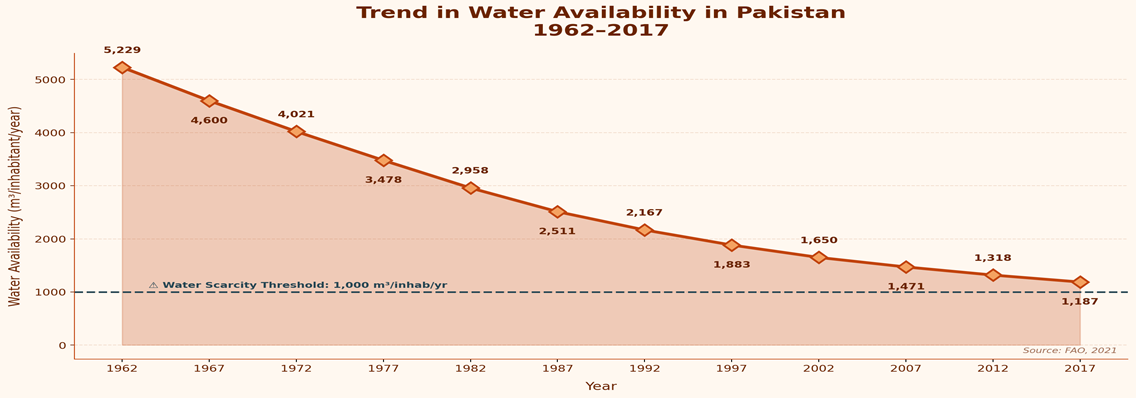
Source: FAO 2021
Along with water crises, food security is also under threat. The United Nations World Food Programme confirms what the hunger numbers already suggest: Pakistan is unlikely to achieve Zero Hunger by 2030.
Children under five are stunting and wasting at alarming rates, vulnerable communities face growing food insecurity from climate shocks, and a government that funds less than half its budget from its own revenues has little room to fix any of it.
State Bank of Pakistan Report
The State Bank of Pakistan (SBP) reported that cotton production declined by about 41 percent in recent years due to flooding and waterlogging, adversely affecting the textile industry and rural employment.
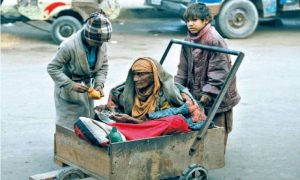
And if water and food were not enough, Pakistan is simultaneously choking under an energy crisis that blacks out homes for hours, gasping beneath smog so thick that its cities have become symbols of the world’s most unbreathable, struggling to house, educate, and employ a population. Each one arriving in a country that is running out of almost everything, all at once.
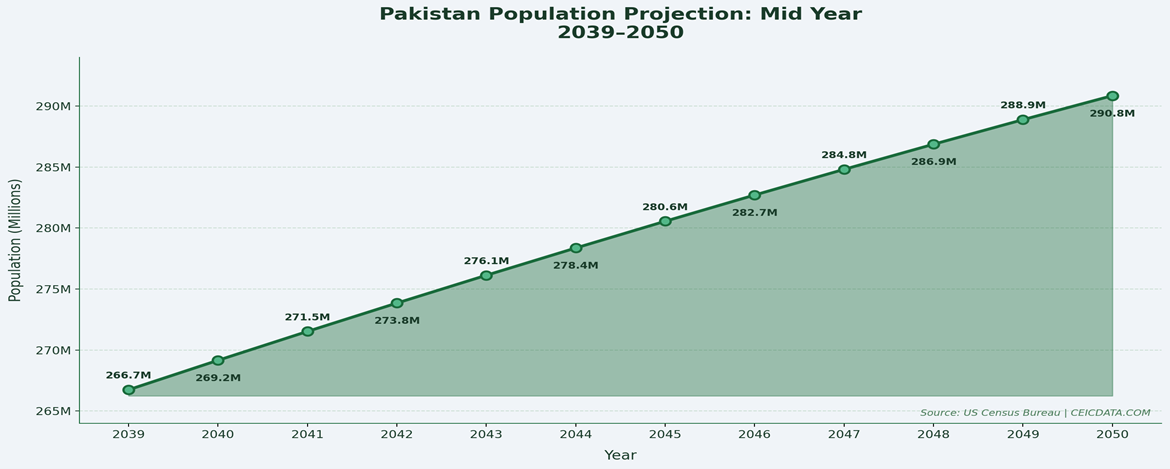
According to the United States Census Bureau, Pakistan’s population will not slow down, and it is already streaming every resource that it has. By 2050, it is projected to cross 290 million, adding tens of millions more mouths to feed, bodies to hydrate, and lives to sustain in a country that is already running short on nearly everything.
The consequences of this collision between a rising population and shrinking resources are not difficult to imagine. They are already unfolding, but as the number grows, so does the severity of what lies ahead.
More people mean more energy demand in a country that already cannot keep its lights on. Many people mean more homes to be built on shrinking agricultural land. More children are born into a school system that already has 26 million children out of school.
More patients are arriving at hospitals that are already overwhelmed. More young people are entering a job market that is already failing to absorb them.
.
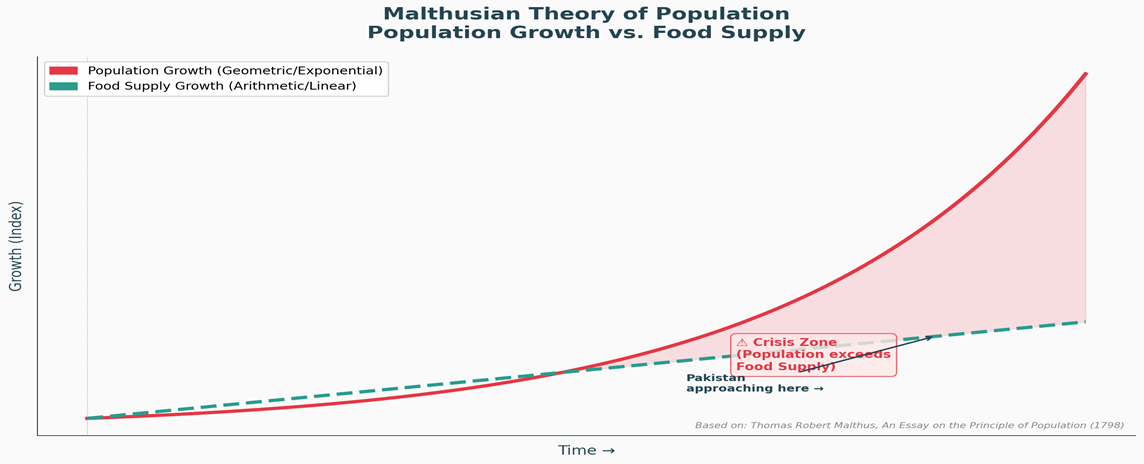
The story of Pakistan’s current condition is a painful reminder of the famous theory of Thomas Robert Malthus. As he warned that population grows geometrically (doubling), while food and resources grow only arithmetically (slow and steady).
He argued that a point comes where population surpasses food and resources, and when they do, nature enforces its own brutal correction through famines, disease, and poverty. Malthus wrote it two centuries ago; Pakistan is living it today.
A nation was once asked whether it could feed Asia. Today, the question is far more personal, far more urgent, and far more frightening. Will Pakistan breathe? Only those in power finally decide that the answer cannot wait any longer.