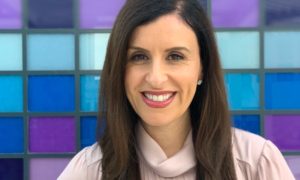
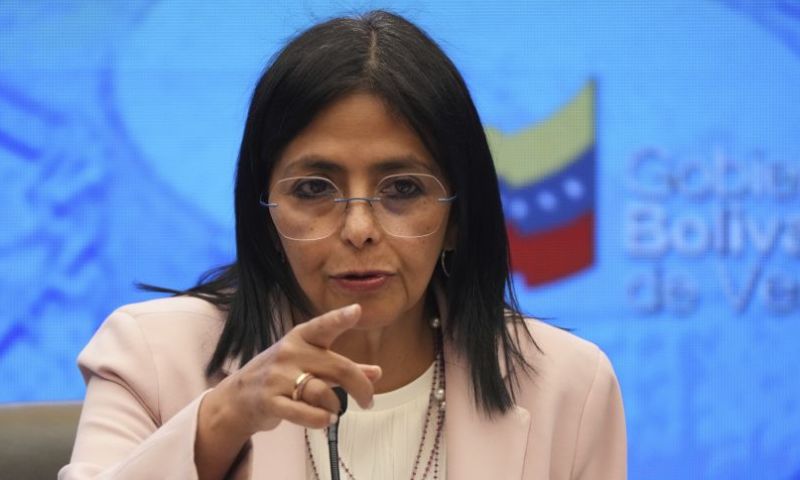



CARACAS, Venezuela: Venezuela’s Vice President Delcy Rodríguez, 56, was sworn in as interim president of the South American country on Saturday after President Nicolás Maduro was captured in a US military operation, creating a brief power vacuum in the country.
Venezuela’s constitution also outlines this in its different scenarios, anticipating a president’s absence.
Under Articles 233 and 234 of Venezuela’s constitution, whether the absence is temporary or absolute, the vice president takes over the presidential duties.
Rodríguez – also minister for both finance and oil – stepped into the role on Saturday afternoon. Hours after the capture of Maduro and his wife, Cilia Flores, she chaired a National Defence Council session, surrounded by other ministers and senior officials, and demanded the couple’s “immediate release” while condemning the US military operation.
Standing before the Venezuelan flag, Rodríguez said the early-morning operation represents a blatant violation of international law and Venezuela’s sovereignty.
She added that the action must be rejected by Venezuelans and condemned by governments across Latin America.
“We call on the peoples of the great homeland to remain united, because what was done to Venezuela can be done to anyone. That brutal use of force to bend the will of the people can be carried out against any country,” she told the council in an address broadcast by state television channel VTV.
Maduro’s ‘full trust’
Rodríguez, 56, is from Caracas and studied law at the Central University of Venezuela.
She has spent more than two decades as one of the leading figures of chavismo, the political movement founded by President Hugo Chávez and led by Maduro since Chávez’s death in 2013.
Alongside her brother Jorge Rodríguez, the current president of the National Assembly, she has held various positions of power since the Chávez era.
She served as minister of communication and information from 2013 to 2014 and later became foreign minister from 2014 to 2017. In that role, she defended Maduro’s government against international criticism.
As foreign minister, Rodríguez represented Venezuela at forums such as the United Nations, where she accused other governments of seeking to undermine her country.
In 2017, Rodríguez became president of the Constituent National Assembly that expanded the government’s powers after the opposition won the 2015 legislative elections.
In 2018, Maduro appointed her vice president for his second term. She retained the post during his third presidential term, which began on January 10, 2025, following the July 28, 2024, elections.
Until the president’s capture, she served as Venezuela’s chief economic authority and minister of petroleum.
José Manuel Romano, a constitutional lawyer and political analyst, told CNN that the positions Rodríguez has held show she is a “very prominent” figure within the Venezuelan government and someone who enjoys the president’s “full trust.”
“The executive vice president of the republic is a highly effective operator, a woman with strong leadership skills for managing teams,” Romano said.
“She is very results-oriented and has significant influence over the entire government apparatus, including the Ministry of Defence. That is very important to note in the current circumstances,” he added.
Understanding with the US
Hours after Maduro’s capture, and before Rodríguez addressed the National Defence Council, US President Donald Trump said at a press conference that Secretary of State Marco Rubio had spoken with the vice president.
According to Trump, she appeared willing to work with Washington on a new phase for Venezuela.
“She had a conversation with Marco. She said, ‘We’re going to do whatever you need.’ I think she was quite courteous. We’re going to do this right,” Trump said.
Trump’s remarks, however, surprised some analysts, who believe Rodríguez is unlikely to make concessions to the United States.
“She is not a moderate alternative to Maduro. She has been one of the most powerful and hard-line figures in the entire system,” Imdat Oner, a policy analyst at the Jack D. Gordon Institute and a former Turkish diplomat based in Venezuela, told CNN.
“Her rise to power appears to be the result of some kind of understanding between the United States and key actors preparing for a post-Maduro scenario. In that context, she would essentially serve as a caretaker until a democratically elected leader takes office,” the analyst added.
In her first messages following Maduro’s capture, Rodríguez showed no signs of backing down and, without referencing Trump’s statements, closed the door to any potential cooperation with the United States.
Earlier in the morning, during a phone interview with VTV, Rodríguez said the whereabouts of Maduro and Flores were unknown and demanded proof that they were alive.
Later in the afternoon, during the National Defence Council session, she escalated her rhetoric, condemned the US operation and, despite the circumstances, insisted that Maduro remains in charge of Venezuela.
“There is only one president in this country, and his name is Nicolás Maduro Moros,” said Rodríguez — now, by force of events, the most visible face of the government.
The Constitutional Chamber of Venezuela’s Supreme Court later formally ordered Rodríguez to assume the office of president “to guarantee administrative continuity and the comprehensive defence of the Nation.”
Some constitutional guarantees may be temporarily restricted, suggesting that her powers could be limited initially, according to Caracas-based journalist Sleither Fernández.
Defiance against US intervention
Following Maduro’s capture, Rodríguez demanded proof of life for Maduro and his wife, Cilia Flores, and rejected any US attempts to assert control.
“We will never return to being the colony of another empire,” she said in a televised address, while leaving open the possibility of “respectful relations” with the United States.
Maduro and Flores are expected to be detained in a federal prison in New York, where they face charges of narco-terrorism conspiracy, cocaine importation conspiracy, and two weapons counts, according to the indictment.
Rodríguez’s firm stance signals that any transition following the US operation is unlikely to proceed smoothly.
While Trump suggested that the US could temporarily “run” Venezuela, Rodríguez has asserted that Venezuela’s sovereignty remains intact.