


ISTANBUL: As the war involving Iran, the United States, and Israel intensifies, experts warn that vital water infrastructure across the Middle East is becoming increasingly vulnerable to attacks.
According to a report published by Turkish News Agency Anadolu, recent strikes on desalination plants in the region have drawn attention to how water systems — essential for the survival of millions — can become strategic targets during conflicts.
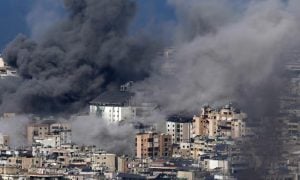
Over the weekend, airstrikes and drone attacks reportedly hit desalination facilities in Iran and Bahrain, raising fears that the conflict could begin to affect infrastructure that provides daily water supplies to tens of millions of people in one of the world’s most water-scarce regions.
Iran’s Foreign Minister Abbas Araghchi accused the United States of striking a desalination facility on Qeshm Island, saying the attack disrupted water supplies to around 30 villages and warned it could have serious consequences. Washington denied responsibility for the incident.
A day later, Bahraini officials said an Iranian drone caused material damage to a desalination plant in the island country, although authorities said water supplies were not affected.
The situation comes at a sensitive time for the region as temperatures rise ahead of the summer months, when demand for water increases significantly. Experts warn that even short disruptions to desalination plants could quickly create humanitarian risks.
Growing reliance on desalination
Water security specialists say the Middle East relies heavily on desalination plants to meet daily water demand.
Mohammed Mahmoud, a water security expert and Middle East lead at the United Nations University Institute for Water, Environment and Health, said desalination plants supply between half and nearly 90 percent of national water needs in several Gulf countries.
“When infrastructure that generates the water supply is impacted and goes offline, it creates a very dangerous situation,” Mahmoud told Anadolu.
The strategic importance of desalination systems was highlighted in a 2010 assessment by the US Central Intelligence Agency, which warned that disruption to Gulf desalination facilities could have more severe consequences than the loss of many other industries.
Major regional cities such as Abu Dhabi, Dubai, Doha, Kuwait City, and Jeddah now depend heavily on desalinated water.
Across the Gulf Cooperation Council countries, more than 800 desalination plants operate, accounting for roughly 31 percent of global desalination capacity.
Governments in the region are also expanding the sector, with more than 53 billion dollars expected to be invested in new desalination projects in the coming years.
At the same time, water scarcity is worsening. According to the World Resources Institute, about 83 percent of the Middle East population already faces severe renewable water scarcity — a figure projected to approach nearly 100 percent by 2050 due to climate change.
Water is increasingly targeted in conflicts
Analysts say the incidents in the Gulf reflect a broader global trend in which water infrastructure is increasingly affected by armed conflicts.
A recent assessment by the Pacific Institute found that violence linked to water resources reached record levels in 2024.
The report documented 420 water-related violent incidents last year — a 20 percent increase compared with 2023 and a 78 percent rise from 2022. In contrast, only 24 such incidents were recorded worldwide in 2000.
Experts classify water-related violence into three categories: water used as a weapon, water infrastructure damaged during conflicts, and disputes over water resources triggering violence.
David Michel, a senior associate with the global food and water security program at the Center for Strategic and International Studies, said water can become a strategic tool in war.
“Water can be used to withhold resources from an adversary or to flood areas under enemy control,” he said.
One major example occurred during the Russia-Ukraine war when the Kakhovka dam was destroyed in 2023, causing widespread flooding downstream.
A potential war crime
International humanitarian law prohibits attacks on infrastructure essential to civilian survival, including water systems.
However, experts say the weaponization of water has been seen repeatedly in recent conflicts.
Mahmoud pointed to the period between 2014 and 2016 when ISIS controlled parts of Iraq and Syria and manipulated dams and water flows to control communities.
“Water was used as a tool to pressure or punish different communities,” he said.
Historical events in the Gulf also show the vulnerability of water systems.
During the 1991 Gulf War, Iraq reportedly released large quantities of oil into the waters near desalination facilities, contaminating seawater used for drinking supplies and forcing Kuwait to rely on emergency water shipments from neighboring countries.
While the recent attacks in the Iran conflict have not yet reached that level, analysts say the signals are concerning.
“Direct attacks on desalination plants would represent one of the clearest examples of water being weaponized,” Michel said.
“Targeting this infrastructure would directly disrupt the lives of civilians.”
Rising water tensions worldwide
Data from the Pacific Institute shows that 61 percent of water-related violence in 2024 involved attacks on water infrastructure.
Another 34 percent stemmed from disputes over access or control of water resources, while 5 percent involved the deliberate use of water as a weapon.
Approximately 16 percent of incidents last year were linked to the Russia-Ukraine war, while around 12 percent were associated with the war in Gaza.
The Middle East, South Asia, and Sub-Saharan Africa recorded the highest number of water-related conflicts.
Experts say that, beyond armed conflict, increasing demand, climate change, and weak water management systems are also intensifying global water tensions.
Global water demand is expected to rise by 20 to 30 percent by 2050, while climate change is altering rainfall patterns and increasing the frequency of droughts and floods.
“There are multiple pressures on the world’s shared water resources,” Michel said.