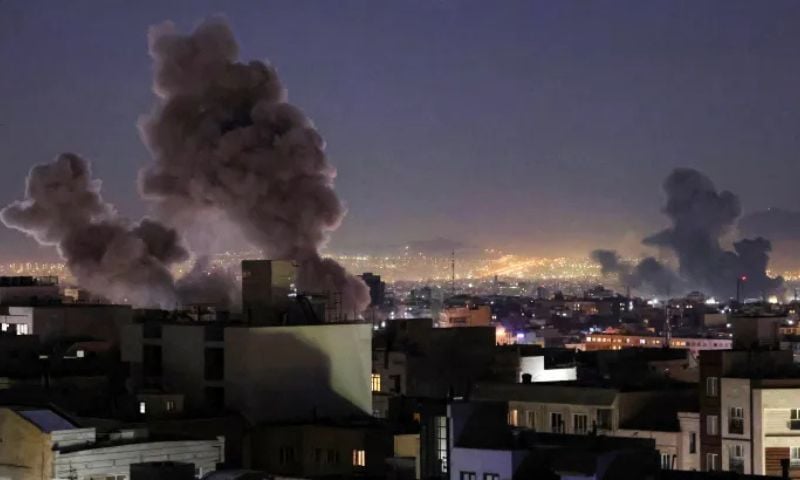



TEHRAN, Iran: The United States and Israel launched fresh strikes on Tehran on Sunday night while Iran responded with new waves of missiles and drones on Israel and across the region.
The fighting marks one of the most serious escalations in the decades-long confrontation between Iran, Israel and the United States.
In a video posted on his Truth Social platform, US President Donald Trump said US combat operations were continuing “in full force” and would persist until Washington’s objectives were achieved.
“Combat operations continue at this time, in full force, and they will continue until all of our objectives are achieved. We have very strong objectives,” Trump said.
The president confirmed that three US service members had been killed, as earlier announced by US Central Command. Five others were seriously wounded, while several sustained minor injuries.
“As one nation, we grieve for the true American patriots who have made the ultimate sacrifice for our nation,” Trump said. “Sadly there will likely be more before it ends.”
In separate interviews with NBC News and the Daily Mail, Trump said further casualties “could happen again” as operations continued.
He described the strikes as part of “Operation Epic Fury”, calling it one of the largest and most complex offensives ever launched.
He said hundreds of targets had been hit, including facilities belonging to the Islamic Revolutionary Guard Corps (IRGC) and Iranian air defence systems.
President Donald J. Trump provides an update on Operation Epic Fury: pic.twitter.com/Vte8QKpISn
— The White House (@WhiteHouse) March 1, 2026
Trump claimed nine Iranian naval vessels had been “destroyed and sunk” and that Iran’s naval headquarters had been largely destroyed.
He also reiterated that Iran’s Supreme Leader Ayatollah Ali Khamenei and several senior commanders were killed in the strikes, a claim confirmed by Iranian state media.
Trump’s rationale for the strikes
In an interview with NBC News, Trump said he ordered the strikes because Iran was unwilling to halt its nuclear programme.
“They weren’t willing to stop their nuclear research. They weren’t willing to say they will not have a nuclear weapon,” he said.
Asked whether strikes would cease if Tehran returned to negotiations, Trump said he would be open “if they can satisfy us”.
He told the Daily Mail the military operation against Iran could last “four weeks — or less”.
Israeli strikes on Tehran
The Israeli military said it carried out large-scale strikes targeting command centres and security infrastructure in Tehran.
In a statement on Telegram, the Israel Defense Forces (IDF) said it had “dismantled the Iranian Combat Headquarters” and struck IRGC intelligence and air force command centres.
The IDF said more than 1,200 munitions had been dropped across 24 of Iran’s 31 provinces over the past day in coordination with US forces.
Iranian media reported that Israeli strikes hit a hospital in northern Tehran, causing severe damage and prompting evacuations.
There were no immediate confirmed reports of casualties at the hospital.
Iran fires missiles on and across region
Iran responded with missile and drone attacks targeting Israel and US military facilities across the Middle East.
The IRGC said it had launched attacks on 27 bases hosting US troops, as well as Israeli military sites in Tel Aviv and other cities.
Explosions and air raid sirens were reported in Jerusalem, Tel Aviv and Haifa.
Israel’s emergency service Magen David Adom said it was treating several wounded in the Jerusalem area after missile impacts and falling debris.
בתום הערכת מצב, פיקוד העורף הפיץ הנחייה כי ניתן לצאת מהמרחב המוגן, יש להמשיך ולשהות בסמיכות למרחבים מוגנים ברחבי הארץ.
כוחות חילוץ והצלה פועלים במספר זירות ברחבי הארץ בהן התקבלו דיווחים על נפילות. יש להימנע מהתקהלויות האזורים אלו
הנכם מתבקשים להמשיך ולהישמע להנחיות פיקוד העורף…
— צבא ההגנה לישראל (@idfonline) March 1, 2026
In Beit Shemesh, near Jerusalem, Israeli authorities said eight people were killed in a ballistic missile strike.
At least 121 others have been injured across Israel since the attacks began, local officials said.
Israel’s Channel 12 reported damage to buildings near Tel Aviv after missile debris fell in the area.
Police urged residents to avoid impact sites while rescue teams operated.
Iran said it had also launched strikes across Bahrain, Iraq, Jordan, Kuwait, Oman, Qatar and the United Arab Emirates, targeting locations where US forces are deployed.
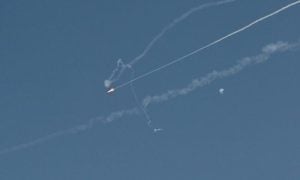
Most of the projectiles were intercepted, regional authorities said.
War deaths in Iran
Iranian state media, citing the Iranian Red Crescent Society, said at least 201 people had been killed and 747 injured in Israeli and US strikes as of Sunday morning.
The deadliest reported incident was a strike on a girls’ school in Minab in southern Iran.
Iranian news agency IRNA later said the death toll in that attack had risen to 165, with 96 injured.
Israel’s army said it was not aware of any strike in the area, while the US military said it was reviewing the reports.
Dr Tedros Adhanom Ghebreyesus, head of the World Health Organisation (WHO), has called reports of the Gandhi Hospital in Tehran being hit by bombardments “extremely worrying”.
“[The WHO] is working to verify the incident. But it serves as a reminder that all efforts must be taken to prevent health facilities from being caught up in the ongoing conflict,” Ghebreyesus said in a post on X.
“Health facilities are protected under international humanitarian law. Health is not a target.”
Reports of Tehran's Gandhi Hospital being damaged during today’s bombardment of the Iranian capital are extremely worrying.@WHO is working to verify the incident. But it serves as a reminder that all efforts must be taken to prevent health facilities from being caught up in the…
— Tedros Adhanom Ghebreyesus (@DrTedros) March 1, 2026
Iran’s Foreign Minister Abbas Araghchi told ABC News that Tehran would set “no limit” to its response.
“We are defending ourselves — whatever it takes,” he said. “What the United States is doing is an act of aggression. What we are doing is the act of self-defence.”
Diplomatic channels remain open
Despite the escalating conflict, Oman said diplomatic efforts had not collapsed.
Oman’s Foreign Minister Badr Albusaidi said the “door to diplomacy remains open” after recent talks in Geneva between US and Iranian officials.
“War should not mean that the hope of peace is extinguished,” he wrote on X, urging Washington not to be drawn further into conflict.
I want to be very clear – the door to diplomacy remains open. Talks in Geneva made genuine progress towards an unprecedented agreement between Iran and the United States and although the hope was to avoid war, war should not mean that the hope of peace is extinguished. I still…
— Badr Albusaidi – بدر البوسعيدي (@badralbusaidi) March 1, 2026
Trump told The Atlantic that he had agreed to hold talks with Iran’s new leadership, saying they “want to talk” but had “waited too long”.
He did not specify when discussions might take place.
Earlier, Oman’s Ministry of Foreign Affairs said Iran’s Foreign Minister Abbas Araqchi told his Omani counterpart, Badr bin Hamad Al Busaidi, that Tehran is open to any “serious efforts at de-escalation”.
The statement emphasised the importance of addressing the crisis’s causes, halting military operations and returning to diplomacy.
Oman has served as a mediator in past nuclear negotiations between Washington and Tehran.
Global impact of the conflict
The conflict has disrupted air travel across the Middle East and rattled global energy markets.
Brent crude rose around 10 percent to about $80 a barrel, with analysts warning prices could approach $100 if shipping through the Strait of Hormuz is disrupted.
According to the Council on Foreign Relations, the United States maintains military sites at at least 19 locations in the Middle East, with an estimated 40,000 to 50,000 troops stationed in the region.