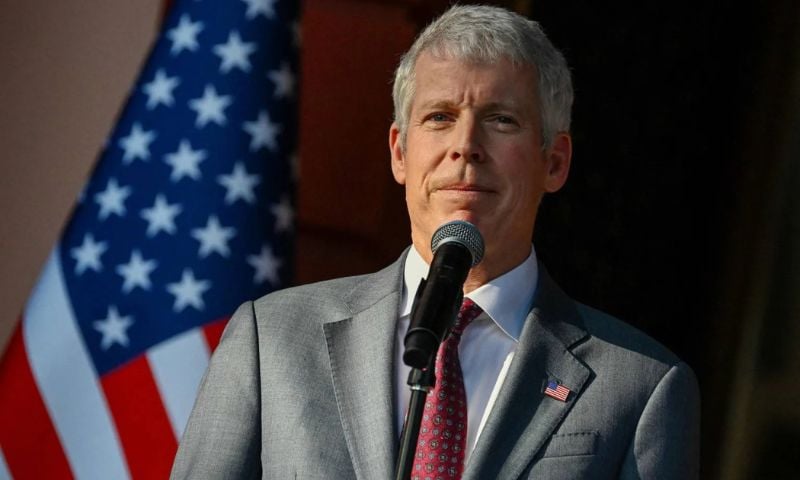



PARIS: The United States will prevent Iran from acquiring nuclear weapons “one way or the other”, US Energy Secretary Chris Wright said on Wednesday, as Washington and Tehran reported progress in indirect talks in Geneva on Tuesday.
US President Donald Trump “believes firmly we cannot have a nuclear-armed Iran,” Wright told reporters in Paris on the sidelines of meetings of the International Energy Agency.
“They’ve been very clear about what they would do with nuclear weapons. It’s entirely unacceptable,” Wright said.
“So one way or the other, we are going to end, deter Iran’s march towards a nuclear weapon.”
His remarks came a day after US and Iranian officials concluded a second round of indirect negotiations in Geneva under Omani mediation.
US, Iran agreed on guiding principles
On Tuesday, Iranian Foreign Minister Abbas Araghchi said the two sides had reached broad agreement on a set of “guiding principles” that would form the basis for drafting a potential nuclear deal.
“Ultimately, we were able to reach broad agreement on a set of guiding principles, based on which we will move forward and begin working on the text of a potential agreement,” Araghchi told Iranian state television after around four hours of talks.
He described the discussions as “more constructive” than the previous round held earlier this month.
“It was agreed that both sides would work further on draft texts for a potential agreement, after which the drafts would be exchanged, and a date for a third round would be set,” he said, adding that no specific time had been fixed for the next meeting.
Araghchi said that progress did not mean a final agreement was imminent. “Both sides have positions that will take some time to bring closer together,” he said.
The Iranian delegation was led by Araghchi. The US side was headed by Special Envoy Steve Witkoff and President Trump’s adviser Jared Kushner.
Both delegations held separate meetings with Omani Foreign Minister Badr Albusaidi at the Omani ambassador’s residence before exchanging messages through mediators.
Albusaidi said on X that the talks concluded with “good progress towards identifying common goals and relevant technical issues” and described the discussions as constructive.
Iran eyes sanctions relief
Iranian Foreign Ministry spokesman Esmaeil Baghaei said lifting sanctions was an integral part of any agreement.
“We have come here with an open mind and open eyes,” Baghaei told Iranian state media on the sidelines of the talks.
“Time is very important and vital for us.”
He said Iran was prepared to remain in Geneva for several days or even weeks if necessary to finalise an agreement.
A senior Iranian official told Reuters that US seriousness in lifting sanctions and avoiding what he called “unrealistic demands” would be key to effective negotiations.
The official said Tehran had come with “genuine and constructive proposals”.
Iranian state media reported that the discussions focused primarily on technical aspects of the nuclear file, including sanctions relief as well as legal and economic matters.
Disputes over enrichment
Iran insists it does not seek nuclear weapons.
Araghchi said Tehran has repeatedly affirmed that nuclear arms have “no place whatsoever in Iran’s national security doctrine”.
He said the Nuclear Non-Proliferation Treaty recognises the “inalienable right” of state parties to develop nuclear energy, including enrichment for peaceful purposes.
“This right is inherent, non-negotiable and legally binding,” he said.
Washington has repeatedly called for zero enrichment and has sought to broaden discussions to include Iran’s ballistic missile programme.
Tehran insists talks should focus solely on the nuclear programme.
Araghchi also criticised the US withdrawal in 2018 from the 2015 nuclear deal, formally known as the Joint Comprehensive Plan of Action (JCPOA), describing it as a “clear violation of an internationally endorsed agreement”.
US, Iran tensions
The diplomatic efforts come amid heightened tensions in the Gulf.
Iran’s Supreme Leader Ayatollah Ali Khamenei warned against imposing preconditions on negotiations.
“If negotiations are going to take place, determining the outcome of the negotiations in advance is wrong and foolish,” he said during remarks in East Azerbaijan province.
Khamenei said Trump would not succeed in undermining the Islamic Republic and warned that US naval assets could be targeted.
“A warship is certainly a dangerous weapon, but even more dangerous is the weapon capable of sinking it,” he said.
Iran’s Revolutionary Guard navy commander, Rear Admiral Alireza Tangsiri, said his forces could close the Strait of Hormuz if ordered by senior leadership.
Iranian media reported live-fire exercises in the strategic waterway, with parts temporarily closed for security precautions.
The Strait of Hormuz, which links the Gulf to the Gulf of Oman and the Arabian Sea, is the world’s most important oil transit chokepoint.
According to the US Energy Information Administration, around 20 percent of global oil consumption passes through it.
Meanwhile, Washington has increased its naval presence in the region, deploying an aircraft carrier group following recent unrest in Iran linked to inflation and economic hardship.
Ahead of the Geneva talks, Araghchi met International Atomic Energy Agency Director General Rafael Grossi to discuss technical cooperation and oversight of Iran’s nuclear programme.
Albusaidi also thanked Grossi for his contribution to the diplomatic process.