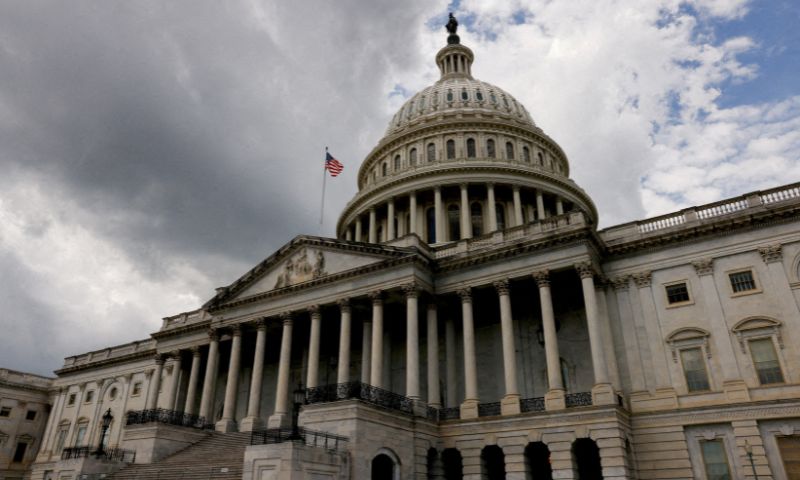



WASHINGTON: The US Senate on Thursday advanced a war powers resolution that would bar President Donald Trump from taking further military action against Venezuela without clear authorisation from Congress, marking a rare challenge to presidential authority over the use of force.
The Senate voted 52–47 to clear a procedural hurdle and move the resolution forward. Five Republicans joined all Democrats in backing the measure.
One Republican senator did not vote. The move paves the way for a full debate and a final vote expected next week.
The vote came days after US forces captured Venezuelan President Nicolas Maduro in a military raid in Caracas, an operation that has heightened concerns in Congress about the administration’s actions and transparency.
Bipartisan break with Trump
The Republicans who voted with Democrats were Rand Paul of Kentucky, Susan Collins of Maine, Josh Hawley of Missouri, Lisa Murkowski of Alaska and Todd Young of Indiana.
Trump’s Republican Party holds a 53–47 majority in the 100-member Senate.
The resolution is co-sponsored by Senator Rand Paul and Democratic Senator Tim Kaine of Virginia, both members of the Senate Foreign Relations Committee.
They argue that the Constitution gives Congress, not the president, the power to declare war.
“I spoke to at least two Republicans today who did not vote for this resolution previously who are thinking about it,” Paul told a press conference earlier this week, standing alongside Kaine.
He said some Republicans had publicly voiced concerns over the administration’s actions.
Fallout from Maduro’s capture
Trump’s administration had previously assured lawmakers that it did not plan to change Venezuela’s government or strike Venezuelan territory.
After Maduro’s capture, some lawmakers accused the administration of misleading Congress, according to US media reports.
The Senate had blocked similar war powers resolutions last year, including one in November that failed by a narrow 51–49 vote.
At that time, the White House was increasing military pressure on Venezuela, including attacks on boats in the Caribbean and eastern Pacific.
Lawmakers have also cited Trump’s rhetoric and threats against other countries, including Greenland, an autonomous territory of Denmark, as raising broader concerns about unchecked military authority.
Trump slams dissenting Republicans
President Trump reacted angrily to Thursday’s vote. Writing on his Truth Social platform, he criticised Republican senators who backed the measure.
“Republicans should be ashamed of the Senators that just voted with Democrats in attempting to take away our Powers to fight and defend the United States of America,” Trump wrote.
A vote on final passage of the resolution is expected next week.
( @realDonaldTrump – Truth Social Post )
( Donald J. Trump – Jan 08 2026, 12:49 PM ET )Republicans should be ashamed of the Senators that just voted with Democrats in attempting to take away our Powers to fight and defend the United States of America. … pic.twitter.com/ymOofj9zcw
— Donald J Trump Posts TruthSocial (@TruthTrumpPost) January 8, 2026
Legal and political hurdles
If passed by the Senate, the resolution would require Trump to remove US armed forces from any “imminent engagement” in hostilities “within or against Venezuela” unless Congress grants approval.
However, the measure faces major obstacles. It would still need to pass the Republican-controlled House of Representatives and overcome an expected presidential veto.
That would require two-thirds majorities in both chambers, a threshold widely seen as unlikely.
Dylan Williams, vice president for government affairs at the Center for International Policy, called the move “a major rebuke” to Trump in a post on X.
Cavan Kharrazian of Demand Progress said it was “a rare ray of good news for the nation and our Constitution”.
Arguments on both sides
Opponents of the resolution argued that Maduro’s capture was a law enforcement operation rather than an act of war.
Maduro faces trial in the United States on drug and gun charges, which he has denied.
Senator Jim Risch of Idaho, the Republican chair of the Foreign Relations Committee, said the resolution was unnecessary.
“The purpose of this resolution is to slap the president in the face,” Risch said in a Senate speech.
“It will do nothing that it purports to do because it can’t stop something that isn’t going on right now.”
Supporters disagreed. Kaine said US forces had been striking Venezuelan boats for months and cited Trump’s statements about “running” Venezuela and seizing its oil.
“This is not a surgical arrest operation by any stretch,” Kaine said.