


KEY POINTS
- Rubio said Washington sees a diplomatic opportunity to reach a deal with Iran.
- Indirect US-Iran nuclear talks are set to resume in Geneva on Tuesday.
- Iranian Foreign Minister said he arrived in Geneva with “real ideas” for a fair deal.
- Tehran insists negotiations focus only on its nuclear programme and sanctions relief.
- IAEA urges Iran to clarify status of 440 kg of enriched uranium and allow inspections of nuclear sites.
BUDAPEST/GENEVA: The United States sees an opportunity to reach a diplomatic agreement with Iran, Secretary of State Marco Rubio said on Monday, a day before a new round of indirect nuclear talks between Washington and Tehran in Geneva.
Speaking during a visit to Budapest, Rubio said that striking a deal would be difficult.
“I think that there’s an opportunity here to diplomatically reach an agreement that addresses the things we’re concerned about. We’ll be very open and welcoming to that. But I don’t want to overstate it either,” Rubio said.
“It’s going to be hard. It’s been very difficult for anyone to do real deals with Iran, because we’re dealing with … who are making theological decisions, not geopolitical ones,” he added.
US-Iran talks resume in Geneva
Iran’s Foreign Minister Abbas Araghchi arrived in Geneva on Sunday night at the head of a senior diplomatic and technical delegation.
A second round of indirect talks with the United States is scheduled for Tuesday, with Oman acting as mediator.
The first round was held in Muscat last week and was described by both sides as a “good start”.
Araghchi said he was in Geneva with “real ideas” to secure a fair agreement.
“I am in Geneva with real ideas to achieve a fair and equitable deal. What is not on the table: submission before threats,” he wrote on X.
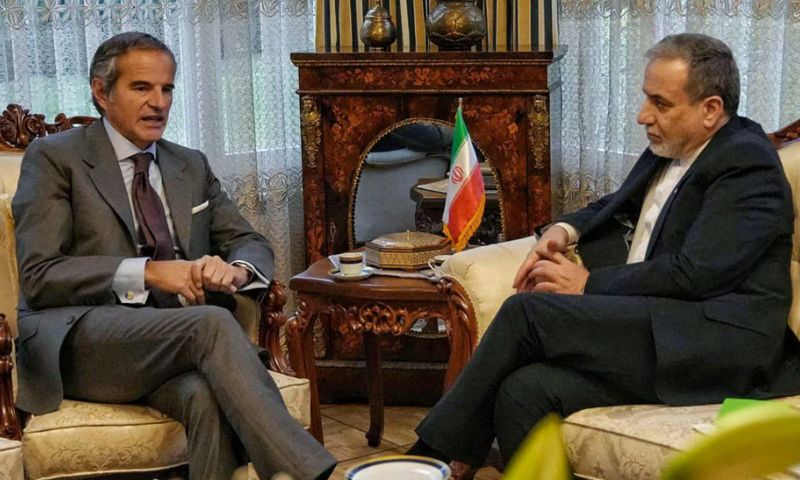
He said he held “deep technical discussions” with Rafael Grossi, Director General of the International Atomic Energy Agency (IAEA).
He said he would also meet Omani Foreign Minister Badr Al-Busaidi ahead of Tuesday’s diplomacy with the United States.
Iran’s Foreign Ministry said Araghchi and Grossi discussed cooperation with the IAEA and Tehran’s technical perspective on the nuclear talks.
Scope of negotiations
The renewed diplomacy comes amid long-running disputes over Iran’s nuclear programme.
Washington, other Western powers and Israel say Tehran’s programme aims to develop nuclear weapons.
Iran denies this and says its nuclear activities are solely for civilian purposes.
Deputy Foreign Minister Majid Takht-Ravanchi told the BBC on Sunday that Iran was ready to compromise on its nuclear programme in exchange for sanctions relief, adding that the ball was “in America’s court to prove that they want to do a deal”.
However, Washington has sought to broaden the talks to include Iran’s missiles programme.
Tehran has rejected that demand, saying negotiations will focus only on nuclear issues and sanctions relief.
Ali Larijani, secretary of Iran’s Supreme National Security Council, told Al Jazeera that Iran was ready for fair nuclear talks but would not reduce enrichment to zero.
“It is unrealistic to ask a country that has already mastered this technology to reduce it to zero,” he said, adding that enriched uranium was needed for civilian uses, including cancer treatment at a Tehran research reactor.
“Our missile programme stands entirely separate from the nuclear one. It is a domestic matter … and cannot be part of these negotiations,” Larijani said.
He added that Iran accepts IAEA monitoring within the framework of the Nuclear Non-Proliferation Treaty (NPT).
Rising regional tensions
The diplomatic efforts come amid heightened tensions in the Middle East.
Washington, which joined Israel in air strikes on Iranian nuclear facilities in June, has ordered a second aircraft carrier strike group to the region, in addition to other warships and aircraft already deployed.
Iran began a military exercise on Monday in the Strait of Hormuz, a strategic waterway through which around a fifth of global oil supplies pass.
The semi-official Tasnim news agency said the drill, named “Smart Control of the Strait of Hormuz”, was designed to test naval readiness.
Iran has repeatedly warned it could close the strait in response to any attack, a move that would disrupt global oil markets.
IAEA seeks clarity on uranium stockpile
The IAEA has been pressing Iran to clarify the status of 440 kg of enriched uranium following Israeli-US strikes last year on key nuclear sites at Natanz, Fordow and Isfahan.
The agency has also sought the full resumption of inspections.
Larijani accused Israel of seeking to destabilise the region and said Tehran’s negotiations were exclusively with the United States.
“We are not engaged in any talks with Israel,” he said.
Larijani praised Qatar’s mediation efforts and said regional countries supported a political solution.
He added that Iran’s cooperation with China and Russia was based on mutual interests and political partnership, including support at the UN Security Council.