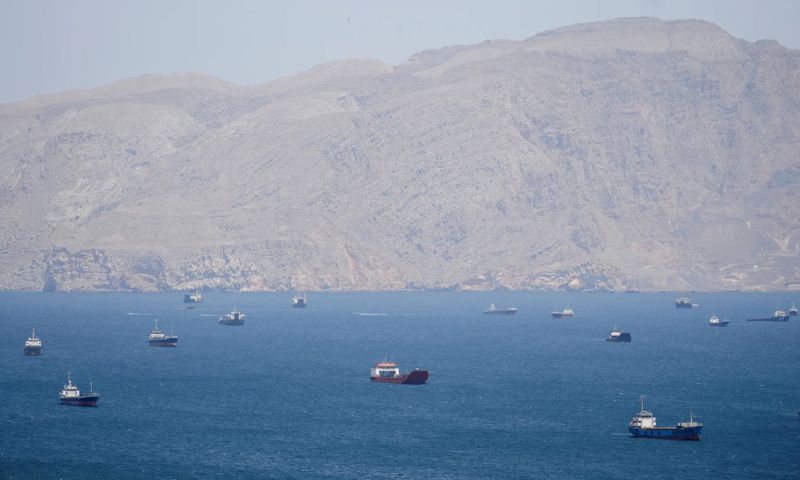



WASHINGTON: The United States is working to build an international coalition to restart commercial shipping through the Strait of Hormuz, a US official said on Thursday, as vessel traffic remains largely stalled amid the US-Israel conflict with Iran.
The “Maritime Freedom Construct” (MFC) will “take steps to ensure safe passage, including providing real-time information, safety guidance, and coordination to ensure vessels can transit these waters securely,” a State Department official told AFP on condition of anonymity.
The official, speaking on condition of anonymity, was responding to questions about a reported diplomatic cable calling on US embassies to press foreign governments to join such an effort.
The Wall Street Journal reported that the MFC will be a joint effort between the State Department and US Central Command (CENTCOM), which oversees American military forces in the Middle East, according to the cable.
“The State-led component, based in Washington, DC, will serve as the diplomatic operations hub, uniting partners and the commercial shipping industry,” the official told AFP.
Iran responded to the US-Israeli attacks which began on February 28 by threatening ships transiting the Strait of Hormuz, bringing traffic to an effective halt in the narrow waterway and sending global fuel prices skyrocketing.
Pakistan-led diplomatic efforts
Despite a ceasefire between the United States and Iran, shipping through the strait has continued to be effectively halted with no immediate let up in sight.
Pakistan-led diplomatic efforts are underway to end the US-Iran conflict through peaceful means.
The Iranian side is reportedly proposing this week to ease its chokehold on the strait in exchange for Washington lifting its retaliatory blockade of Iranian ports while broader negotiations continue.
US President Donald Trump has lashed out at allies since launching the war over their reluctance to get involved in the war on Iran, while urging at various times for countries to take responsibility for opening the Strait of Hormuz.
The cable however, insisted that collective action was “essential to demonstrate unified resolve and impose meaningful costs on Iranian obstruction of transit through the Strait,” according to the Wall Street Journal.
“Your participation will strengthen our collective ability to restore freedom of navigation and protect the global economy,” the cable reportedly said, describing the MCF as a “US-led” initiative.
The UK and France have led talks on a separate maritime effort, recently holding a meeting with over 50 countries on the issue.
US weighs military options
The diplomatic push comes as Washington considers additional measures to pressure Tehran.
According to a report by Axios, Trump is expected to receive a briefing from CENTCOM on options for a “short and intense” series of strikes aimed at breaking the current stalemate.
The proposals reportedly include potential strikes on Iranian infrastructure, as well as increased naval pressure in the Strait of Hormuz.
A senior administration official told US media that such options remain under consideration as part of broader efforts to compel Iran to return to negotiations.
Iran warns of retaliation
Iran has warned it would respond forcefully to any renewed US military action.
Majid Mousavi, commander of the Aerospace Force of Iran’s Islamic Revolutionary Guard Corps, said Tehran would respond to any strikes — “even if short and rapid” — with “prolonged and painful blows”, according to comments carried by the semi-official Tasnim news agency.
“We have seen the fate of your bases in the region; we will also see your vessels,” he said.
Iranian officials have also signalled a strategy to seek compensation for damage caused by the conflict.
Alireza Salimi, a member of Iran’s parliament, said Tehran would pursue legal avenues to claim damages and could resort to “reciprocal action” if those efforts failed, according to remarks carried by the ICANA news agency.
Tehran asserts control over Hormuz
Iranian leaders have reiterated their position on control over the waterway.
President Masoud Pezeshkian said any attempt to impose maritime restrictions in the Gulf would violate international law and undermine regional stability.
Meanwhile, Supreme Leader Mojtaba Khamenei said a “new chapter” for the Arabian Gulf and the Strait of Hormuz was emerging.
He said that Iran would secure the region and prevent what he described as foreign interference, according to statements reported by Press TV.