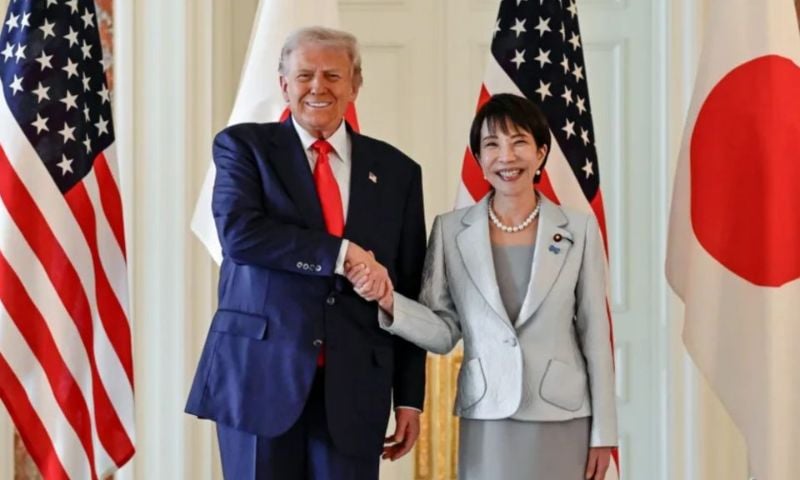



WASHINGTON: The United States on Tuesday announced the first tranche of investments by Japan under a sweeping $550 billion commitment pledged in a 2025 trade agreement with President Donald Trump, marking a significant step in the implementation of the bilateral economic framework.
The initial package, valued at $36 billion, will fund three major infrastructure projects in the United States, as Tokyo faces mounting pressure to demonstrate progress on commitments made in exchange for reduced US trade tariffs.
“Japan is now officially, and financially, moving forward with the FIRST set of Investments under its $550 BILLION Dollar Commitment to invest in the United States of America,” Trump wrote on his social media platform, Truth Social.
“The scale of these projects are so large, and could not be done without one very special word, TARIFFS,” he added, underscoring the linkage between tariff policy and foreign investment commitments.
According to AFP, the announcement comes ahead of a scheduled visit to the White House next month by Japanese Prime Minister Sanae Takaichi, following Trump’s visit to Japan in October.
Takaichi said the projects would “strengthen the Japan–US alliance by enabling Japan and the United States to jointly build resilient supply chains in strategically important areas for economic security – such as critical minerals, energy, and AI/data centers.”
“We believe these initiatives truly embody the purpose of this Strategic Investment Initiative, namely the promotion of mutual benefit between Japan and the United States, the enhancement of economic security, and the promotion of economic growth,” she said in a statement posted on X.
“Going forward, we will continue to work closely together between Japan and the United States to further refine the details of each project and ensure that they can be implemented promptly and smoothly,” she added.
‘Massive Trade Win’
US Trade Secretary Howard Lutnick described the announcement as a “MASSIVE AMERICA FIRST TRADE WIN,” highlighting the strategic and industrial dimensions of the investments.
The three projects include a large-scale natural gas generation facility in Ohio, a deep-water oil export facility in the Gulf of Mexico, and a synthetic diamond manufacturing plant aimed at strengthening US supply chain resilience.
According to Lutnick, the natural gas facility will be the “largest in history,” generating 9.2 gigawatts of power.
At full capacity, the plant would produce electricity equivalent to that generated by nine nuclear reactors or enough to power approximately 7.4 million homes. Takaichi said the facility would supply electricity to AI data centers and other high-demand industrial users.
The deep-water oil export project is expected to generate between $20 billion and $30 billion annually in US crude exports, reinforcing America’s position as a leading global energy supplier.
The third project – a synthetic diamond grit manufacturing facility — is designed to reduce US dependence on foreign imports, particularly from China, which currently dominates global supplies.
Synthetic diamond grit is widely used in industrial applications, including precision cutting and advanced manufacturing.
“Japan is providing the capital (for all three projects). The infrastructure is being built in the United States,” Lutnick said, emphasizing that while Tokyo supplies the funding, the industrial assets will be located on US soil.
“The proceeds are structured so Japan earns its return, and America gains strategic assets, expanded industrial capacity, and strengthened energy dominance,” he added.
Tariff-Linked Investment Framework
The broader $550 billion pledge, announced in July, is to be implemented through 2029 and aims “to rebuild and expand core American industries,” according to the White House.
The commitment was secured as part of a trade arrangement under which threatened US tariffs on Japanese imports were reduced from 25 percent to 15 percent.
Japanese Trade Minister Ryosei Akazawa has clarified that only one to two percent of the $550 billion would consist of direct capital investment.
The remainder is expected to be mobilized through bonds, loans from the Japan Bank for International Cooperation (JBIC), and credit facilities backed by public guarantees.
With Takaichi’s White House visit scheduled for March 19, the timeline for delivering tangible progress has tightened. Media reports have suggested rising tensions over the pace and structure of implementation.
In January, Trump warned South Korea — which had pledged to invest $350 billion — that tariffs could be raised if commitments were not met, stating the country was “not living up to its Deal.”
Analysts note that Japanese companies may approach the projects cautiously, citing concerns over administrative clarity, financial structuring, and potential labor shortages in the United States.
Despite these challenges, both governments have presented the initial $36 billion tranche as a demonstration of forward momentum in what they describe as a strategic, tariff-linked economic partnership aimed at boosting industrial capacity, energy security, and high-tech infrastructure in the United States.