


VIENNA: The United States and Iran are expected to hold talks in Islamabad this weekend covering a broader range of issues, including missiles and regional security, the head of the UN nuclear watchdog said on Wednesday, as diplomatic efforts intensify to end the ongoing Middle East conflict.
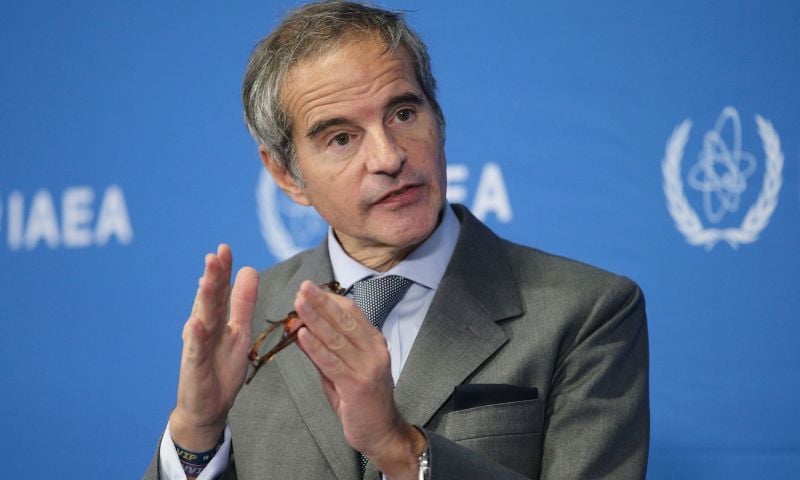
Rafael Grossi, Director General of the International Atomic Energy Agency, said the anticipated negotiations would go beyond previous nuclear-focused discussions.
Speaking to Italy’s Corriere della Sera, and cited by Turkiye’s Anadolu Agency, Grossi said the talks were expected to include Iran’s missile programme and security guarantees for Iran.
“This time, there will also be missiles, militias allied with the Islamic Republic, and security guarantees for Iran on the table,” he said.
Grossi suggested that a temporary diplomatic arrangement could be achievable, stressing the need to avoid military escalation.
“There are alternative diplomatic plans that would allow a solution where, for the moment, there will be no more enrichment due to the political, military and trust situation, with a reassessment in five or ten years,” he added.
Pakistan’s mediation role
The expected talks come amid intensified diplomacy aimed at ending nearly a month-long conflict involving the United States, Israel and Iran, which began on February 28 and has spread across the region.
Pakistan has emerged as a key mediator, working with Turkiye and Egypt to relay messages between Washington and Tehran, according to officials and media reports.
On Tuesday, Pakistan’s Prime Minister Shehbaz Sharif has said Islamabad is ready to host “meaningful and conclusive” talks for a comprehensive settlement.
Pakistan’s Chief of Defence Forces and Chief of Army Staff, Field Marshal Syed Asim Munir, also discussed the conflict with US President Donald Trump, the White House confirmed.
Prime Minister Sharif also held talks with Iranian President Masoud Pezeshkian earlier this week, urging collective efforts for de-escalation and a return to dialogue.
US proposal and Iran’s response
A senior Iranian source told Reuters that Pakistan had conveyed a US proposal to Tehran, though details were not disclosed and it was unclear whether it matched a reported 15-point framework.
According to The Washington Post, the US proposal includes sanctions relief in exchange for Iran halting uranium enrichment, limiting its missile programme and ending support for regional groups.
A senior political-security official of Iran, cited by Press TV, outlined five conditions for ending hostilities, including a halt to “aggression and assassinations”, guarantees against future conflict, payment of reparations, a comprehensive end to fighting across all fronts, and recognition of Iran’s sovereignty over the Strait of Hormuz.
Indirect talks
Iranian officials have acknowledged receiving messages through intermediaries.
Foreign ministry spokesman Esmaeil Baqaei said Pakistan was among several countries offering mediation and confirmed that Iranian Foreign Minister Abbas Araghchi had been in contact with his Pakistani counterpart.
“There have been messages going around for some days,” Baqaei said in a televised interview, adding that Iran had responded to such outreach.
A Pakistani security analyst with knowledge of the negotiations, Syed Muhammad Ali, told The Washington Post that indirect talks had made “significant and rapid progress”, facilitated by Pakistani leadership.
“There has been significant and rapid progress in these indirect talks between the United States and Iran,” Muhammad Ali said as quoted by The Washington Post.
He said that the talks were being facilitated by Pakistani Prime Minister Shehbaz Sharif and Pakistan’s Chief of Defence Forces and Chief of Army Staff Field Marshal Syed Asim Munir, among others.