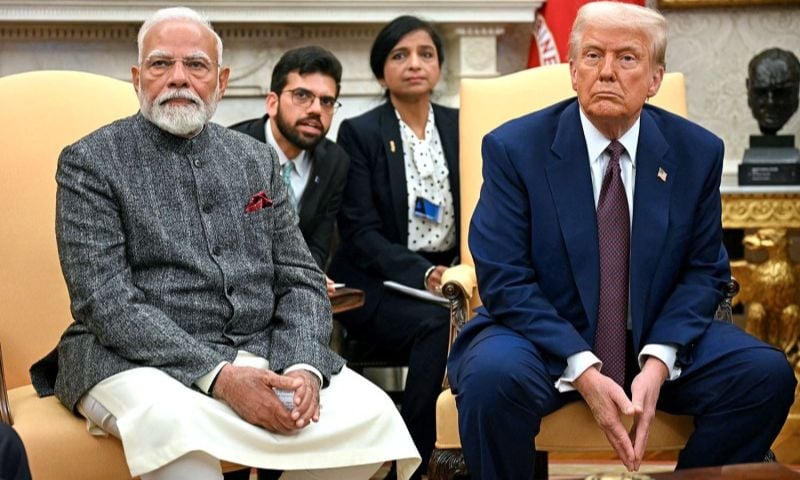



WASHINGTON: A US magazine, Foreign Affairs, has reported that relations between the United States and India have come under strain following a four-day conflict with Pakistan in May, 2025.
According to a recent analysis by Foreign Affairs, Pakistan publicly acknowledged and praised US President Donald Trump’s role in facilitating the ceasefire between the two nuclear-armed rivals, India rejected any notion of American mediation.
The report noted that Trump’s repeated public references to Pakistan’s diplomatic and military achievements, as well as his close engagement with Pakistani leaders, caused significant diplomatic discomfort for India.
Trump declines to sign trade agreement with India
Tensions were further exacerbated when the US President declined to sign a proposed trade agreement with India and imposed additional tariffs on Indian exports, intensifying the bilateral strain.
Foreign Affairs noted that these actions have led to a growing perception in the US that India may not be a reliable strategic partner.
Analysts note that the India–Pakistan ceasefire was largely facilitated by US intervention at India’s own request.
Yet, India avoids acknowledging this publicly for domestic political reasons, emphasising control over the narrative rather than the substance of mediation.
Furthermore, analysts highlight a contradiction in India’s approach; while rejecting US mediation in regional conflicts, it continues to seek unconditional American support in countering China, reflecting an inconsistent stance in its foreign policy strategy.
US praise of Pakistan’s diplomatic and military role during the conflict drew criticism in India.
Repeated public mentions by the US President of Pakistan’s “successes” and positive diplomatic engagement with Islamabad were viewed in New Delhi as downplaying India’s position and contributed to a chill in relations.
President Trump hosted Pakistan’s army chief
President Trump hosted Pakistan’s army chief at the White House in June 2025 — the first such visit — drawing private diplomatic protests from India over what it saw as Washington’s signalling toward Islamabad.
Sharp tariff increases by the US on Indian imports in 2025 further strained relations. Washington imposed successive tariffs totalling up to 50 % on Indian goods, which India strongly condemned as unfair and unjustified.
Reports emerged that India may pause plans to buy US-made defence equipment in response to tariff tensions, although India denied this, calling the reports fabricated.
Some commentators note that India is recalibrating its foreign policy — including reconsidering deeper ties with China — partly because of perceived unpredictability in US policy and shifting US engagement in South Asia following the Pakistan conflict.
These developments illustrate that US–India relations experienced heightened tension in 2025, driven not only by the India–Pakistan conflict and related diplomacy but also by broader disagreements on trade, strategic narratives, and regional priorities.
Modi skipped ASEAN summit to avoid a face‑to‑face with Trump
Reports from October 2025 indicate that Modi chose not to attend the ASEAN leaders’ summit in Malaysia in person because Indian officials were concerned that Trump might raise Pakistan and India‑Pakistan ceasefire issues publicly.
Instead, Modi participated virtually, which Indian commentators described as a diplomatic choice to avoid an uncomfortable meeting with Trump.
Modi declined to meet Trump on the sidelines of G7
During the June 2025 G7 summit in Canada, a planned in‑person meeting between Modi and Trump did not take place because Trump left early for other commitments.
Indian officials later clarified that although they spoke by phone, the leaders never met in person.
Modi also insisted in that call that India did not accept US mediation in the ceasefire with Pakistan, a point of disagreement with Washington.
Reports of avoided calls
German media reported that, amid escalating tensions — particularly over US claims about brokering peace between India and Pakistan and high tariffs — Modi repeatedly declined multiple direct calls from Trump, a move interpreted as signalling diplomatic discomfort.
Indian officials characterised the reports as not typical of Modi’s style, but the coverage nevertheless highlighted perceived unease in the relationship.
Experts suggest that India’s tendency to distance itself from the United States over relatively minor diplomatic disagreements raises questions about its reliability as a confident and stable partner.
The fragility of a 25-year relationship, seemingly driven by ego and rhetoric rather than strong institutional foundations, underscores underlying weaknesses in the bilateral partnership.