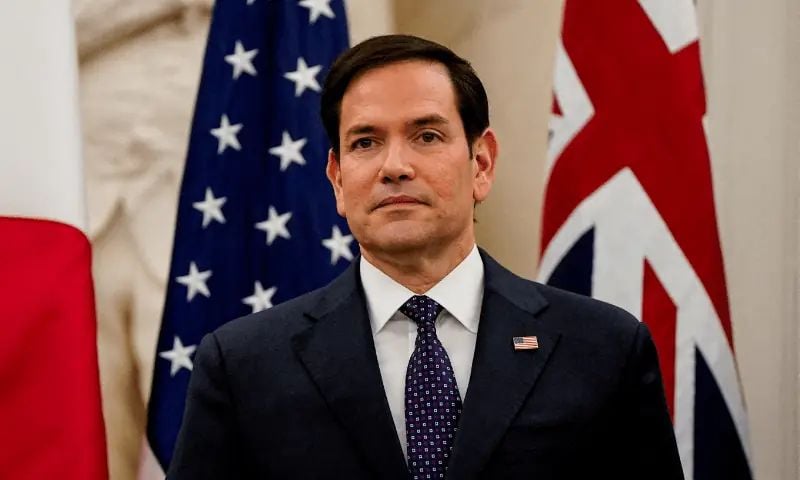



WASHINGTON: US Secretary of State Marco Rubio has told G7 foreign ministers that the ongoing conflict with Iran could continue for another two to four weeks, according to sources familiar with the discussions, signaling a potentially longer timeline than previously anticipated.
Speaking during a meeting in France, Rubio indicated that while the United States remains engaged in indirect communication with Iran through mediators, military operations are expected to persist in the near term.
The assessment marks the first time a senior US official has publicly suggested the conflict may extend beyond the timeframe earlier discussed by President Donald Trump.
Despite the ongoing hostilities, Rubio told counterparts that Washington is moving closer to serious negotiations with Tehran. However, he acknowledged uncertainty over decision-making authority within Iran, noting that while some Iranian officials appear open to talks, they require approval from the country’s top leadership.
He also highlighted communication challenges, saying Iranian officials are avoiding electronic devices due to fears of being tracked and targeted, which has slowed diplomatic exchanges through intermediaries.
On the strategic front, Rubio told G7 allies that while the US does not require assistance to reopen the Strait of Hormuz, it expects international partners to play a role in a post-war maritime security framework. The proposed effort would involve escorting commercial vessels and maintaining a multinational presence to ensure freedom of navigation in the critical waterway.
Later, speaking to reporters after meeting G7 counterparts in France, Rubio said the US operation was progressing “on or ahead of schedule” and expressed optimism that objectives could be achieved within a short timeframe.
He stressed that while ground troops were not necessary to meet military goals, limited deployments were being made to provide strategic flexibility in case conditions change.
“We expect to conclude this at the appropriate time — a matter of weeks, not months,” Rubio said, adding that troop movements were designed to give policymakers “maximum optionality” in responding to emerging contingencies.
The Pentagon has already dispatched thousands of Marines to the region, with the first contingent expected to arrive by the end of March aboard a large amphibious assault ship, according to Reuters.
Additional deployments, including elite airborne units, are also anticipated. These moves have raised concerns among analysts and global markets that the conflict could escalate into a broader and more prolonged ground engagement.
The war has already disrupted global energy flows, intensifying uncertainty in international markets, particularly due to tensions surrounding key maritime routes in the Gulf.
Despite the military buildup, the White House has continued to signal interest in a diplomatic resolution.
President Donald Trump this week pointed to what he described as “productive negotiations,” although Tehran has publicly denied that formal talks are underway.
Rubio confirmed that the United States had sent a comprehensive proposal to Iran earlier in the week and is awaiting a formal response.
While acknowledging indirect communication between the two sides, he said there was still a lack of clarity over the framework and participants of any potential negotiations.
“We’ve had exchanges of messages and some indications of willingness to discuss certain issues,” Rubio noted. “But we are still waiting for clarity on who we would be engaging with, what the scope would be, and when talks could begin.”
Iran, however, has signalled resistance to the US proposal. Officials in Tehran have indicated that the terms were viewed as heavily one-sided, favouring US and allied interests.
Nevertheless, they have not completely closed the door on diplomacy, maintaining communication channels through intermediaries.
Meanwhile, tensions escalated further after Washington extended a deadline for Iran to reopen the strategically critical Strait of Hormuz.
The US has warned of potential strikes targeting Iran’s civilian energy infrastructure if the blockade continues, underscoring the high stakes of the standoff.
According to sources familiar with the situation, Iranian officials are preparing a counter-proposal that could be delivered through diplomatic backchannels, raising cautious hopes that negotiations may yet gain traction.
As both sides balance military pressure with tentative diplomatic outreach, the coming days are likely to prove decisive in determining whether the conflict de-escalates or deepens further.