


WASHINGTON: U.S. President Donald Trump said Friday that the United States had heavily bombed military targets on Iran’s oil hub Kharg Island and the US Navy would soon begin escorting tankers through the Strait of Hormuz.
Writing on the “Truth Social” platform on Saturday, Trump said, “The US Central Command executed one of the strongest airstrikes in Middle Eastern history, completely destroying all military targets on Iran’s crown jewel, Kharg Island.”
He added, “For reasons of decency, I have chosen NOT to wipe out the Oil Infrastructure on the Island. However, should Iran, or anyone else, do anything to interfere with the Free and Safe Passage of Ships through the Strait of Hormuz, I will immediately reconsider this decision.”
“Moments ago, at my direction, the United States Central Command executed one of the most powerful bombing raids in the History of the Middle East, and totally obliterated every MILITARY target in Iran’s crown jewel, Kharg Island… Iran has NO ability to defend anything that we… pic.twitter.com/2iEzCOyA3P
— The White House (@WhiteHouse) March 13, 2026
Trump continued, “Iran is completely unable to defend anything we target, will never possess nuclear weapons, and will not have the ability to threaten the US, the Middle East, or the entire world.
It would be wise for the Iranian military and all involved with this terrorist regime to lay down their arms and save what remains of their country.”
The US president had earlier said in a social media post that strikes had “obliterated” military targets on Kharg Island.
Trump had also threatened to hit the island’s oil infrastructure if Tehran did not allow passage for ships via the strategic Strait of Hormuz, through which a fifth of global crude oil and liquefied natural gas normally pass.
Kharg Island, located around 30 kilometres (19 miles) off the Iranian mainland, handles roughly 90 percent of Iran’s crude exports, according to a recent JP Morgan note. The war has sparked chaos in global markets and sent oil prices soaring.
Iranian strikes have all but halted maritime traffic in the Strait of Hormuz, leaving investors and governments globally nervous about the risk of dwindling energy supply and higher inflation.
The US and Israel have taken a cautious stance regarding the island, though officials in the Trump administration said seizing Kharg Island was on the table as the war with Iran continues.
The report noted that “a direct strike on the island would immediately halt the majority of Iran’s crude exports and is likely to trigger violent responses in the Strait of Hormuz or against regional energy infrastructure.”
Iranian strikes have nearly halted shipping through the Strait of Hormuz, which normally carries one-fifth of global crude oil and LNG, and also targeted oil infrastructure in Gulf countries.
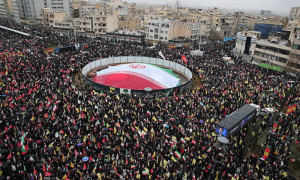
On Friday, several top Iranian officials joined a defiant pro-government rally in Tehran, meanwhile, marching alongside demonstrators waving banners reading “Death to America” and “Death to Israel.”
As the United States intensified its bombing of Iran, Tehran launched a new wave of drone and missile attacks on Israel and its Gulf neighbours.
The war between Israel and Hezbollah in Lebanon continued to rage, and the Lebanese health ministry said an Israeli strike on a primary healthcare center in southern Lebanon had killed at least 12 medical personnel on Friday.
According to the Lebanese authorities, at least 773 people have been killed by Israeli attacks in Lebanon aimed at wiping out Iranian ally Hezbollah.
Iranian strikes have all but halted maritime traffic in the Strait of Hormuz, through which a fifth of global crude oil and liquefied natural gas normally pass.
US Marines dispatched
The United States and Israel have treaded carefully around Kharg Island until now, but US officials have been reported as saying that capturing the island was potentially on the table.
The Wall Street Journal and New York Times reported on Friday that the Pentagon had dispatched the Japan-based amphibious assault ship USS Tripoli to the region along with its complement of some 2,500 Marines.
Heavy blasts shook Tehran late Friday after the United States vowed to step up air strikes and Iranian state media said a fresh round of missiles had been launched towards Israel. Israeli rescue workers said no casualties were reported.
Blasts were heard in Doha early Saturday, and Qatar’s defense ministry said its military had intercepted missiles targeting the Gulf state.
Saudi Arabia’s defense ministry said its forces had intercepted dozens of drones on Friday, and Turkey said NATO forces shot down a ballistic missile launched from Iran — the third such interception in the war.
The Islamic Republic is intent on showing it will come through the war intact and in control, despite its supreme leader, Ali Khamenei, being killed at the start of the US-Israeli campaign on February 28.
Khamenei’s son, Mojtaba Khamenei, was named the new supreme leader, but has been absent from public view and is reportedly wounded but stable.
The US government has unveiled a $ 10 million reward for information about Mojtaba Khamenei’s whereabouts.
$100 a barrel
US Defense Secretary Pete Hegseth told a news conference the US military would bombard Iran more heavily than any other day so far in the war.
According to the Pentagon, the US and Israel have struck more than 15,000 targets in Iran over the past two weeks. Israel’s military said it conducted 7,600 strikes on the country, most of them against its missile program.
The conflict has sparked chaos in global markets and sent oil prices soaring.
Brent contracts for a barrel of crude oil have soared more than 42 percent, leaving markets and governments everywhere skittish about energy supply and the prospect of higher inflation. On Friday, oil stayed above $100 a barrel.
Within Iran, the Revolutionary Guards have warned of an even stronger response to any anti-government protests, after the ones in January in which several people were killed.
Iranian authorities have maintained an internet blackout since the war started.
A woman in Kermanshah, western Iran, told AFP that “countless” people from Tehran had come to seek refuge from the airstrikes, adding to the demand for food and scarce medicine, with prices “nearly doubling.”
The UN refugee agency has estimated that up to 3.2 million people have been displaced inside Iran since the war started.
Iran’s health ministry said on March 8 that more than 1,200 people have been killed, a figure AFP has not been able to verify independently.
The US military has lost 13 personnel since the war started — including six members of a refuelling aircraft that crashed in Iraq after an incident officials claimed was not caused by hostile fire.