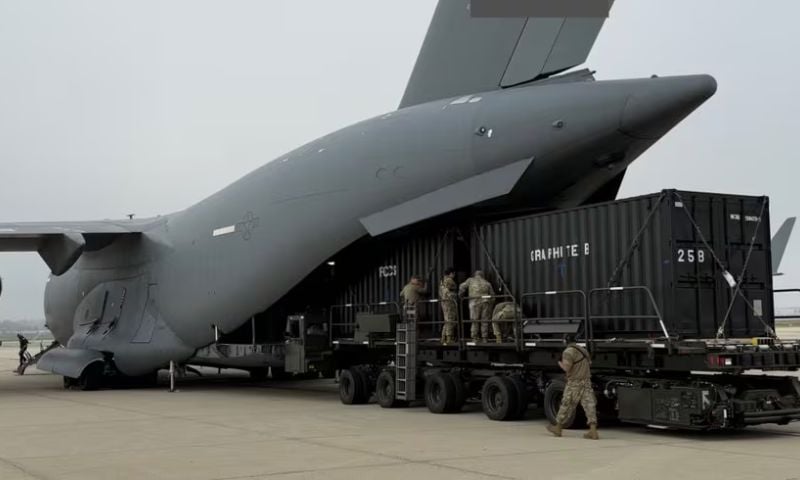



WASHINGTON: The United States has airlifted a modular nuclear microreactor for the first time in a military-led demonstration aimed at showcasing rapid deployment of nuclear power for defence and remote energy use, officials said.
The US Departments of Energy and Defence successfully transported a small nuclear reactor aboard a cargo plane on Sunday, flying it from California to Utah in a demonstration aimed at showcasing the potential for rapid deployment of nuclear power for both military and civilian applications.
C-17 aircraft transported eight unfuelled modules of the Ward 250 microreactor—developed by California-based Valar Atomics—from March Air Reserve Base in California to Hill Air Force Base in Utah.
The reactor, roughly the size of a minivan, is designed to generate up to five megawatts of power once operational, enough to supply approximately 5,000 homes or sustain critical military installations independent of fragile fuel supply lines
Energy Secretary Chris Wright and Under Secretary of Defence for Acquisition and Sustainment Michael Duffey were on the C-17 flight.
“This gets us closer to deploying nuclear power when and where it is needed to give our nation’s warfighters the tools to win in battle,” Duffey said.
The Trump administration views small nuclear reactors as a key component in its strategy to expand US energy production.
In May last year, President Donald Trump issued four executive orders aimed at accelerating domestic nuclear deployment, citing the need to meet growing energy demands for national security and competitive advancements in artificial intelligence.
Building on that momentum, the Energy Department issued two grants in December to help fast-track the development of small modular reactors (SMRs).
Proponents of microreactors have touted them as a viable power source for remote and far-flung locations, offering a clean and reliable alternative to diesel generators, which require costly and frequent fuel deliveries.
However, the technology is not without its skeptics. Critics argue that the industry has yet to prove that small nuclear reactors can generate power at a reasonable and commercially viable price.
“There is no business case for microreactors, which — even if they work as designed — will produce electricity at a far higher cost than large nuclear reactors, not to mention renewables like wind or solar,” said Edwin Lyman, director of nuclear power safety at the Union of Concerned Scientists.
According to Energy Department officials, the goal is to have three microreactors achieve “criticality”—the point at which a nuclear reaction sustains itself—by July 4.
The microreactor transported during Sunday’s historic event, described as slightly larger than a minivan, is capable of generating up to 5 megawatts of electricity, enough to power approximately 5,000 homes, according to Valar CEO Isaiah Taylor.
Taylor outlined the reactor’s rollout timeline, stating that it will begin operating in July at 100 kilowatts, peak at 250 kilowatts later this year, and eventually ramp up to full capacity.
Looking ahead, Valar aims to begin selling power on a test basis in 2027, with full commercial operations targeted for 2028.
While emphasising that private industry funds its own nuclear technology development, Taylor noted that federal support remains crucial.
“We need the federal government doing some enabling actions to allow fuel fabrication here and uranium enrichment here,” he said, highlighting the public-private partnership required to advance the domestic nuclear sector.